GATE 2024 CE (Set 2) question paper PDF and answer key
The official GATE 2024 Civil Engineering (Set 2) paper, organised by IISc Bengaluru: 65 questions for 100 marks in 3 hours. Download the official question paper and answer key as PDFs. Below is how the marks were split by topic, the complete official answer key and 5 questions solved step by step.
Source: the official paper and answer key published by IISc Bengaluru for GATE 2024 (official GATE site). Spotted a mistake? Email team@lemyte.com.
General Aptitude
10 · 15 marks
Civil Engineering
55 · 85 marks
MCQ / MSQ / NAT
40 / 3 / 22
Marks to all
None
Not in 2027 1 question (Q 37) is on topics removed from the GATE 2027 syllabus. They are marked in the answer key below. What changed for CE
Where the marks were
GATE 2024 CE (Set 2) topic-wise marks
Civil Engineering questions only; General Aptitude adds 15 marks on top. The top three topics carried 40 of the 85 subject marks.
Topic
Questions
Marks
Structural Engineering
10
15
Geotechnical Engineering
8
13
Water Resources Engineering
7
12
Transportation Engineering
7
11
Construction Materials and Management
5
8
Environmental Engineering
5
8
Geomatics Engineering
5
7
Linear Algebra
3
5
Probability and Statistics
1
2
Partial Differential Equations
1
1
Numerical Methods
1
1
Calculus
1
1
Ordinary Differential Equations
1
1
Free solved questions
5 solved questions from GATE 2024 CE (Set 2)
Question text and figures as in the official paper, the answer from the official key, and a worked solution. The other 60 solutions are in your report after you take the paper.
Q4 · General Aptitude · MCQ · 1 mark
The sum of the first 20 consecutive positive odd integers is divided by 202.
What is the result?
(A)
1
(B)
20
(C)
2
(D)
1/2
Answer (official key): A
Solution
The sum of the first n positive odd integers is
1+3+⋯+(2n−1)=n2.
For n=20, the numerator is 202, hence
202202=1.
Therefore, the correct answer is Option A.
Q5 · General Aptitude · MCQ · 1 mark
The girls-to-boys ratio in class VIII equals the boys-to-girls ratio in class IX.
The total numbers of students in classes VIII and IX are 450 and 360,
respectively. The two classes contain the same number of girls.
How many girls are there in each class?
(A)
150
(B)
200
(C)
250
(D)
175
Answer (official key): B
Solution
Let the common number of girls be g.
Then boys in class VIII are 450−g, while boys in class IX are 360−g.
The ratio condition gives
450−gg=g360−g.
Hence
g2=(450−g)(360−g).
After cancellation,
810g=162000,
so
g=200.
Therefore, the correct answer is Option B.
Q16 · Structural Engineering · MCQ · 1 mark
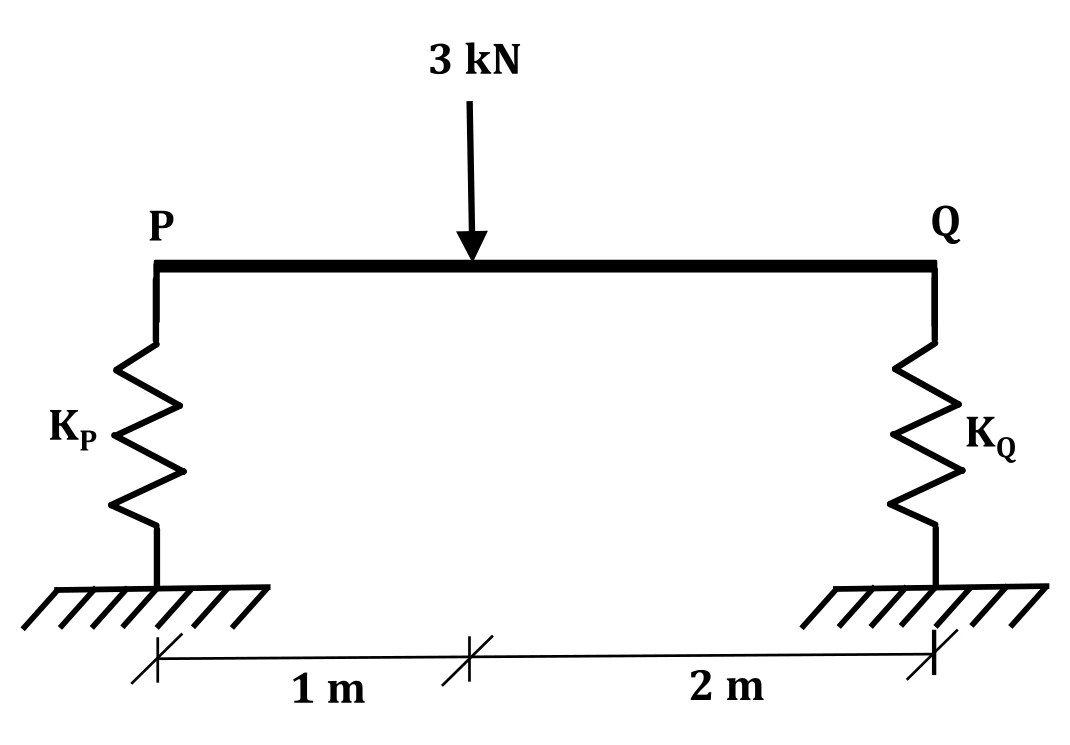
A 3 m long, horizontal, rigid, uniform beam PQ has negligible mass. The beam is subjected to a 3 kN concentrated vertically downward force at 1 m from P, as shown in the figure. The beam is resting on vertical linear springs at the ends P and Q. For the spring at the end P, the spring constant KP = 100 kN/m.
(Figure NOT to scale)
If the beam DOES NOT rotate under the application of the force and displaces only vertically, the value of the spring constant KQ (in kN/m) for the spring at the end Q is
(A)
150 kN/m
(B)
100 kN/m
(C)
50 kN/m
(D)
200 kN/m
Answer (official key): C
Solution
Beam equilibrium gives
RQ(3)=3(1),
so
RQ=1 kN,RP=2 kN.
No rotation means both spring deflections are equal:
KPRP=KQRQ.
Therefore,
1002=KQ1,
giving
KQ=50 kN/m.
Therefore, the correct answer is Option C.
Q44 · Linear Algebra · MSQ · 2 marks
Three vectors p, q, and r are
p=i^+j^+k^,q=i^+2j^+3k^,r=2i^+3j^+4k^.
Which of the following is/are CORRECT?
(A)
p×(q×r)+q×(r×p)+r×(p×q)=0
(B)
p×(q×r)=(p⋅r)q−(p⋅q)r
(C)
p×(q×r)=(p×q)×r
(D)
r⋅(p×q)=(q×p)⋅r
Answer (official key): A, B
Solution
Statement (A) is the Jacobi identity for the cross product:
p×(q×r)+q×(r×p)+r×(p×q)=0.
Hence (A) is true.
Statement (B) is the standard vector triple-product identity:
p×(q×r)=(p⋅r)q−(p⋅q)r.
Hence (B) is true.
Statement (C) is false in general because the cross product is not associative.
For the printed vectors,
r=p+q.
Therefore the scalar triple product
r⋅(p×q)=0.
Also,
(q×p)⋅r=−r⋅(p×q)=0.
So for these particular printed vectors, statement (D) also evaluates true.
However, the official GATE 2024 CE2 answer key lists only A and B (statement (D) is not true for arbitrary vectors, which is presumably the intended reading).
Therefore, the official keyed answers are Options A and B.
Q53 · Geotechnical Engineering · Numerical · 2 marks
A homogeneous earth dam has a maximum water-head difference of 15 m between the
upstream and downstream sides. A flownet has 10 potential drops and the average
length of the element is 3 m. The specific gravity of soil is 2.65.
For a factor of safety of 2.0 against piping failure, the void ratio of the soil is
______ (rounded off to 2 decimal places).
Answer (official key): 0.63 to 0.67
Solution
Head loss per potential drop is
Δh=1015=1.5 m.
Using the average element length 3 m, the hydraulic gradient is
i=31.5=0.5.
Factor of safety against piping is
FS=iic=2,
so
ic=1.0.
For saturated soil,
ic=1+eGs−1.
Therefore,
1=1+e2.65−1=1+e1.65.
Thus
e=0.65.
Therefore, the answer is 0.65
(official accepted range 0.63 to 0.67).
The other 60 questions are solved in your report when you take GATE 2024 CE (Set 2) as a 3-hour test.
Structural EngineeringNot in GATE 2027 syllabus: Free vibration of undamped SDOF systems
MCQ
2
A
38
Construction Materials and Management
MCQ
2
A
39
Structural Engineering
MCQ
2
A
40
Geotechnical Engineering
MCQ
2
A
41
Water Resources Engineering
MCQ
2
A
42
Environmental Engineering
MCQ
2
A
43
Transportation Engineering
MCQ
2
B
44
Linear Algebra
MSQ
2
A, B
45
Geotechnical Engineering
MSQ
2
C, D
46
Transportation Engineering
MSQ
2
A, C, D
47
Construction Materials and Management
Numerical
2
5.11 to 5.15
48
Linear Algebra
Numerical
2
10
49
Structural Engineering
Numerical
2
1.176 to 1.186
50
Structural Engineering
Numerical
2
150
51
Structural Engineering
Numerical
2
3.2 to 3.4
52
Construction Materials and Management
Numerical
2
30
53
Geotechnical Engineering
Numerical
2
0.63 to 0.67
54
Geotechnical Engineering
Numerical
2
0.12 to 0.14
55
Geotechnical Engineering
Numerical
2
30
56
Water Resources Engineering
Numerical
2
0.64 to 0.65
57
Water Resources Engineering
Numerical
2
0.7 to 0.8
58
Water Resources Engineering
Numerical
2
102 to 106
59
Water Resources Engineering
Numerical
2
3.3 to 3.7
60
Environmental Engineering
Numerical
2
3.25 to 3.4
61
Environmental Engineering
Numerical
2
9.9 to 10.2
62
Transportation Engineering
Numerical
2
113 to 116
63
Transportation Engineering
Numerical
2
117 to 120
64
Geomatics Engineering
Numerical
2
6 to 8
65
Geomatics Engineering
Numerical
2
199.704 to 199.706
Questions about GATE 2024 CE (Set 2)
How many questions are in the GATE 2024 CE (Set 2) paper?
65 questions for 100 marks: 10 General Aptitude questions worth 15 marks and 55 Civil Engineering questions worth 85 marks. By type, there were 40 MCQs, 3 MSQs, 22 numerical answer (NAT) questions. The paper lasted 3 hours.
Is there negative marking in GATE 2024 CE (Set 2)?
Yes, for MCQs only. A wrong MCQ answer costs one-third of its marks (−⅓ for a 1-mark question, −⅔ for a 2-mark question). MSQ and numerical (NAT) questions have no negative marking, and an MSQ earns marks only when every correct option is chosen.
Which topics carried the most marks in GATE 2024 CE (Set 2)?
Outside General Aptitude, the biggest topics were Structural Engineering (15 marks), Geotechnical Engineering (13 marks), Water Resources Engineering (12 marks). The full topic-wise split is in the table on this page.
Were any GATE 2024 CE (Set 2) questions awarded marks to all?
No. Every question was graded with the answer in the official key.
Where does this GATE 2024 CE (Set 2) answer key come from?
From the official answer key published by IISc Bengaluru, which organised GATE 2024. Range answers for numerical questions and questions with more than one accepted answer are kept exactly as the key gives them.