
GATE 2025 CE (Set 2) question paper PDF and answer key

The official GATE 2025 Civil Engineering (Set 2) paper, organised by IIT Roorkee: 65 questions for 100 marks in 3 hours. Download the official question paper and answer key as PDFs. Below is how the marks were split by topic, the complete official answer key and 5 questions solved step by step.

Source: the official paper and answer key published by IIT Roorkee for GATE 2025 (official GATE site). Spotted a mistake? Email team@lemyte.com.

General Aptitude
10 · 15 marks
Civil Engineering
55 · 85 marks
MCQ / MSQ / NAT
28 / 15 / 22
Marks to all
None

Where the marks were

GATE 2025 CE (Set 2) topic-wise marks

Civil Engineering questions only; General Aptitude adds 15 marks on top. The top three topics carried 44 of the 85 subject marks.

TopicQuestionsMarks
Structural Engineering916
Geotechnical Engineering914
Water Resources Engineering914
Environmental Engineering711
Transportation Engineering710
Calculus34
Construction Materials and Management34
Linear Algebra23
Probability and Statistics23
Ordinary Differential Equations23
Geomatics Engineering23

Free solved questions

5 solved questions from GATE 2025 CE (Set 2)

Question text and figures as in the official paper, the answer from the official key, and a worked solution. The other 60 solutions are in your report after you take the paper.

Q8 · General Aptitude · MCQ · 2 marks

Consider a five-digit number PQRSTPQRST that has distinct digits P,Q,R,S,P,Q,R,S, and TT, and satisfies the following conditions:

P<Q,S>P>T,R<T.P<Q,\qquad S>P>T,\qquad R<T.

If integers 1 through 5 are used to construct such a number, the value of PP is:

  • (A)
    1
  • (B)
    2
  • (C)
    3
  • (D)
    4

Answer (official key): C

Solution

The inequalities imply the strict ordering constraints

R<T<P<QR<T<P<Q

and

P<S.P<S.

Since the five distinct digits are exactly 1,2,3,4,51,2,3,4,5, there must be two digits below PP (R,TR,T) and two digits above PP (Q,SQ,S).

Therefore PP must be the middle digit:

P=3.P=3.

Therefore, the correct answer is Option C.
Q9 · General Aptitude · MCQ · 2 marks

A business person buys potatoes of two different varieties P and Q, mixes them in a certain ratio and sells them at ₹ 192 per kg.

The cost of variety P is ₹ 800 for 5 kg.
The cost of variety Q is ₹ 800 for 4 kg.

If the person gets 8% profit, what is the P:Q ratio (by weight)?

  • (A)
    5:4
  • (B)
    3:4
  • (C)
    3:2
  • (D)
    1:1

Answer (official key): A

Solution

The unit costs are

CP=8005=₹160/kg,CQ=8004=₹200/kg.C_P=\frac{800}{5}=₹160/\text{kg}, \qquad C_Q=\frac{800}{4}=₹200/\text{kg}.

With 8% profit, the mixture cost price is

Cm=1921.08=₹177.777…/kg.C_m=\frac{192}{1.08}=₹177.777\ldots/\text{kg}.

By alligation, the ratio of the cheaper variety P to the dearer variety Q is

P:Q=(200−177.777…):(177.777…−160)=22.222…:17.777…=5:4.P:Q = (200-177.777\ldots):(177.777\ldots-160) = 22.222\ldots:17.777\ldots = 5:4.

Therefore, the correct answer is Option A.

Q21 · Calculus · MSQ · 1 mark

Consider a velocity vector, V⃗\vec{V} in (x, y, z) coordinates given below. Pick one or more CORRECT statements(s) from the choices given below.

V⃗=ux^+vy^\vec{V} = u\hat{x} + v\hat{y}

  • (A)
    zz-component of curl: (∂v∂x−∂u∂y)z^\left(\dfrac{\partial v}{\partial x}-\dfrac{\partial u}{\partial y}\right)\hat z
  • (B)
    zz-component of curl: (∂u∂x−∂v∂y)z^\left(\dfrac{\partial u}{\partial x}-\dfrac{\partial v}{\partial y}\right)\hat z
  • (C)
    Divergence: ∂u∂x+∂v∂y\dfrac{\partial u}{\partial x}+\dfrac{\partial v}{\partial y}
  • (D)
    Divergence: ∂u∂y+∂v∂x\dfrac{\partial u}{\partial y}+\dfrac{\partial v}{\partial x}

Answer (official key): A, C

Solution

For a two-dimensional velocity field,

∇×V⃗=(∂v∂x−∂u∂y)z^.\nabla\times\vec V = \left( \frac{\partial v}{\partial x} - \frac{\partial u}{\partial y} \right)\hat z.

Also,

∇⋅V⃗=∂u∂x+∂v∂y.\nabla\cdot\vec V = \frac{\partial u}{\partial x} + \frac{\partial v}{\partial y}.

Therefore, the correct answers are Options A and C.

Q29 · Ordinary Differential Equations · Numerical · 1 mark

The “order” of the following ordinary differential equation is ______:

d3ydx3+(d2ydx2)6+(dydx)4+y=0.\frac{d^3y}{dx^3} + \left(\frac{d^2y}{dx^2}\right)^6 + \left(\frac{dy}{dx}\right)^4 +y=0.

Answer (official key): 3

Solution

The order of a differential equation is the order of the highest derivative present.

The highest derivative is

d3ydx3,\frac{d^3y}{dx^3},

so the order is 3. The powers applied to lower derivatives do not change the order.

Therefore, the answer is 3 (official accepted range 3 to 3).

Q33 · Water Resources Engineering · Numerical · 1 mark

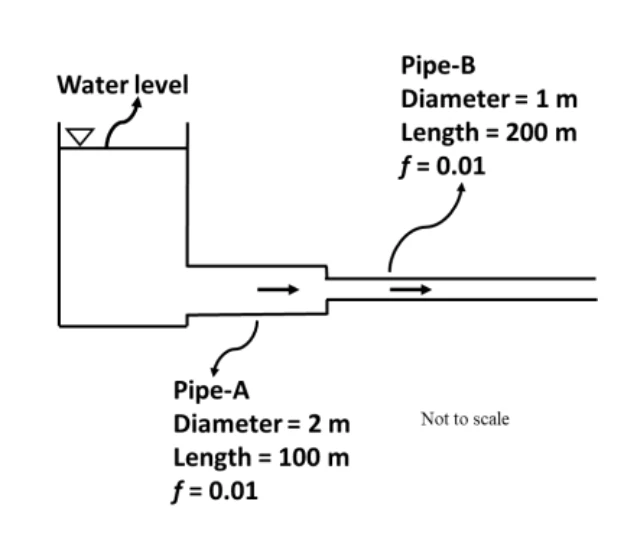
Consider steady flow of water in the series pipe system shown below, with specified discharge. The diameters of Pipes A and B are 2 m and 1 m, respectively. The lengths of pipes A and B are 100 m and 200 m, respectively. Assume the Darcy-Weisbach friction coefficient, ff, as 0.01 for both the pipes.

Series pipe system for Q33

The ratio of head loss in Pipe-B to the head loss in Pipe-A is ______ (round off to the nearest integer).

Answer (official key): 64

Solution

For the same discharge through pipes in series,

V∝1D2.V\propto\frac1{D^2}.

Darcy-Weisbach head loss is

hf=fLDV22g.h_f=f\frac{L}{D}\frac{V^2}{2g}.

With the same ff and discharge,

hf∝LD5.h_f\propto\frac{L}{D^5}.

Therefore,

hf,Bhf,A=LBLA(DADB)5=200100(2)5=64.\frac{h_{f,B}}{h_{f,A}} = \frac{L_B}{L_A} \left(\frac{D_A}{D_B}\right)^5 = \frac{200}{100}(2)^5 = 64.

Therefore, the answer is 64 (official accepted range 64 to 64).

The other 60 questions are solved in your report when you take GATE 2025 CE (Set 2) as a 3-hour test.

Take GATE 2025 CE (Set 2) as a test

Official answer key

GATE 2025 CE (Set 2) answer key

All 65 answers from the official key. Numerical answers are ranges; “or” means the key accepts either answer.

Download the official GATE 2025 CE (Set 2) answer key (PDF)
QTopicTypeMarksAnswer
1Verbal AptitudeMCQ1D
2Verbal AptitudeMCQ1B
3Quantitative AptitudeMCQ1B
4Analytical AptitudeMCQ1C
5Analytical AptitudeMCQ1A
6Verbal AptitudeMCQ2A
7Analytical AptitudeMCQ2B
8Analytical AptitudeMCQ2C
9Quantitative AptitudeMCQ2A
10Quantitative AptitudeMCQ2C
11Linear AlgebraMCQ1A
12CalculusMCQ1A
13Construction Materials and ManagementMCQ1A
14Structural EngineeringMCQ1B
15Geotechnical EngineeringMCQ1D
16Water Resources EngineeringMCQ1B
17Environmental EngineeringMCQ1C
18Transportation EngineeringMCQ1A
19Transportation EngineeringMCQ1A
20Transportation EngineeringMCQ1C
21CalculusMSQ1A, C
22Probability and StatisticsMSQ1B, C
23Construction Materials and ManagementMSQ1A, C, D
24Geotechnical EngineeringMSQ1A, D
25Water Resources EngineeringMSQ1B, C
26Water Resources EngineeringMSQ1B, C
27Environmental EngineeringMSQ1D
28Transportation EngineeringMSQ1A
29Ordinary Differential EquationsNumerical13
30Structural EngineeringNumerical15.7 to 6
31Geotechnical EngineeringNumerical11.24 to 1.3
32Geotechnical EngineeringNumerical10.01 to 0.015
33Water Resources EngineeringNumerical164
34Environmental EngineeringNumerical12.5 to 2.6
35Geomatics EngineeringNumerical1936
36Ordinary Differential EquationsMCQ2A
37Structural EngineeringMCQ2A
38Structural EngineeringMCQ2C
39Structural EngineeringMCQ2B
40Structural EngineeringMCQ2B
41Geotechnical EngineeringMCQ2B
42Water Resources EngineeringMCQ2B
43Transportation EngineeringMCQ2A
44CalculusMSQ2A, D
45Linear AlgebraMSQ2A, C
46Structural EngineeringMSQ2A, D
47Geotechnical EngineeringMSQ2A, C, D
48Water Resources EngineeringMSQ2A, C
49Environmental EngineeringMSQ2A, B, C
50Transportation EngineeringMSQ2A, C
51Probability and StatisticsNumerical22.7 to 2.9
52Structural EngineeringNumerical216.3 to 16.6
53Construction Materials and ManagementNumerical21
54Structural EngineeringNumerical2283 to 284
55Geotechnical EngineeringNumerical21 to 1.1
56Geotechnical EngineeringNumerical2300
57Geotechnical EngineeringNumerical21.5 to 1.52
58Water Resources EngineeringNumerical2271 to 273
59Water Resources EngineeringNumerical225
60Water Resources EngineeringNumerical27 to 9
61Environmental EngineeringNumerical250
62Environmental EngineeringNumerical212.3 to 12.7
63Environmental EngineeringNumerical221 to 45
64Transportation EngineeringNumerical20.63 to 0.66
65Geomatics EngineeringNumerical2118

Questions about GATE 2025 CE (Set 2)

How many questions are in the GATE 2025 CE (Set 2) paper?

65 questions for 100 marks: 10 General Aptitude questions worth 15 marks and 55 Civil Engineering questions worth 85 marks. By type, there were 28 MCQs, 15 MSQs, 22 numerical answer (NAT) questions. The paper lasted 3 hours.

Is there negative marking in GATE 2025 CE (Set 2)?

Yes, for MCQs only. A wrong MCQ answer costs one-third of its marks (−⅓ for a 1-mark question, −⅔ for a 2-mark question). MSQ and numerical (NAT) questions have no negative marking, and an MSQ earns marks only when every correct option is chosen.

Which topics carried the most marks in GATE 2025 CE (Set 2)?

Outside General Aptitude, the biggest topics were Structural Engineering (16 marks), Geotechnical Engineering (14 marks), Water Resources Engineering (14 marks). The full topic-wise split is in the table on this page.

Were any GATE 2025 CE (Set 2) questions awarded marks to all?

No. Every question was graded with the answer in the official key.

Where does this GATE 2025 CE (Set 2) answer key come from?

From the official answer key published by IIT Roorkee, which organised GATE 2025. Range answers for numerical questions and questions with more than one accepted answer are kept exactly as the key gives them.

More GATE papers