
GATE 2020 CE (Set 1) question paper PDF and answer key

The official GATE 2020 Civil Engineering (Set 1) paper, organised by IIT Delhi: 65 questions for 100 marks in 3 hours. Download the official question paper and answer key as PDFs. Below is how the marks were split by topic, the complete official answer key and 5 questions solved step by step.

Source: the official paper and answer key published by IIT Delhi for GATE 2020 (official GATE site). Spotted a mistake? Email team@lemyte.com.

General Aptitude
10 · 15 marks
Civil Engineering
55 · 85 marks
MCQ / MSQ / NAT
40 / 0 / 25
Marks to all
Q 42, 55

Not in 2027 1 question (Q 54) is on topics removed from the GATE 2027 syllabus. They are marked in the answer key below. What changed for CE

Where the marks were

GATE 2020 CE (Set 1) topic-wise marks

Civil Engineering questions only; General Aptitude adds 15 marks on top. The top three topics carried 46 of the 85 subject marks.

TopicQuestionsMarks
Structural Engineering1118
Geotechnical Engineering1015
Water Resources Engineering913
Transportation Engineering711
Environmental Engineering711
Calculus34
Geomatics Engineering24
Numerical Methods23
Ordinary Differential Equations12
Linear Algebra12
Partial Differential Equations11
Construction Materials and Management11

Free solved questions

5 solved questions from GATE 2020 CE (Set 1)

Question text and figures as in the official paper, the answer from the official key, and a worked solution. The other 60 solutions are in your report after you take the paper.

Q1 · General Aptitude · MCQ · 1 mark

It is a common criticism that most of the academicians live in their _____, so, they are not aware of the real life challenges.

  • (A)
    homes
  • (B)
    ivory towers
  • (C)
    glass palaces
  • (D)
    big flats

Answer (official key): B

Solution

“Ivory towers” is the idiom for intellectual or academic isolation from practical, everyday concerns. It fits the criticism stated in the sentence.

Official accepted option: B.
Q2 · General Aptitude · MCQ · 1 mark

His hunger for reading is insatiable. He reads indiscriminately. He is most certainly a/an _____ reader.

  • (A)
    all-round
  • (B)
    precocious
  • (C)
    voracious
  • (D)
    wise

Answer (official key): C

Solution

“Voracious” describes an exceptionally eager or insatiable reader. “Precocious” concerns unusually early development; “wise” and “all-round” do not express the stated appetite for reading.

Official accepted option: C.

Q15 · Structural Engineering · MCQ · 1 mark

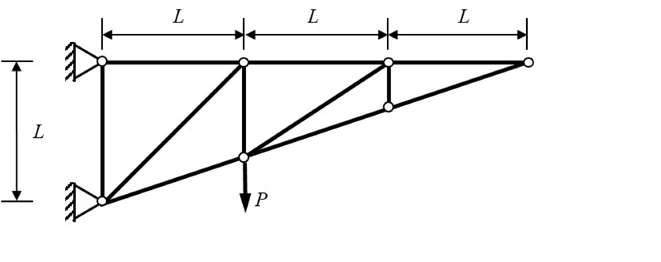
Consider the planar truss shown in the figure (not drawn to the scale).

Original source figure for Q15

Neglecting self-weight of the members, the number of zero-force members in the truss under the action of the load P, is

  • (A)
    6
  • (B)
    7
  • (C)
    8
  • (D)
    9

Answer (official key): C

Solution

Label the top joints from left to right A, C, E, G and the lower joints B, D, F, with the load at D. At the unloaded end G, EG and FG are zero. Joint F then gives DF=EF=0; joint E gives CE=DE=0. Horizontal equilibrium at D gives BD=0. The member AB connects the two immovable supports; with no imposed support movement or initial strain, its axial extension and force are zero. Thus eight members carry zero force. The three nonzero members are AC, BC and CD. A stiffness calculation using the shown geometry is included in the audit code.

Official accepted option: C.

Q63 · Environmental Engineering · Numerical · 2 marks

A gaseous chemical has a concentration of 41.6 μmol/m³ in air at 1 atm pressure and temperature 293 K. The universal gas constant R is 82.05 × 10⁻⁶ (m³ atm)/(mol K). Assuming that the ideal gas law is valid, the concentration of the gaseous chemical (in ppm, round off to one decimal place), is _____.

Answer (official key): 0.9 to 1.1

Solution

The total molar concentration is P/(RT)P/(RT). Hence the chemical mole fraction is (41.6×10⁻⁶)RT/P(41.6\times10^{-6})RT/P. Multiplying by 10610^6 gives 41.6(82.05×10⁻⁶)(293)=1.0000941.6(82.05\times10^{-6})(293)=1.00009 ppm, which rounds to 1.0 ppm.

Official accepted interval: 0.9 to 1.1.

Q64 · Environmental Engineering · Numerical · 2 marks

A stream with a flow rate of 5 m³/s is having an ultimate BOD of 30 mg/litre. A wastewater discharge of 0.20 m³/s having BOD₅ of 500 mg/litre joins the stream at a location and gets instantaneously mixed up completely. The cross-sectional area of the stream is 40 m² which remains constant. BOD exertion constant is 0.3 per day (logarithm base e). The BOD (in mg/litre, round off to two decimal places) remaining at 3 km downstream from the mixing location, is _____.

Answer (official key): 49 to 50

Solution

Convert the wastewater BOD₅ to ultimate BOD: Lw=500/(1−e−0.3(5))=643.6085L_w=500/(1-e^{-0.3(5)})=643.6085 mg/L. Immediately after mixing, L0=[5(30)+0.20Lw]/5.20=53.6003L_0=[5(30)+0.20L_w]/5.20=53.6003 mg/L. The mixed velocity is 5.20/40=0.135.20/40=0.13 m/s, and travel time is 3000/(0.13×86400)=0.2670943000/(0.13\times86400)=0.267094 day. Remaining BOD is L=L0e−0.3t=49.4730L=L_0e^{-0.3t}=49.4730 mg/L, or 49.47 mg/L. Using wastewater BOD₅ directly as ultimate BOD would be incorrect.

Official accepted interval: 49.00 to 50.00.

The other 60 questions are solved in your report when you take GATE 2020 CE (Set 1) as a 3-hour test.

Take GATE 2020 CE (Set 1) as a test

Official answer key

GATE 2020 CE (Set 1) answer key

All 65 answers from the official key. Numerical answers are ranges; “or” means the key accepts either answer.

Download the official GATE 2020 CE (Set 1) answer key (PDF)
QTopicTypeMarksAnswer
1Verbal AptitudeMCQ1B
2Verbal AptitudeMCQ1C
3Verbal AptitudeMCQ1A
4Analytical AptitudeMCQ1B
5Quantitative AptitudeMCQ1D
6Verbal AptitudeMCQ2D
7Analytical AptitudeMCQ2A
8Quantitative AptitudeMCQ2C
9Quantitative AptitudeMCQ2A
10Quantitative AptitudeMCQ2C
11Partial Differential EquationsMCQ1C
12CalculusMCQ1B
13Numerical MethodsMCQ1B
14CalculusMCQ1C
15Structural EngineeringMCQ1C
16Structural EngineeringMCQ1C
17Structural EngineeringMCQ1C
18Construction Materials and ManagementMCQ1B
19Transportation EngineeringMCQ1A
20Geotechnical EngineeringMCQ1A
21Geotechnical EngineeringMCQ1C
22Geotechnical EngineeringMCQ1A
23Water Resources EngineeringMCQ1A
24Water Resources EngineeringMCQ1A
25Water Resources EngineeringMCQ1C
26Environmental EngineeringMCQ1B
27Environmental EngineeringMCQ1B
28Water Resources EngineeringNumerical10.59 to 0.61
29Structural EngineeringNumerical195 to 97
30Transportation EngineeringNumerical15
31Transportation EngineeringNumerical14
32Geotechnical EngineeringNumerical136 to 38
33Geotechnical EngineeringNumerical10.59 to 0.61
34Water Resources EngineeringNumerical12.35 to 2.55
35Environmental EngineeringNumerical12.45 to 2.65
36Ordinary Differential EquationsMCQ2C
37Numerical MethodsMCQ2A
38Structural EngineeringMCQ2B
39Structural EngineeringMCQ2B
40Structural EngineeringMCQ2C
41Transportation EngineeringMCQ2B
42Transportation EngineeringMCQ2Marks to all
43Transportation EngineeringMCQ2C
44Geotechnical EngineeringMCQ2B
45Geotechnical EngineeringMCQ2D
46Water Resources EngineeringMCQ2A
47Environmental EngineeringMCQ2C
48Geomatics EngineeringMCQ2C
49CalculusNumerical23
50Linear AlgebraNumerical23
51Structural EngineeringNumerical2129 to 131
52Structural EngineeringNumerical2393.5 to 399.1
53Structural EngineeringNumerical2158 to 158.8
54Structural EngineeringNot in GATE 2027 syllabus: Prestressed concreteNumerical239 to 41
55Transportation EngineeringNumerical2Marks to all
56Geotechnical EngineeringNumerical221 to 23
57Geotechnical EngineeringNumerical28.7 to 9.3
58Geotechnical EngineeringNumerical218.4 to 19.5
59Water Resources EngineeringNumerical297.2 to 97.8
60Water Resources EngineeringNumerical21.4 to 1.6
61Water Resources EngineeringNumerical20.5 to 0.54
62Environmental EngineeringNumerical214 to 15
63Environmental EngineeringNumerical20.9 to 1.1
64Environmental EngineeringNumerical249 to 50
65Geomatics EngineeringNumerical244 to 45

Questions about GATE 2020 CE (Set 1)

How many questions are in the GATE 2020 CE (Set 1) paper?

65 questions for 100 marks: 10 General Aptitude questions worth 15 marks and 55 Civil Engineering questions worth 85 marks. By type, there were 40 MCQs, 25 numerical answer (NAT) questions. The paper lasted 3 hours.

Is there negative marking in GATE 2020 CE (Set 1)?

Yes, for MCQs only. A wrong MCQ answer costs one-third of its marks (−⅓ for a 1-mark question, −⅔ for a 2-mark question). MSQ and numerical (NAT) questions have no negative marking, and an MSQ earns marks only when every correct option is chosen.

Which topics carried the most marks in GATE 2020 CE (Set 1)?

Outside General Aptitude, the biggest topics were Structural Engineering (18 marks), Geotechnical Engineering (15 marks), Water Resources Engineering (13 marks). The full topic-wise split is in the table on this page.

Were any GATE 2020 CE (Set 1) questions awarded marks to all?

Yes. The official key awarded full marks to everyone for questions 42, 55.

Where does this GATE 2020 CE (Set 1) answer key come from?

From the official answer key published by IIT Delhi, which organised GATE 2020. Range answers for numerical questions and questions with more than one accepted answer are kept exactly as the key gives them.

More GATE papers