GATE 2020 ME (Set 1) question paper PDF and answer key

The official GATE 2020 Mechanical Engineering (Set 1) paper, organised by IIT Delhi: 65 questions for 100 marks in 3 hours. Download the official question paper and answer key as PDFs. Below is how the marks were split by topic, the complete official answer key and 5 questions solved step by step.

Source: the official paper and answer key published by IIT Delhi for GATE 2020 (official GATE site). Spotted a mistake? Email team@lemyte.com.

General Aptitude
10 · 15 marks
Mechanical Engineering
55 · 85 marks
MCQ / MSQ / NAT
37 / 0 / 28
Marks to all
Q 34

Where the marks were

GATE 2020 ME (Set 1) topic-wise marks

Mechanical Engineering questions only; General Aptitude adds 15 marks on top. The top three topics carried 35 of the 85 subject marks.

TopicQuestionsMarks
Manufacturing Engineering814
Thermodynamics711
Fluid Mechanics610
Mechanics of Materials47
Industrial Engineering47
Theory of Machines45
Machine Design35
Heat Transfer34
Calculus23
Complex Variables23
Applied Mechanics23
Vibrations23
Probability and Statistics23
Linear Algebra22
Engineering Materials22
Numerical Methods12
Differential Equations11

Free solved questions

5 solved questions from GATE 2020 ME (Set 1)

Question text and figures as in the official paper, the answer from the official key, and a worked solution. The other 60 solutions are in your report after you take the paper.

Q7 · General Aptitude · MCQ · 2 marks

P, Q, R and S are to be uniquely coded using α\alpha and β\beta. If P is coded as αα\alpha\alpha and Q as αβ\alpha\beta, then R and S, respectively, can be coded as _____.

  • (A)
    βα\beta\alpha and αβ\alpha\beta
  • (B)
    ββ\beta\beta and αα\alpha\alpha
  • (C)
    αβ\alpha\beta and ββ\beta\beta
  • (D)
    βα\beta\alpha and ββ\beta\beta

Answer (official key): D

Solution

The four possible two-symbol codes are αα\alpha\alpha, αβ\alpha\beta, βα\beta\alpha and ββ\beta\beta. Since the first two are already used, R and S can be βα\beta\alpha and ββ\beta\beta, respectively (D).

Q9 · General Aptitude · MCQ · 2 marks

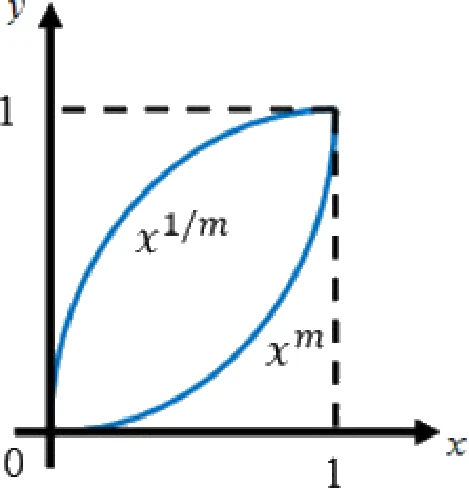
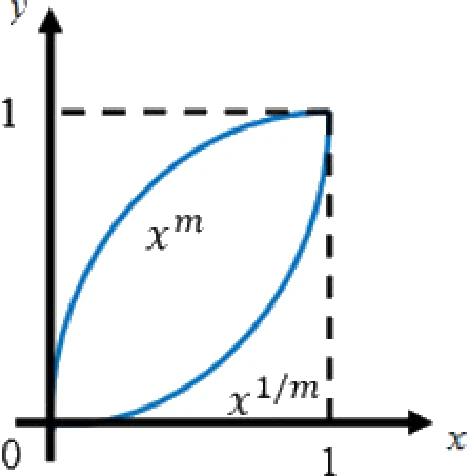
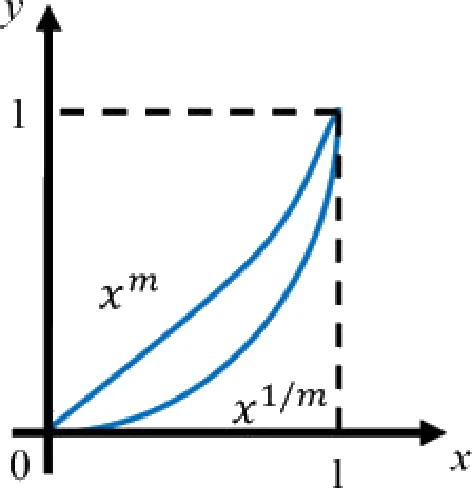
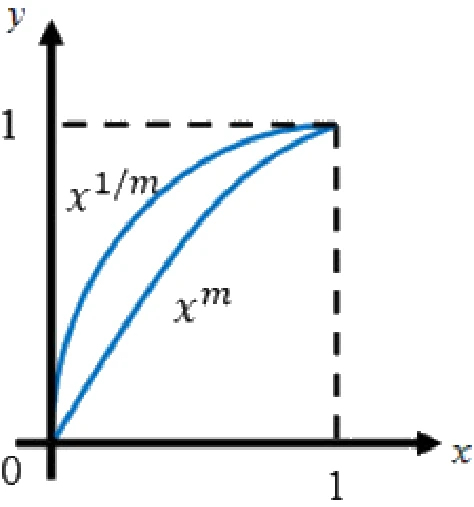
Select the graph that schematically represents BOTH y=xmy=x^m and y=x1/my=x^{1/m} properly in the interval 0≤x≤10\leq x\leq1, for integer values of mm, where m>1m>1.

  • (A)
    GATE 2020 ME (Set 1) question 9 (Quantitative Aptitude), option A
  • (B)
    GATE 2020 ME (Set 1) question 9 (Quantitative Aptitude), option B
  • (C)
    GATE 2020 ME (Set 1) question 9 (Quantitative Aptitude), option C
  • (D)
    GATE 2020 ME (Set 1) question 9 (Quantitative Aptitude), option D

Answer (official key): A

Solution

For 0<x<10<x<1 and m>1m>1, xm<x<x1/mx^m<x<x^{1/m}. The curve y=xmy=x^m is convex upward, while y=x1/my=x^{1/m} is concave downward; both pass through (0,0)(0,0) and (1,1)(1,1). Graph A has these properties.

Q57 · Industrial Engineering · Numerical · 2 marks

Two business owners Shveta and Ashok run their businesses in two different states. Each of them, independent of the other, produces two products A and B, sells them at Rs. 2,0002,000 per kg and Rs. 3,0003,000 per kg, respectively, and uses Linear Programming to determine the optimal quantity of A and B to maximize their respective daily revenue. Their constraints are as follows: i) for each business owner, the production process is such that the daily production of A has to be at least as much as B, and the upper limit for production of B is 10 kg10\ \mathrm{kg} per day, and ii) the respective state regulations restrict Shveta’s production of A to less than 20 kg20\ \mathrm{kg} per day, and Ashok’s production of A to less than 15 kg15\ \mathrm{kg} per day. The demand of both A and B in both the states is very high and everything produced is sold.

The absolute value of the difference in daily (optimal) revenue of Shveta and Ashok is ______________ thousand Rupees (round off to 22 decimal places).

Answer (official key): 9.9 to 10.1

Solution

Revenue in thousand rupees is R=2A+3BR=2A+3B, with A≥BA\geq B and B≤10B\leq10. Interpreting the stated production limits as the intended inclusive bounds, Shveta produces (A,B)=(20,10)(A,B)=(20,10) and earns 7070, while Ashok produces (15,10)(15,10) and earns 6060. The difference is 10.0010.00 thousand rupees. Literal strict bounds give these as revenue suprema.

Q58 · Industrial Engineering · Numerical · 2 marks

Consider two cases as below.

Case 1: A company buys 10001000 pieces per year of a certain part from vendor ‘X’. The changeover time is 22 hours and the price is Rs. 1010 per piece. The holding cost rate per part is 10%10\% per year.

Case 2: For the same part, another vendor ‘Y’ offers a design where the changeover time is 66 minutes, with a price of Rs. 55 per piece, and a holding cost rate per part of 100%100\% per year. The order size is 800800 pieces per year from ‘X’ and 200200 pieces per year from ‘Y’.

Assume the cost of downtime as Rs. 200200 per hour. The percentage reduction in the annual cost for Case 22, as compared to Case 11 is __________ (round off to 22 decimal places).

Answer (official key): 8.19 to 8.23

Solution

The official numerical answer is 8.21%8.21\%, but the wording does not yield this under the standard annual inventory-cost model. Taking 800800 and 200200 as the respective order quantities, C=Dp+(D/Q)S+QH/2C=Dp+(D/Q)S+QH/2. For X, S=400S=400, H=1H=1, and CX=10000+(1000/800)400+800/2=10900C_X=10000+(1000/800)400+800/2=10900. For Y, S=20S=20, H=5H=5, and CY=5000+(1000/200)20+200(5)/2=5600C_Y=5000+(1000/200)20+200(5)/2=5600. These give a reduction of 48.62%48.62\%, so the official value cannot be reconciled with this interpretation of the supplied data.

Q59 · Fluid Mechanics · Numerical · 2 marks

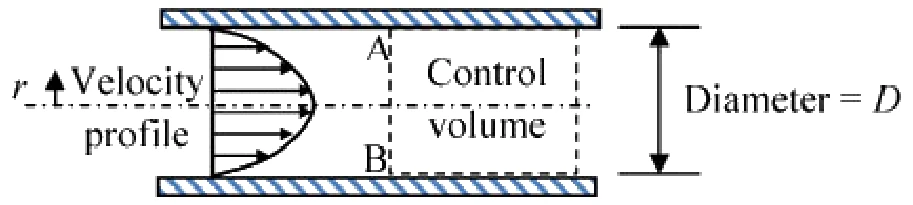
Consider steady, viscous, fully developed flow of a fluid through a circular pipe of internal diameter DD. We know that the velocity profile forms a paraboloid about the pipe centre line, given by: V=−C(r2−D24) m/sV=-C\left(r^2-\dfrac{D^2}{4}\right)\ \mathrm{m/s}, where CC is a constant. The rate of kinetic energy (in J/s\mathrm{J/s}) at the control surface A-B, as shown in the figure, is proportional to DnD^n. The value of nn is ______________.

Figure for GATE 2020 ME (Set 1) question 59 (Fluid Mechanics)

Answer (official key): 8

Solution

With R=D/2R=D/2, V=C(R2−r2)V=C(R^2-r^2). The kinetic-energy flow rate is E˙k=12ρ∫AV3 dA=ρπC3∫0R(R2−r2)3r dr=ρπC3R8/8\dot E_k=\tfrac12\rho\int_A V^3\,dA=\rho\pi C^3\int_0^R(R^2-r^2)^3r\,dr=\rho\pi C^3R^8/8. Thus E˙k∝D8\dot E_k\propto D^8 and n=8n=8.

The other 60 questions are solved in your report when you take GATE 2020 ME (Set 1) as a 3-hour test.

Take GATE 2020 ME (Set 1) as a test

Official answer key

GATE 2020 ME (Set 1) answer key

All 65 answers from the official key. Numerical answers are ranges; “or” means the key accepts either answer.

Download the official GATE 2020 ME (Set 1) answer key (PDF)
QTopicTypeMarksAnswer
1Verbal AptitudeMCQ1C
2Verbal AptitudeMCQ1A
3Verbal AptitudeMCQ1C
4Verbal AptitudeMCQ1B
5Quantitative AptitudeMCQ1D
6Verbal AptitudeMCQ2D
7Analytical AptitudeMCQ2D
8Quantitative AptitudeMCQ2D
9Quantitative AptitudeMCQ2A
10Quantitative AptitudeMCQ2C
11Linear AlgebraMCQ1A
12CalculusMCQ1C
13Differential EquationsMCQ1C
14Complex VariablesMCQ1D
15Applied MechanicsMCQ1C
16VibrationsMCQ1C
17Mechanics of MaterialsMCQ1B
18Theory of MachinesMCQ1A
19Machine DesignMCQ1A or A, C
20Engineering MaterialsMCQ1B
21Engineering MaterialsMCQ1A
22Manufacturing EngineeringMCQ1A
23Industrial EngineeringMCQ1D
24Fluid MechanicsMCQ1D
25Heat TransferMCQ1D
26Fluid MechanicsMCQ1B
27ThermodynamicsMCQ1C
28ThermodynamicsMCQ1D
29Linear AlgebraNumerical16
30Theory of MachinesNumerical10.98 to 1.02
31Theory of MachinesNumerical10.09 to 0.11
32Manufacturing EngineeringNumerical11 to 1.3
33Probability and StatisticsNumerical10.9 to 0.95
34ThermodynamicsNumerical1Marks to all
35Heat TransferNumerical148.8 to 49.8
36Numerical MethodsMCQ2D
37CalculusMCQ2A
38Mechanics of MaterialsMCQ2A
39Applied MechanicsMCQ2C
40Mechanics of MaterialsMCQ2C
41VibrationsMCQ2C
42Manufacturing EngineeringMCQ2D
43Industrial EngineeringMCQ2C
44Heat TransferMCQ2B
45Probability and StatisticsNumerical2-1 to -0.98
46Complex VariablesNumerical21.99 to 2.01
47Machine DesignNumerical20.85 to 0.89
48Theory of MachinesNumerical247.9 to 48.1
49Machine DesignNumerical215.9 to 16.1
50Fluid MechanicsNumerical2104 to 106
51Mechanics of MaterialsNumerical219.95 to 20.05
52Manufacturing EngineeringNumerical27 to 9
53Manufacturing EngineeringNumerical250.005
54Manufacturing EngineeringNumerical20
55Manufacturing EngineeringNumerical222 to 25
56Manufacturing EngineeringNumerical21164 to 1168
57Industrial EngineeringNumerical29.9 to 10.1
58Industrial EngineeringNumerical28.19 to 8.23
59Fluid MechanicsNumerical28
60Fluid MechanicsNumerical20.37 to 0.45
61ThermodynamicsNumerical2244 to 246
62ThermodynamicsNumerical2114.6 to 115
63ThermodynamicsNumerical23.98 to 4.02
64Fluid MechanicsNumerical211 to 14
65ThermodynamicsNumerical24.4 to 4.6

Questions about GATE 2020 ME (Set 1)

How many questions are in the GATE 2020 ME (Set 1) paper?

65 questions for 100 marks: 10 General Aptitude questions worth 15 marks and 55 Mechanical Engineering questions worth 85 marks. By type, there were 37 MCQs, 28 numerical answer (NAT) questions. The paper lasted 3 hours.

Is there negative marking in GATE 2020 ME (Set 1)?

Yes, for MCQs only. A wrong MCQ answer costs one-third of its marks (−⅓ for a 1-mark question, −⅔ for a 2-mark question). MSQ and numerical (NAT) questions have no negative marking, and an MSQ earns marks only when every correct option is chosen.

Which topics carried the most marks in GATE 2020 ME (Set 1)?

Outside General Aptitude, the biggest topics were Manufacturing Engineering (14 marks), Thermodynamics (11 marks), Fluid Mechanics (10 marks). The full topic-wise split is in the table on this page.

Were any GATE 2020 ME (Set 1) questions awarded marks to all?

Yes. The official key awarded full marks to everyone for question 34.

Where does this GATE 2020 ME (Set 1) answer key come from?

From the official answer key published by IIT Delhi, which organised GATE 2020. Range answers for numerical questions and questions with more than one accepted answer are kept exactly as the key gives them.

More GATE papers