GATE 2020 AE question paper PDF and answer key

The official GATE 2020 Aerospace Engineering paper, organised by IIT Delhi: 65 questions for 100 marks in 3 hours. Download the official question paper and answer key as PDFs. Below is how the marks were split by topic, the complete official answer key and 5 questions solved step by step.

Source: the official paper and answer key published by IIT Delhi for GATE 2020 (official GATE site). Spotted a mistake? Email team@lemyte.com.

General Aptitude
10 · 15 marks
Aerospace Engineering
55 · 85 marks
MCQ / MSQ / NAT
38 / 0 / 27
Marks to all
None

Not in 2027 2 questions (Q 11, 19) are on topics removed from the GATE 2027 syllabus. They are marked in the answer key below. What changed for AE

Where the marks were

GATE 2020 AE topic-wise marks

Aerospace Engineering questions only; General Aptitude adds 15 marks on top. The top three topics carried 54 of the 85 subject marks.

TopicQuestionsMarks
Structures1422
Aerodynamics1117
Flight Mechanics915
Propulsion914
Calculus46
Differential Equations34
Space Dynamics34
Linear Algebra23

Free solved questions

5 solved questions from GATE 2020 AE

Question text and figures as in the official paper, the answer from the official key, and a worked solution. The other 60 solutions are in your report after you take the paper.

Q51 · Aerodynamics · Numerical · 2 marks

A wing of 15 m span with elliptic lift distribution is generating a lift of 80 kN at a speed of 90 m/s. The density of surrounding air is 1.2 kg/m³. The induced angle of attack at this condition is _________ degrees (round off to two decimal places).

Answer (official key): 1.29 to 1.38

Solution

L=π4ρVΓ0bL = \tfrac{\pi}{4}\rho V\Gamma_0b gives Γ0=62.9\Gamma_0 = 62.9 m²/s. Uniform downwash w=Γ02b=2.10w = \dfrac{\Gamma_0}{2b} = 2.10 m/s, so αi=w/V=0.0233\alpha_i = w/V = 0.0233 rad =1.33°= 1.33°.

Q54 · Flight Mechanics · Numerical · 2 marks

The eigenvalues for phugoid mode of a general aviation airplane at a stable cruise flight condition at low angle of attack are λ1,2=−0.02±i 0.25\lambda_{1,2} = -0.02 \pm i\,0.25. If the acceleration due to gravity is 9.8 m/s², the equilibrium speed of the airplane is ________ m/s (round off to two decimal places).

Answer (official key): 55.2 to 55.33

Solution

ωn=0.022+0.252=0.2508\omega_n = \sqrt{0.02^2 + 0.25^2} = 0.2508 rad/s. Lanchester's approximation ωn=2 g/V\omega_n = \sqrt2\,g/V gives V=2×9.80.2508=55.26V = \dfrac{\sqrt2 \times 9.8}{0.2508} = 55.26 m/s.

Q55 · Flight Mechanics · Numerical · 2 marks

For a general aviation airplane with tail efficiency η\eta = 0.95, horizontal tail volume ratio VHV_H = 0.453, downwash angle slope dϵdα\dfrac{d\epsilon}{d\alpha} = 0.35, wing lift curve slope CLαwC^w_{L\alpha} = 4.8 rad⁻¹, horizontal tail lift curve slope CLαtC^t_{L\alpha} = 4.4 rad⁻¹, shift in neutral point location as a percentage of mean aerodynamic chord is _____ (round off to two decimal places).

Answer (official key): 25.6 to 25.7

Solution

Δxˉnp=ηVHataw(1−dϵdα)=0.95×0.453×4.44.8×0.65=0.2564\Delta\bar{x}_{np} = \eta V_H\dfrac{a_t}{a_w}\left(1 - \dfrac{d\epsilon}{d\alpha}\right) = 0.95 \times 0.453 \times \dfrac{4.4}{4.8} \times 0.65 = 0.2564, i.e. 25.64%.

Q56 · Flight Mechanics · Numerical · 2 marks

A single engine, propeller driven, general aviation airplane is flying in cruise at sea-level condition (density of air at sea-level is 1.225 kg/m³) with speed to cover maximum range. For drag coefficient CD=0.025+0.049CL2C_D = 0.025 + 0.049C_L^2 and wing loading W/S = 9844 N/m², the speed of the airplane is _____ m/s (round off to one decimal place).

Answer (official key): 149 to 151

Solution

A propeller aircraft's range is maximum at (L/D)max(L/D)_{max}: CL=0.025/0.049=0.714C_L = \sqrt{0.025/0.049} = 0.714. V=2×98441.225×0.714=150.0V = \sqrt{\dfrac{2 \times 9844}{1.225 \times 0.714}} = 150.0 m/s.

Q62 · Structures · Numerical · 2 marks

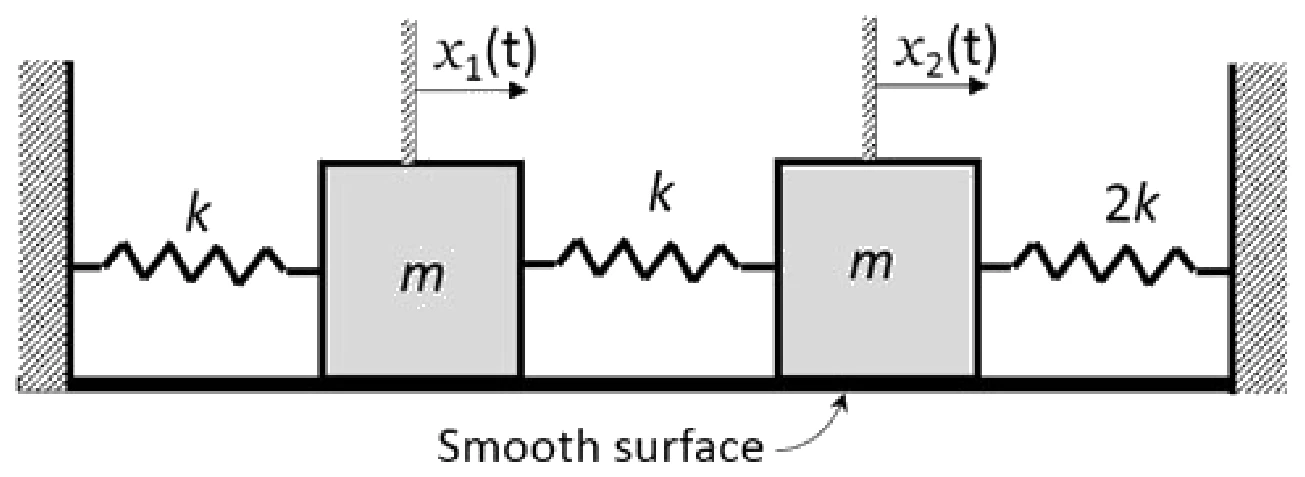
The two masses of the two degree of freedom system shown in the figure are given initial displacements of 2 cm (x1x_1) and 1.24 cm (x2x_2). The system starts to vibrate in the first mode. The first mode shape of this system is ϕ1=[1 a]T\phi_1 = [1\ a]^T, where aa = ______ (round off to two decimal places).

Figure for GATE 2020 AE question 62 (Structures)

Answer (official key): 0.61 to 0.63

Solution

A pure first-mode vibration needs the initial displacements in the mode ratio: a=1.24/2=0.62a = 1.24/2 = 0.62. (Check: K=k[2−1−13]K = k\begin{bmatrix} 2 & -1 \\ -1 & 3 \end{bmatrix} gives λ1=1.382k/m\lambda_1 = 1.382k/m and a=2−1.382=0.618a = 2 - 1.382 = 0.618.)

The other 60 questions are solved in your report when you take GATE 2020 AE as a 3-hour test.

Take GATE 2020 AE as a test

Official answer key

GATE 2020 AE answer key

All 65 answers from the official key. Numerical answers are ranges; “or” means the key accepts either answer.

Download the official GATE 2020 AE answer key (PDF)
QTopicTypeMarksAnswer
1Verbal AptitudeMCQ1A
2Verbal AptitudeMCQ1B
3Verbal AptitudeMCQ1B
4Verbal AptitudeMCQ1C
5Quantitative AptitudeMCQ1A
6Verbal AptitudeMCQ2A
7Quantitative AptitudeMCQ2B
8Quantitative AptitudeMCQ2C
9Quantitative AptitudeMCQ2C
10Analytical AptitudeMCQ2B
11CalculusNot in GATE 2027 syllabus: Mean value theoremMCQ1C
12CalculusMCQ1D
13Differential EquationsMCQ1A
14AerodynamicsMCQ1C
15AerodynamicsMCQ1D
16AerodynamicsMCQ1C
17AerodynamicsMCQ1B
18AerodynamicsMCQ1C
19StructuresNot in GATE 2027 syllabus: Airy's stress functionMCQ1B
20StructuresMCQ1D
21Space DynamicsMCQ1A
22Flight MechanicsMCQ1A
23PropulsionMCQ1C
24PropulsionMCQ1B
25PropulsionMCQ1C
26StructuresMCQ1D
27StructuresMCQ1C
28StructuresMCQ1A
29Linear AlgebraMCQ1B
30Space DynamicsNumerical113.42 to 13.47
31Flight MechanicsNumerical1-5.62 to -5.57
32Differential EquationsNumerical11.9 to 2.1
33PropulsionNumerical129.8 to 30
34StructuresNumerical10.009 to 0.011
35Flight MechanicsNumerical13.5 to 3.6
36Differential EquationsMCQ2C
37AerodynamicsMCQ2D
38StructuresMCQ2D
39StructuresMCQ2C
40StructuresMCQ2D
41Flight MechanicsMCQ2C
42CalculusMCQ2A
43PropulsionMCQ2B
44StructuresMCQ2B
45Linear AlgebraNumerical20.9 to 1.1
46CalculusNumerical20.01 to 0.012
47AerodynamicsNumerical20.92 to 0.94
48AerodynamicsNumerical20.009 to 0.011
49AerodynamicsNumerical21.9 to 2.1
50AerodynamicsNumerical24 to 4.2
51AerodynamicsNumerical21.29 to 1.38
52StructuresNumerical23.55 to 3.58
53Space DynamicsNumerical20.016 to 0.018
54Flight MechanicsNumerical255.2 to 55.33
55Flight MechanicsNumerical225.6 to 25.7
56Flight MechanicsNumerical2149 to 151
57PropulsionNumerical21712 to 1719
58PropulsionNumerical291 to 93
59PropulsionNumerical287 to 89
60PropulsionNumerical227 to 27.2
61StructuresNumerical21.43 to 1.45
62StructuresNumerical20.61 to 0.63
63StructuresNumerical23.74 to 3.76
64Flight MechanicsNumerical262.95 to 63.08
65Flight MechanicsNumerical257.1 to 60

Questions about GATE 2020 AE

How many questions are in the GATE 2020 AE paper?

65 questions for 100 marks: 10 General Aptitude questions worth 15 marks and 55 Aerospace Engineering questions worth 85 marks. By type, there were 38 MCQs, 27 numerical answer (NAT) questions. The paper lasted 3 hours.

Is there negative marking in GATE 2020 AE?

Yes, for MCQs only. A wrong MCQ answer costs one-third of its marks (−⅓ for a 1-mark question, −⅔ for a 2-mark question). MSQ and numerical (NAT) questions have no negative marking, and an MSQ earns marks only when every correct option is chosen.

Which topics carried the most marks in GATE 2020 AE?

Outside General Aptitude, the biggest topics were Structures (22 marks), Aerodynamics (17 marks), Flight Mechanics (15 marks). The full topic-wise split is in the table on this page.

Were any GATE 2020 AE questions awarded marks to all?

No. Every question was graded with the answer in the official key.

Where does this GATE 2020 AE answer key come from?

From the official answer key published by IIT Delhi, which organised GATE 2020. Range answers for numerical questions and questions with more than one accepted answer are kept exactly as the key gives them.

More GATE papers