GATE 2024 AE question paper PDF and answer key

The official GATE 2024 Aerospace Engineering paper, organised by IISc Bengaluru: 65 questions for 100 marks in 3 hours. Download the official question paper and answer key as PDFs. Below is how the marks were split by topic, the complete official answer key and 5 questions solved step by step.

Source: the official paper and answer key published by IISc Bengaluru for GATE 2024 (official GATE site). Spotted a mistake? Email team@lemyte.com.

General Aptitude
10 · 15 marks
Aerospace Engineering
55 · 85 marks
MCQ / MSQ / NAT
33 / 10 / 22
Marks to all
None

Not in 2027 1 question (Q 50) is on topics removed from the GATE 2027 syllabus. They are marked in the answer key below. What changed for AE

Where the marks were

GATE 2024 AE topic-wise marks

Aerospace Engineering questions only; General Aptitude adds 15 marks on top. The top three topics carried 53 of the 85 subject marks.

TopicQuestionsMarks
Aerodynamics1219
Structures1117
Propulsion1117
Flight Mechanics914
Calculus57
Space Dynamics35
Linear Algebra23
Differential Equations23

Free solved questions

5 solved questions from GATE 2024 AE

Question text and figures as in the official paper, the answer from the official key, and a worked solution. The other 60 solutions are in your report after you take the paper.

Q7 · General Aptitude · MCQ · 2 marks

A rectangular paper sheet of dimensions 54 cm × 4 cm is taken. The two longer edges of the sheet are joined together to create a cylindrical tube. A cube whose surface area is equal to the area of the sheet is also taken.

Then, the ratio of the volume of the cylindrical tube to the volume of the cube is

  • (A)
    1/π1/\pi
  • (B)
    2/π2/\pi
  • (C)
    3/π3/\pi
  • (D)
    4/π4/\pi

Answer (official key): A

Solution

Joining the 54 cm edges makes a tube of length 54 cm and circumference 4 cm: r=2/πr = 2/\pi, V=πr2×54=216/πV = \pi r^2 \times 54 = 216/\pi. The cube has 6a2=2166a^2 = 216, so a=6a = 6 and V=216V = 216. Ratio =1/π= 1/\pi.

Q27 · Flight Mechanics · MSQ · 1 mark

In a conventional configuration airplane, the rudder can be used:

  • (A)
    to overcome adverse yaw during a turning maneuver
  • (B)
    to overcome yawing moment due to failure of one engine in a multi engine airplane
  • (C)
    for landing the airplane in crosswind conditions
  • (D)
    for enhancing longitudinal stability

Answer (official key): A, B, C

Solution

The rudder provides yaw control: coordinating turns (A), countering asymmetric thrust (B) and crosswind landings (C). It plays no role in longitudinal (pitch) stability.

Q28 · Flight Mechanics · MSQ · 1 mark

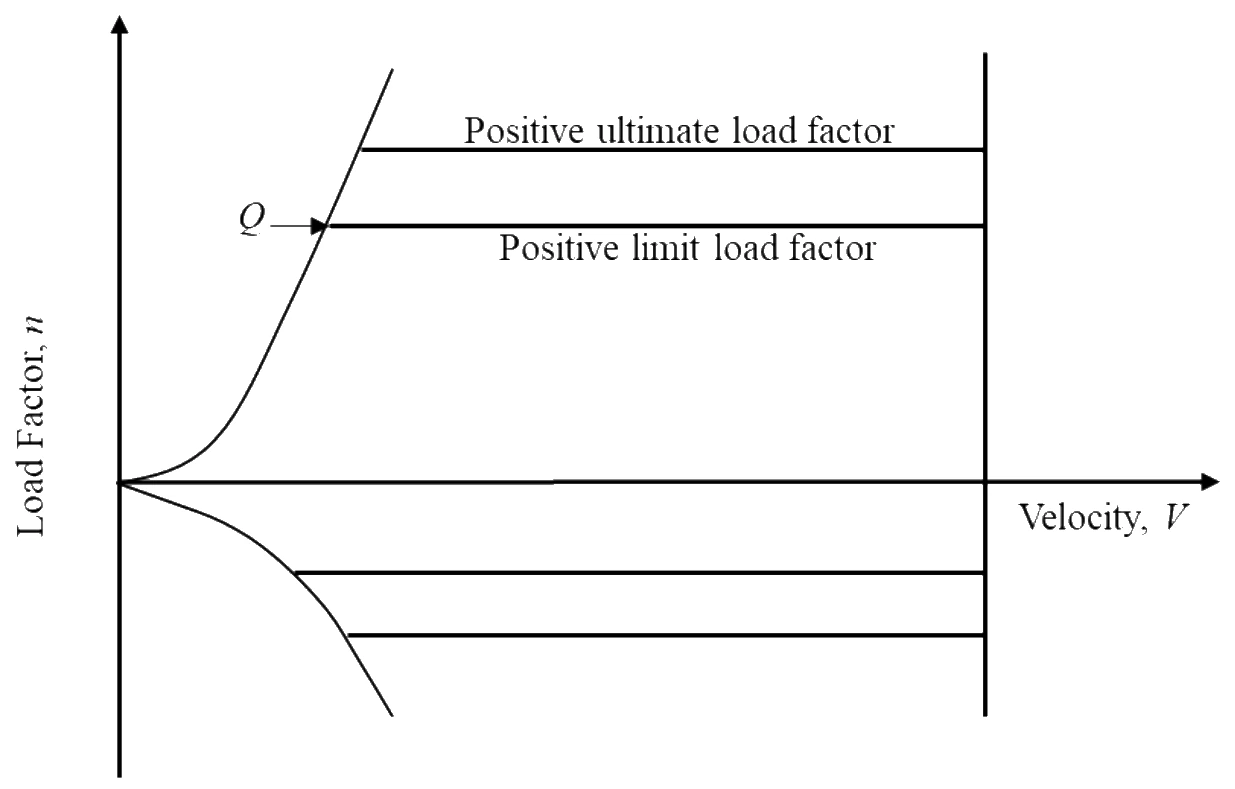
Which of the following statements about a general aviation aircraft, while operating at point Q in the V-n diagram, is/are true?

Figure for GATE 2024 AE question 28 (Flight Mechanics)

  • (A)
    The aircraft has the highest turn rate
  • (B)
    The aircraft has the smallest turn radius
  • (C)
    The aircraft is flying with minimum drag
  • (D)
    The aircraft is operating at CL,maxC_{L,max}

Answer (official key): A, B, D

Solution

Point Q is the corner of the V-n diagram where the stall (CL,maxC_{L,max}) curve meets the limit load factor: the corner speed, giving the maximum turn rate and minimum turn radius. Drag there is high, not minimum.

Q37 · Calculus · MCQ · 2 marks

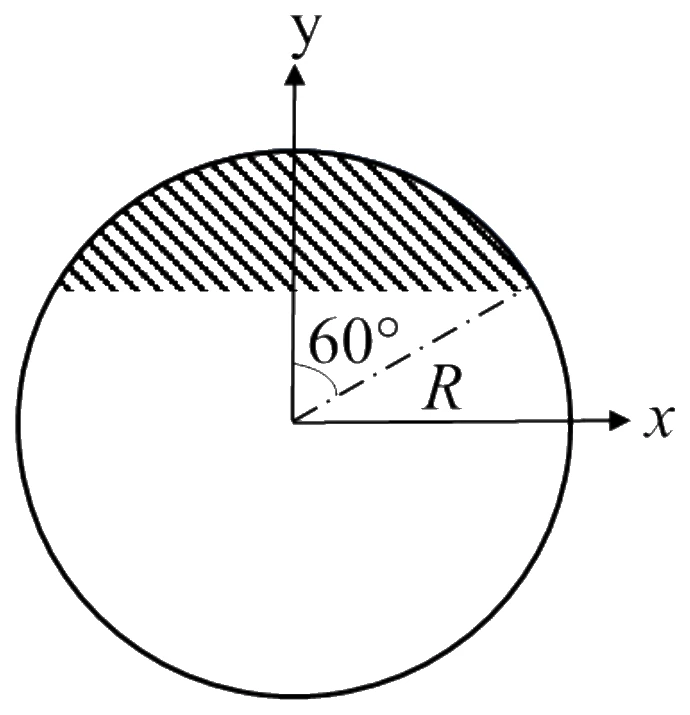
The volume of the solid formed by a complete rotation of the shaded portion of the circle of radius R about the y-axis is kπR3k\pi R^3. The value of kk is:

Figure for GATE 2024 AE question 37 (Calculus)

  • (A)
    512\frac{5}{12}
  • (B)
    524\frac{5}{24}
  • (C)
    712\frac{7}{12}
  • (D)
    724\frac{7}{24}

Answer (official key): B

Solution

The shaded portion is the cap above the chord at height Rcos⁡60°=R/2R\cos 60° = R/2; rotating it about the y-axis gives a spherical cap of height h=R/2h = R/2:

V=πh2(3R−h)3=π(R2/4)(5R/2)3=524πR3.V = \frac{\pi h^2(3R - h)}{3} = \frac{\pi (R^2/4)(5R/2)}{3} = \frac{5}{24}\pi R^3.

Q53 · Structures · Numerical · 2 marks

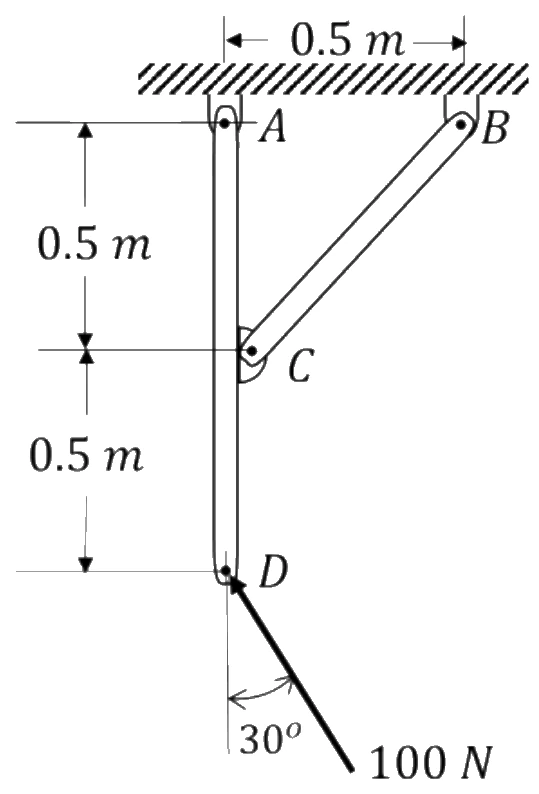
In the figure shown below, the magnitude of internal force in member BC is ___________ N (rounded off to 1 decimal place).

Figure for GATE 2024 AE question 53 (Structures)

Answer (official key): 141 to 141.5

Solution

BC is a two-force member at 45°. Taking moments about the pin A for bar ACD: the 100 N load at D (1.0 m below A, 30° from vertical) has horizontal component 50 N, giving 50 N·m. BC acts at C (0.5 m below A) with horizontal component Fcos⁡45°F\cos 45°: Fcos⁡45°×0.5=50F\cos 45° \times 0.5 = 50, so F=141.4F = 141.4 N.

The other 60 questions are solved in your report when you take GATE 2024 AE as a 3-hour test.

Take GATE 2024 AE as a test

Official answer key

GATE 2024 AE answer key

All 65 answers from the official key. Numerical answers are ranges; “or” means the key accepts either answer.

Download the official GATE 2024 AE answer key (PDF)
QTopicTypeMarksAnswer
1Verbal AptitudeMCQ1A
2Quantitative AptitudeMCQ1D
3Quantitative AptitudeMCQ1A
4Quantitative AptitudeMCQ1C
5Quantitative AptitudeMCQ1A
6Verbal AptitudeMCQ2C
7Quantitative AptitudeMCQ2A
8Quantitative AptitudeMCQ2C
9Spatial AptitudeMCQ2A
10Spatial AptitudeMCQ2A
11Linear AlgebraMCQ1A
12Differential EquationsMCQ1A
13StructuresMCQ1A
14StructuresMCQ1C
15StructuresMCQ1A
16PropulsionMCQ1A
17PropulsionMCQ1A
18PropulsionMCQ1C
19PropulsionMCQ1A
20Flight MechanicsMCQ1D
21AerodynamicsMCQ1B
22AerodynamicsMCQ1B
23AerodynamicsMCQ1C
24AerodynamicsMCQ1C
25StructuresMSQ1B, C, D
26Space DynamicsMSQ1A, B
27Flight MechanicsMSQ1A, B, C
28Flight MechanicsMSQ1A, B, D
29CalculusNumerical10.24 to 0.26
30CalculusNumerical124
31CalculusNumerical10.35
32StructuresNumerical10
33Flight MechanicsNumerical11.5
34PropulsionNumerical175000
35AerodynamicsNumerical10.54 to 0.56
36Differential EquationsMCQ2A
37CalculusMCQ2B
38Flight MechanicsMCQ2D
39Space DynamicsMCQ2B
40PropulsionMCQ2A
41PropulsionMCQ2A
42AerodynamicsMCQ2D
43AerodynamicsMCQ2D
44AerodynamicsMCQ2D
45CalculusMSQ2A, B, C
46StructuresMSQ2A, B
47Flight MechanicsMSQ2A, B
48Flight MechanicsMSQ2A, B, C
49PropulsionMSQ2A, C
50PropulsionNot in GATE 2027 syllabus: Compressor surge and stallMSQ2A, C
51Linear AlgebraNumerical21.4 to 1.6
52StructuresNumerical20
53StructuresNumerical2141 to 141.5
54StructuresNumerical214900 to 15100
55StructuresNumerical21.72 to 1.74
56StructuresNumerical24.9 to 5.1
57PropulsionNumerical22500 to 2600
58PropulsionNumerical2230 to 240
59AerodynamicsNumerical2227 to 231
60Space DynamicsNumerical21.05 to 1.07
61Flight MechanicsNumerical20.8 to 0.84
62Flight MechanicsNumerical217.7 to 17.9
63AerodynamicsNumerical20.018 to 0.022
64AerodynamicsNumerical262 to 66
65AerodynamicsNumerical21

Questions about GATE 2024 AE

How many questions are in the GATE 2024 AE paper?

65 questions for 100 marks: 10 General Aptitude questions worth 15 marks and 55 Aerospace Engineering questions worth 85 marks. By type, there were 33 MCQs, 10 MSQs, 22 numerical answer (NAT) questions. The paper lasted 3 hours.

Is there negative marking in GATE 2024 AE?

Yes, for MCQs only. A wrong MCQ answer costs one-third of its marks (−⅓ for a 1-mark question, −⅔ for a 2-mark question). MSQ and numerical (NAT) questions have no negative marking, and an MSQ earns marks only when every correct option is chosen.

Which topics carried the most marks in GATE 2024 AE?

Outside General Aptitude, the biggest topics were Aerodynamics (19 marks), Structures (17 marks), Propulsion (17 marks). The full topic-wise split is in the table on this page.

Were any GATE 2024 AE questions awarded marks to all?

No. Every question was graded with the answer in the official key.

Where does this GATE 2024 AE answer key come from?

From the official answer key published by IISc Bengaluru, which organised GATE 2024. Range answers for numerical questions and questions with more than one accepted answer are kept exactly as the key gives them.

More GATE papers