GATE 2024 ME question paper PDF and answer key

The official GATE 2024 Mechanical Engineering paper, organised by IISc Bengaluru: 65 questions for 100 marks in 3 hours. Download the official question paper and answer key as PDFs. Below is how the marks were split by topic, the complete official answer key and 5 questions solved step by step.

Source: the official paper and answer key published by IISc Bengaluru for GATE 2024 (official GATE site). Spotted a mistake? Email team@lemyte.com.

General Aptitude
10 · 15 marks
Mechanical Engineering
55 · 85 marks
MCQ / MSQ / NAT
39 / 2 / 24
Marks to all
Q 7, 10, 19, 34, 63

Where the marks were

GATE 2024 ME topic-wise marks

Mechanical Engineering questions only; General Aptitude adds 15 marks on top. The top three topics carried 32 of the 85 subject marks.

TopicQuestionsMarks
Manufacturing Engineering1015
Heat Transfer69
Industrial Engineering58
Fluid Mechanics47
Thermodynamics47
Theory of Machines47
Mechanics of Materials36
Calculus34
Machine Design34
Applied Mechanics34
Linear Algebra23
Vibrations23
Differential Equations12
Probability and Statistics12
Numerical Methods11
Complex Variables11
Thermal Applications11
Engineering Materials11

Free solved questions

5 solved questions from GATE 2024 ME

Question text and figures as in the official paper, the answer from the official key, and a worked solution. The other 60 solutions are in your report after you take the paper.

Q3 · General Aptitude · MCQ · 1 mark

In the following series, identify the number that needs to be changed to form the Fibonacci series.

1,1,2,3,6,8,13,21,…1, 1, 2, 3, 6, 8, 13, 21,\ldots

  • (A)
    88
  • (B)
    2121
  • (C)
    66
  • (D)
    1313

Answer (official key): C

Solution

Each Fibonacci number is the sum of the preceding two. The term after 2,32,3 must be 55, giving 1,1,2,3,5,8,13,21,…1,1,2,3,5,8,13,21,\ldots. Therefore, 66 must be changed, so the answer is C.
Q6 · General Aptitude · MCQ · 2 marks

In the given text, the blanks are numbered (i)−(iv). Select the best match for all the blanks.

Prof. P _____ (i) merely a man who narrated funny stories. _____ (ii) in his blackest moments he was capable of self-deprecating humor.

Prof. Q _____ (iii) a man who hardly narrated funny stories. _____ (iv) in his blackest moments was he able to find humor.

  • (A)
    (i) was (ii) Only (iii) wasn’t (iv) Even
  • (B)
    (i) wasn’t (ii) Even (iii) was (iv) Only
  • (C)
    (i) was (ii) Even (iii) wasn’t (iv) Only
  • (D)
    (i) wasn’t (ii) Only (iii) was (iv) Even

Answer (official key): B

Solution

Prof. P “wasn’t merely” a storyteller: “Even” in his darkest moments he could find self-deprecating humor. Prof. Q “was” someone who rarely told funny stories. “Only” correctly introduces the inversion “was he able.” Thus, the answer is B.

Q40 · Fluid Mechanics · MSQ · 2 marks

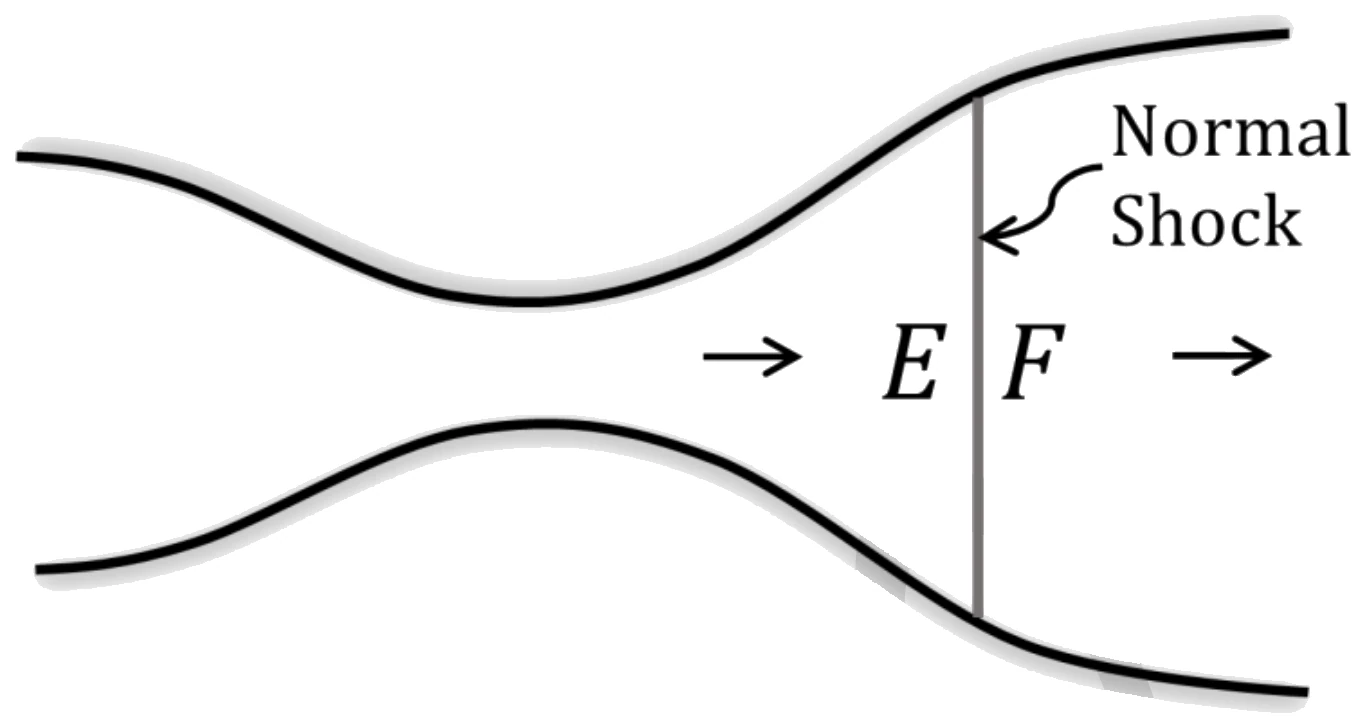
Steady, compressible flow of air takes place through an adiabatic converging-diverging nozzle, as shown in the figure. For a particular value of pressure difference across the nozzle, a stationary normal shock wave forms in the diverging section of the nozzle. If EE and FF denote the flow conditions just upstream and downstream of the normal shock, respectively, which of the following statement(s) is/are TRUE?

Figure for GATE 2024 ME question 40 (Fluid Mechanics)

  • (A)
    Static pressure at EE is lower than the static pressure at FF
  • (B)
    Density at EE is lower than the density at FF
  • (C)
    Mach number at EE is lower than the Mach number at FF
  • (D)
    Specific entropy at EE is lower than the specific entropy at FF

Answer (official key): A, B, D

Solution

Across a normal shock, supersonic flow becomes subsonic, with increases in static pressure, density, and specific entropy. Thus pE<pFp_E<p_F makes A true, ρE<ρF\rho_E<\rho_F makes B true, and sE<sFs_E<s_F makes D true. Since ME>1>MFM_E>1>M_F, C is false. The correct options are A, B, and D.

Q50 · Heat Transfer · Numerical · 2 marks

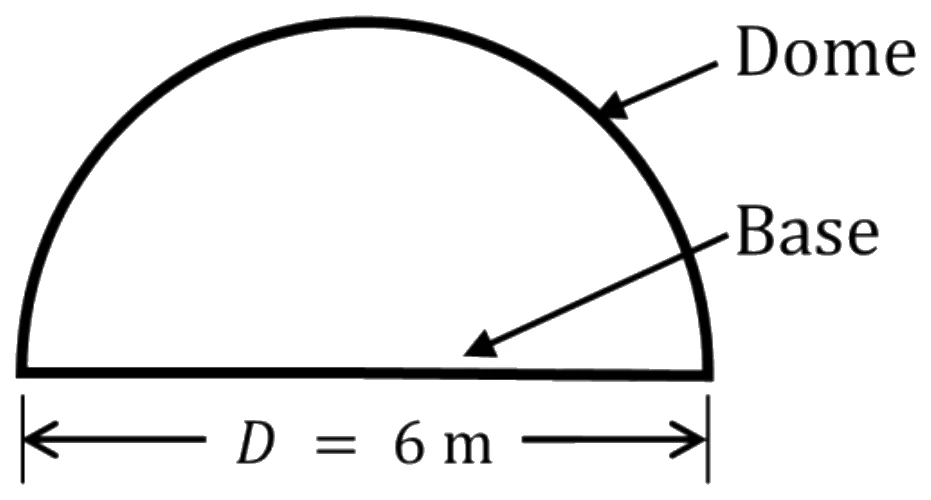
Consider a hemispherical furnace of diameter D=6D=6 m with a flat base. The dome of the furnace has an emissivity of 0.70.7 and the flat base is a blackbody. The base and the dome are maintained at uniform temperature of 300300 K and 12001200 K, respectively. Under steady state conditions, the rate of radiation heat transfer from the dome to the base is ________kW (rounded off to the nearest integer).

Use Stefan-Boltzmann constant =5.67×10−8=5.67\times10^{-8} W/(m2^2 K4^4)

Figure for GATE 2024 ME question 50 (Heat Transfer)

Answer (official key): 2720 to 2740

Solution

The base and dome areas are Ab=9πA_b=9\pi and Ad=18πA_d=18\pi m2^2. Since Fbd=1F_{bd}=1, reciprocity gives AdFdb=AbA_dF_{db}=A_b. The black base has no surface resistance, so Q˙=σ(Td4−Tb4)/[(1−0.7)/(0.7Ad)+1/Ab]\dot Q=\sigma(T_d^4-T_b^4)/[(1-0.7)/(0.7A_d)+1/A_b]. Substitution gives approximately 27272727 kW.

Q52 · Theory of Machines · Numerical · 2 marks

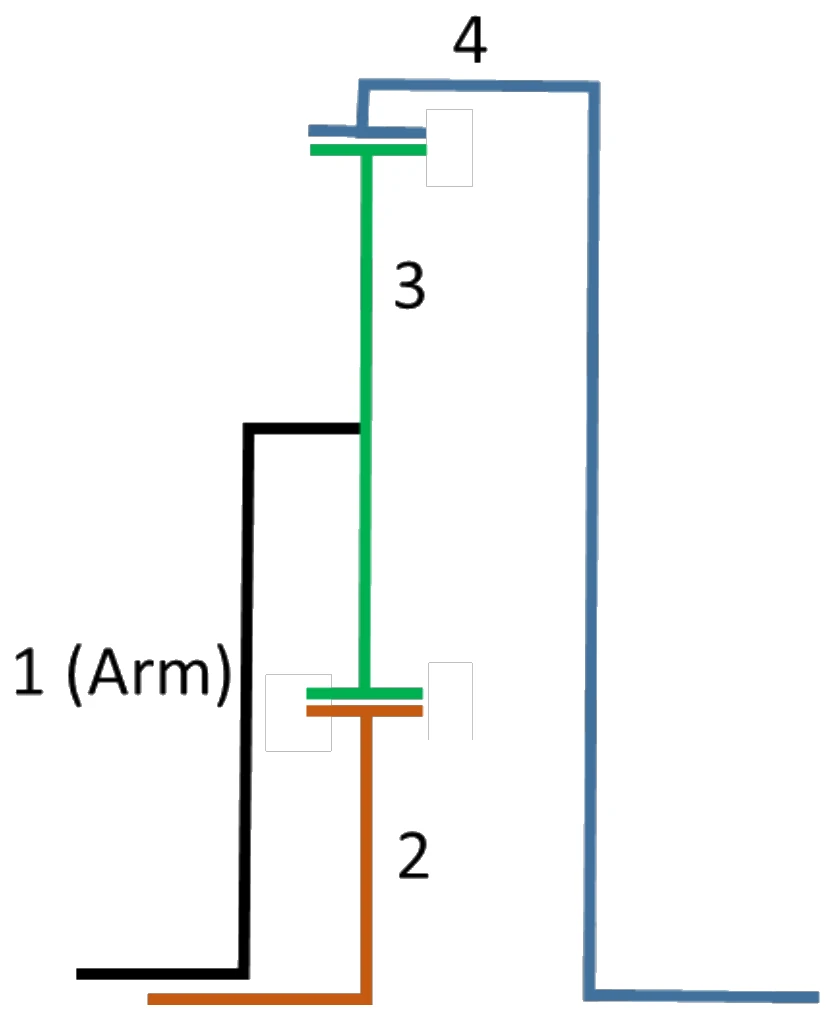
The Levai type-A train illustrated in the figure has gears with module m=8m=8 mm/tooth. Gears 22 and 33 have 1919 and 2424 teeth respectively. Gear 22 is fixed and internal gear 44 rotates at 2020 rev/min counter-clockwise. The magnitude of angular velocity of the arm is__________ rev/min. (rounded off to 2 decimal places)

Figure for GATE 2024 ME question 52 (Theory of Machines)

Answer (official key): 15 to 16

Solution

The internal gear has Z4=Z2+2Z3=19+2(24)=67Z_4=Z_2+2Z_3=19+2(24)=67 teeth. The planetary gear relation is (ω2−ωa)/(ω4−ωa)=−Z4/Z2(\omega_2-\omega_a)/(\omega_4-\omega_a)=-Z_4/Z_2. With ω2=0\omega_2=0 and ω4=20\omega_4=20, 19ωa=67(20−ωa)19\omega_a=67(20-\omega_a). Thus ωa=1340/86=15.58\omega_a=1340/86=15.58 rev/min.

The other 60 questions are solved in your report when you take GATE 2024 ME as a 3-hour test.

Take GATE 2024 ME as a test

Official answer key

GATE 2024 ME answer key

All 65 answers from the official key. Numerical answers are ranges; “or” means the key accepts either answer.

Download the official GATE 2024 ME answer key (PDF)
QTopicTypeMarksAnswer
1Verbal AptitudeMCQ1A
2Quantitative AptitudeMCQ1A
3Quantitative AptitudeMCQ1C
4Quantitative AptitudeMCQ1A
5Quantitative AptitudeMCQ1D
6Verbal AptitudeMCQ2B
7Analytical AptitudeMCQ2Marks to all
8Quantitative AptitudeMCQ2C
9Spatial AptitudeMCQ2A
10Spatial AptitudeMCQ2Marks to all
11Numerical MethodsMCQ1D
12CalculusMCQ1C
13Complex VariablesMCQ1D
14Linear AlgebraMCQ1D
15CalculusMCQ1B
16Fluid MechanicsMCQ1C
17Heat TransferMCQ1B
18Heat TransferMCQ1A
19Heat TransferMCQ1Marks to all
20ThermodynamicsMCQ1A
21Thermal ApplicationsMCQ1D
22Machine DesignMCQ1C
23Theory of MachinesMCQ1B
24Applied MechanicsMCQ1C
25VibrationsMCQ1A
26Machine DesignMCQ1A
27Applied MechanicsMCQ1B
28Engineering MaterialsMCQ1C
29Manufacturing EngineeringMCQ1A
30Manufacturing EngineeringMCQ1D
31Manufacturing EngineeringMCQ1D
32Manufacturing EngineeringMCQ1C
33Manufacturing EngineeringMCQ1A
34Industrial EngineeringMCQ1Marks to all
35Industrial EngineeringMCQ1C
36Linear AlgebraMCQ2A
37Fluid MechanicsMCQ2B
38Industrial EngineeringMCQ2A
39Industrial EngineeringMCQ2A
40Fluid MechanicsMSQ2A, B, D
41Mechanics of MaterialsMSQ2C, D
42CalculusNumerical225
43Differential EquationsNumerical2-1.4 to -1.38
44Probability and StatisticsNumerical20.38 to 0.39
45ThermodynamicsNumerical240
46ThermodynamicsNumerical258 to 61
47ThermodynamicsNumerical21620
48Heat TransferNumerical26
49Heat TransferNumerical20.59 to 0.633
50Heat TransferNumerical22720 to 2740
51Fluid MechanicsNumerical20.5
52Theory of MachinesNumerical215 to 16
53Mechanics of MaterialsNumerical29 to 9.5
54Theory of MachinesNumerical211.3 to 12.7
55VibrationsNumerical229 to 31
56Machine DesignNumerical24.3 to 4.7
57Mechanics of MaterialsNumerical212.3 to 12.7
58Applied MechanicsNumerical237 to 38
59Theory of MachinesNumerical2115 to 119
60Manufacturing EngineeringNumerical221 to 22.5
61Manufacturing EngineeringNumerical21
62Manufacturing EngineeringNumerical219.84 to 19.92
63Manufacturing EngineeringNumerical2Marks to all
64Manufacturing EngineeringNumerical22.2 to 2.65
65Industrial EngineeringNumerical212300

Questions about GATE 2024 ME

How many questions are in the GATE 2024 ME paper?

65 questions for 100 marks: 10 General Aptitude questions worth 15 marks and 55 Mechanical Engineering questions worth 85 marks. By type, there were 39 MCQs, 2 MSQs, 24 numerical answer (NAT) questions. The paper lasted 3 hours.

Is there negative marking in GATE 2024 ME?

Yes, for MCQs only. A wrong MCQ answer costs one-third of its marks (−⅓ for a 1-mark question, −⅔ for a 2-mark question). MSQ and numerical (NAT) questions have no negative marking, and an MSQ earns marks only when every correct option is chosen.

Which topics carried the most marks in GATE 2024 ME?

Outside General Aptitude, the biggest topics were Manufacturing Engineering (15 marks), Heat Transfer (9 marks), Industrial Engineering (8 marks). The full topic-wise split is in the table on this page.

Were any GATE 2024 ME questions awarded marks to all?

Yes. The official key awarded full marks to everyone for questions 7, 10, 19, 34, 63.

Where does this GATE 2024 ME answer key come from?

From the official answer key published by IISc Bengaluru, which organised GATE 2024. Range answers for numerical questions and questions with more than one accepted answer are kept exactly as the key gives them.

More GATE papers