GATE 2020 ME (Set 2) question paper PDF and answer key

The official GATE 2020 Mechanical Engineering (Set 2) paper, organised by IIT Delhi: 65 questions for 100 marks in 3 hours. Download the official question paper and answer key as PDFs. Below is how the marks were split by topic, the complete official answer key and 5 questions solved step by step.

Source: the official paper and answer key published by IIT Delhi for GATE 2020 (official GATE site). Spotted a mistake? Email team@lemyte.com.

General Aptitude
10 · 15 marks
Mechanical Engineering
55 · 85 marks
MCQ / MSQ / NAT
37 / 0 / 28
Marks to all
Q 11

Where the marks were

GATE 2020 ME (Set 2) topic-wise marks

Mechanical Engineering questions only; General Aptitude adds 15 marks on top. The top three topics carried 32 of the 85 subject marks.

TopicQuestionsMarks
Manufacturing Engineering1016
Thermodynamics69
Fluid Mechanics57
Industrial Engineering46
Mechanics of Materials36
Applied Mechanics45
Theory of Machines35
Machine Design35
Heat Transfer35
Thermal Applications24
Probability and Statistics23
Calculus23
Vibrations23
Linear Algebra22
Complex Variables12
Numerical Methods12
Differential Equations11
Engineering Materials11

Free solved questions

5 solved questions from GATE 2020 ME (Set 2)

Question text and figures as in the official paper, the answer from the official key, and a worked solution. The other 60 solutions are in your report after you take the paper.

Q6 · General Aptitude · MCQ · 2 marks

Climate change and resilience deal with two aspects – reduction of sources of non-renewable energy resources and reducing vulnerability of climate change aspects. The terms ‘mitigation’ and ‘adaptation’ are used to refer to these aspects, respectively.

Which of the following assertions is best supported by the above information?

  • (A)
    Mitigation deals with consequences of climate change.
  • (B)
    Adaptation deals with causes of climate change.
  • (C)
    Mitigation deals with actions taken to reduce the use of fossil fuels.
  • (D)
    Adaptation deals with actions taken to combat green-house gas emissions.

Answer (official key): C

Solution

The passage associates mitigation with reducing the use of non-renewable energy resources. Fossil fuels are such resources, so mitigation includes actions to reduce their use.
Q10 · General Aptitude · MCQ · 2 marks

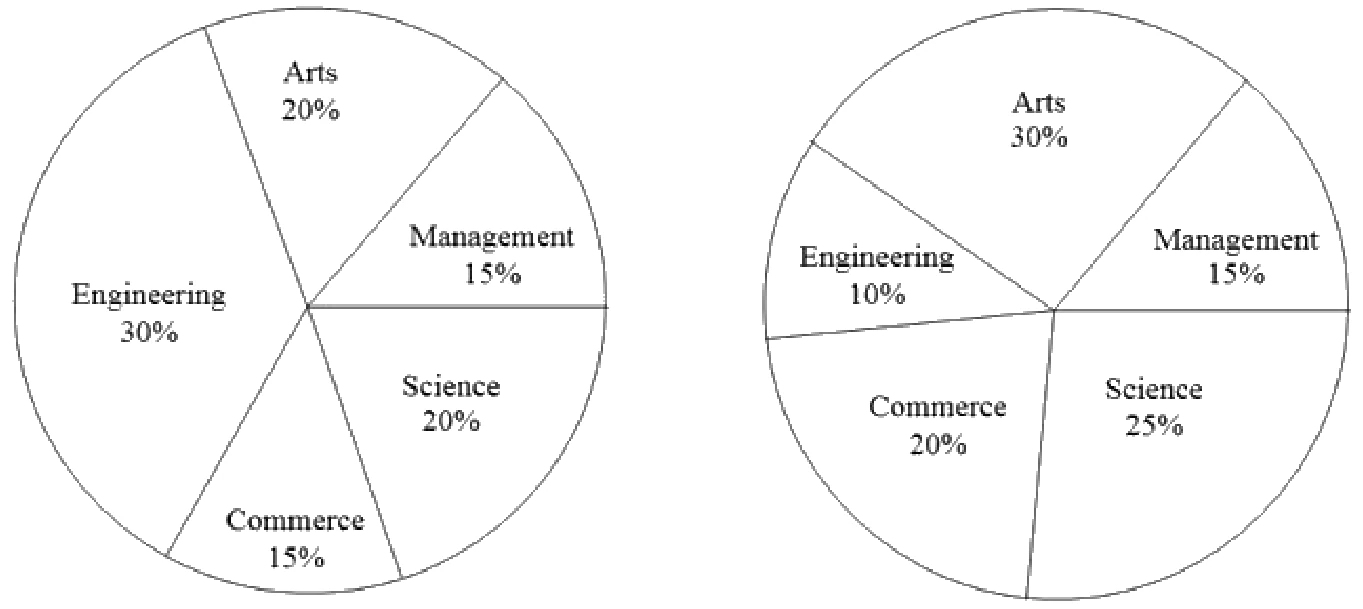
The two pie-charts given below show the data of total students and only girls registered in different streams in a university. If the total number of students registered in the university is 5000, and the total number of the registered girls is 1500; then, the ratio of boys enrolled in Arts to the girls enrolled in Management is _____.

Figure for GATE 2020 ME (Set 2) question 10 (Quantitative Aptitude)

  • (A)
    2:12:1
  • (B)
    9:229:22
  • (C)
    11:911:9
  • (D)
    22:922:9

Answer (official key): D

Solution

Arts has 0.20(5000)=10000.20(5000)=1000 students, including 0.30(1500)=4500.30(1500)=450 girls, so there are 550550 boys. Management has 0.15(1500)=2250.15(1500)=225 girls. The required ratio is 550:225=22:9550:225=\boxed{22:9}.

Q48 · Mechanics of Materials · Numerical · 2 marks

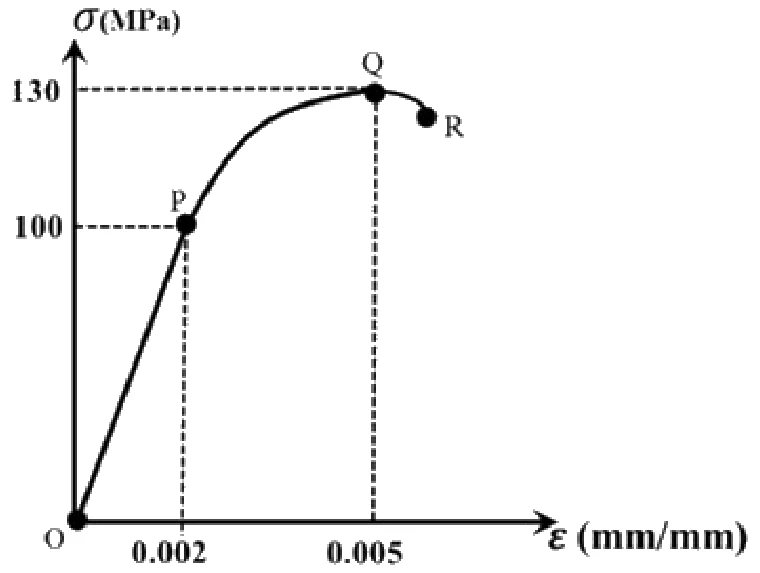
Uniaxial compression test data for a solid metal bar of length 11 m is shown in the figure.

Figure for GATE 2020 ME (Set 2) question 48 (Mechanics of Materials)

The bar material has a linear elastic response from O to P followed by a nonlinear response. The point P represents the yield point of the material. The rod is pinned at both the ends. The minimum diameter of the bar so that it does not buckle under axial loading before reaching the yield point is ________ mm (round off to one decimal place).

Answer (official key): 55 to 58

Solution

From point P, E=100/0.002=50000E=100/0.002=50000 MPa and σy=100\sigma_y=100 MPa. For a pinned solid circular bar, σcr=π2EI/(AL2)=π2Ed2/(16L2)\sigma_{cr}=\pi^2EI/(AL^2)=\pi^2Ed^2/(16L^2). Setting σcr=σy\sigma_{cr}=\sigma_y gives d=(4L/π)σy/E=(4000/π)100/50000=56.9 mmd=(4L/\pi)\sqrt{\sigma_y/E}=(4000/\pi)\sqrt{100/50000}=\boxed{56.9\ \mathrm{mm}}.

Q49 · Theory of Machines · Numerical · 2 marks

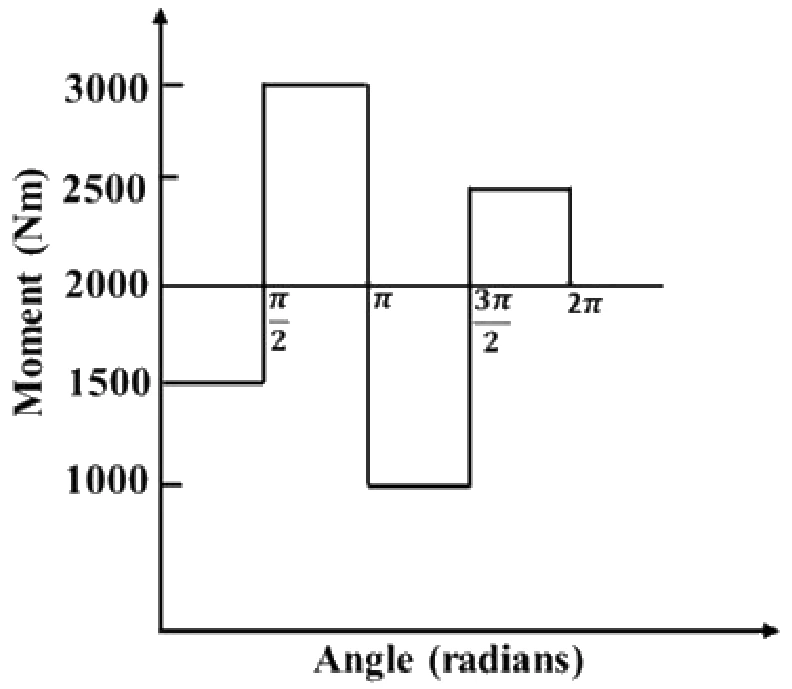
The turning moment diagram of a flywheel fitted to a fictitious engine is shown in the figure.

Figure for GATE 2020 ME (Set 2) question 49 (Theory of Machines)

The mean turning moment is 20002000 Nm. The average engine speed is 10001000 rpm. For fluctuation in the speed to be within ±2%\pm2\% of the average speed, the mass moment of inertia of the flywheel is ______________ kg.m2^2.

Answer (official key): 3.55 to 3.65

Solution

Over successive π/2\pi/2 intervals, the energy changes relative to mean torque are −250π-250\pi, 500π500\pi, −500π-500\pi and 250π250\pi J. The cumulative extremes are −250π-250\pi and 250π250\pi, so ΔE=500π\Delta E=500\pi J. With Cs=0.04C_s=0.04 and ω=1000(2π/60)\omega=1000(2\pi/60) rad/s, I=ΔE/(Csω2)=45/(4π)≈3.58 kg⋅m2I=\Delta E/(C_s\omega^2)=45/(4\pi)\approx\boxed{3.58\ \mathrm{kg\cdot m^2}}.

Q50 · Applied Mechanics · Numerical · 2 marks

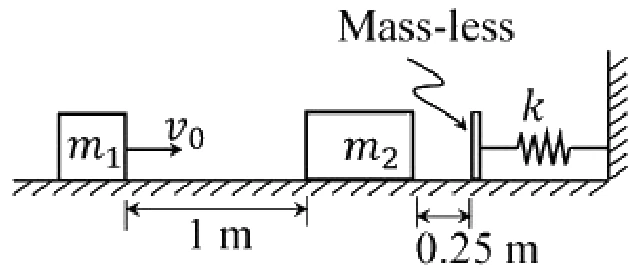
A rigid block of mass m1=10m_1=10 kg having velocity v0=2v_0=2 m/s strikes a stationary block of mass m2=30m_2=30 kg after traveling 11 m along a frictionless horizontal surface as shown in the figure.

Figure for GATE 2020 ME (Set 2) question 50 (Applied Mechanics)

The two masses stick together and jointly move by a distance of 0.250.25 m further along the same frictionless surface, before they touch the mass-less buffer that is connected to the rigid vertical wall by means of a linear spring having a spring constant k=105k=10^5 N/m. The maximum deflection of the spring is ______________ cm (round off to 2 decimal places).

Answer (official key): 0.98 to 1.02

Solution

Momentum conservation during impact gives v=m1v0/(m1+m2)=0.5v=m_1v_0/(m_1+m_2)=0.5 m/s. The combined kinetic energy becomes spring energy: 12(40)(0.5)2=12(105)x2\tfrac12(40)(0.5)^2=\tfrac12(10^5)x^2. Thus x=0.01x=0.01 m =1.00 cm=\boxed{1.00\ \mathrm{cm}}.

The other 60 questions are solved in your report when you take GATE 2020 ME (Set 2) as a 3-hour test.

Take GATE 2020 ME (Set 2) as a test

Official answer key

GATE 2020 ME (Set 2) answer key

All 65 answers from the official key. Numerical answers are ranges; “or” means the key accepts either answer.

Download the official GATE 2020 ME (Set 2) answer key (PDF)
QTopicTypeMarksAnswer
1Verbal AptitudeMCQ1A
2Verbal AptitudeMCQ1A
3Verbal AptitudeMCQ1B
4Verbal AptitudeMCQ1B
5Quantitative AptitudeMCQ1D
6Verbal AptitudeMCQ2C
7Analytical AptitudeMCQ2A
8Quantitative AptitudeMCQ2A
9Quantitative AptitudeMCQ2A
10Quantitative AptitudeMCQ2D
11Probability and StatisticsMCQ1Marks to all
12Linear AlgebraMCQ1B
13CalculusMCQ1C
14Differential EquationsMCQ1A
15Applied MechanicsMCQ1B
16Applied MechanicsMCQ1D
17VibrationsMCQ1B
18Theory of MachinesMCQ1C
19Manufacturing EngineeringMCQ1C
20Manufacturing EngineeringMCQ1D
21Engineering MaterialsMCQ1C
22Manufacturing EngineeringMCQ1A
23Industrial EngineeringMCQ1B
24Fluid MechanicsMCQ1C
25Fluid MechanicsMCQ1B
26ThermodynamicsMCQ1B
27ThermodynamicsMCQ1C
28Fluid MechanicsMCQ1B
29Linear AlgebraNumerical11
30Applied MechanicsNumerical11500
31Machine DesignNumerical199.98 to 100.02
32Manufacturing EngineeringNumerical118 to 19.5
33Industrial EngineeringNumerical12
34Heat TransferNumerical10.5
35ThermodynamicsNumerical10.89 to 0.91
36CalculusMCQ2C
37Complex VariablesMCQ2D
38Mechanics of MaterialsMCQ2D
39Theory of MachinesMCQ2A
40Mechanics of MaterialsMCQ2C
41Machine DesignMCQ2B
42Manufacturing EngineeringMCQ2A
43Industrial EngineeringMCQ2A
44ThermodynamicsMCQ2A
45Numerical MethodsNumerical25.1 to 5.5
46Probability and StatisticsNumerical20.041 to 0.043
47VibrationsNumerical28.6 to 8.7
48Mechanics of MaterialsNumerical255 to 58
49Theory of MachinesNumerical23.55 to 3.65
50Applied MechanicsNumerical20.98 to 1.02
51Machine DesignNumerical29.8 to 10.8
52Manufacturing EngineeringNumerical24 to 9
53Manufacturing EngineeringNumerical2-5.8 to -5.5
54Manufacturing EngineeringNumerical20.7 to 0.9
55Manufacturing EngineeringNumerical226 to 28
56Manufacturing EngineeringNumerical21.4 to 1.6
57Industrial EngineeringNumerical21130 to 1140
58Fluid MechanicsNumerical21.5 to 1.55
59Fluid MechanicsNumerical27.9 to 8.1
60Heat TransferNumerical22499 to 2501
61Heat TransferNumerical285.1 to 86.1
62ThermodynamicsNumerical2543 to 545
63Thermal ApplicationsNumerical210
64Thermal ApplicationsNumerical21500 to 1525
65ThermodynamicsNumerical24.6 to 4.9

Questions about GATE 2020 ME (Set 2)

How many questions are in the GATE 2020 ME (Set 2) paper?

65 questions for 100 marks: 10 General Aptitude questions worth 15 marks and 55 Mechanical Engineering questions worth 85 marks. By type, there were 37 MCQs, 28 numerical answer (NAT) questions. The paper lasted 3 hours.

Is there negative marking in GATE 2020 ME (Set 2)?

Yes, for MCQs only. A wrong MCQ answer costs one-third of its marks (−⅓ for a 1-mark question, −⅔ for a 2-mark question). MSQ and numerical (NAT) questions have no negative marking, and an MSQ earns marks only when every correct option is chosen.

Which topics carried the most marks in GATE 2020 ME (Set 2)?

Outside General Aptitude, the biggest topics were Manufacturing Engineering (16 marks), Thermodynamics (9 marks), Fluid Mechanics (7 marks). The full topic-wise split is in the table on this page.

Were any GATE 2020 ME (Set 2) questions awarded marks to all?

Yes. The official key awarded full marks to everyone for question 11.

Where does this GATE 2020 ME (Set 2) answer key come from?

From the official answer key published by IIT Delhi, which organised GATE 2020. Range answers for numerical questions and questions with more than one accepted answer are kept exactly as the key gives them.

More GATE papers