
GATE 2021 AE question paper PDF and answer key

The official GATE 2021 Aerospace Engineering paper, organised by IIT Bombay: 65 questions for 100 marks in 3 hours. Download the official question paper and answer key as PDFs. Below is how the marks were split by topic, the complete official answer key and 5 questions solved step by step.

Source: the official paper and answer key published by IIT Bombay for GATE 2021 (official GATE site). Spotted a mistake? Email team@lemyte.com.

General Aptitude
10 · 15 marks
Aerospace Engineering
55 · 85 marks
MCQ / MSQ / NAT
28 / 9 / 28
Marks to all
None

Not in 2027 3 questions (Q 28, 30, 39) are on topics removed from the GATE 2027 syllabus. They are marked in the answer key below. What changed for AE

Where the marks were

GATE 2021 AE topic-wise marks

Aerospace Engineering questions only; General Aptitude adds 15 marks on top. The top three topics carried 58 of the 85 subject marks.

TopicQuestionsMarks
Aerodynamics1421
Structures1219
Flight Mechanics1118
Propulsion1016
Calculus46
Differential Equations22
Linear Algebra12
Space Dynamics11

Free solved questions

5 solved questions from GATE 2021 AE

Question text and figures as in the official paper, the answer from the official key, and a worked solution. The other 60 solutions are in your report after you take the paper.

Q25 · Aerodynamics · MSQ · 1 mark

Which of the following statement(s) is/are true with regards to Kutta condition for flow past airfoils?

  • (A)
    It is utilized to determine the circulation on an airfoil.
  • (B)
    It is applicable only to airfoils with sharp trailing edge.
  • (C)
    The trailing edge of an airfoil is a stagnation point.
  • (D)
    The flow leaves the trailing edge smoothly.

Answer (official key): A, B, D

Solution

The Kutta condition fixes the circulation (A) by making the flow leave a sharp trailing edge smoothly (B, D). The trailing edge is a stagnation point only for a finite-angle edge, not for a cusp, so (C) is not generally true.
Q26 · Aerodynamics · MSQ · 1 mark

According to the thin airfoil theory, which of the following statement(s) is/are true for a cambered airfoil?

  • (A)
    The lift coefficient for an airfoil is directly proportional to the absolute angle of attack.
  • (B)
    The aerodynamic center lies at quarter chord point.
  • (C)
    The center of pressure lies at quarter chord point.
  • (D)
    Drag coefficient is proportional to the square of lift coefficient.

Answer (official key): A, B

Solution

Thin airfoil theory gives cl=2π(α−αL=0)c_l = 2\pi(\alpha - \alpha_{L=0}) (A) and the aerodynamic centre at c/4c/4 (B). For a cambered airfoil the centre of pressure moves with clc_l (C false), and the theory predicts zero drag (D false).

Q29 · Structures · Numerical · 1 mark

A single degree of freedom spring-mass-damper system is designed to ensure that the system returns to its original undisturbed position in minimum possible time without overshooting. If the mass of the system is 10 kg, spring stiffness is 17400 N/m and the natural frequency is 13.2 rad/s, the coefficient of damping of the system in Ns/m is _________ (round off to nearest integer).

Answer (official key): 264 or 833 to 835

Solution

Minimum time without overshoot means critical damping, cc=2mωn=2×10×13.2=264c_c = 2m\omega_n = 2 \times 10 \times 13.2 = 264 N·s/m.

The data are inconsistent (k/m=41.7\sqrt{k/m} = 41.7 rad/s, not 13.2), so the official key also accepts 2km=8342\sqrt{km} = 834 N·s/m. Only the first value is graded here.

Q34 · Flight Mechanics · Numerical · 1 mark

An aircraft with twin jet engines has the following specifications:

Thrust produced (per engine) = 8000 N

Spanwise distance between the two engines = 10 m

Wing area = 50 m², Wing span = 10 m

Rudder effectiveness, Cnδr=−0.002C_{n_{\delta r}} = -0.002 /deg

Density of air at sea level = 1.225 kg/m³

The rudder deflection, in degrees, required to maintain zero sideslip at 100 m/s in steady and level flight at sea level with a non-functional right engine is ________ (round off to two decimal places).

Answer (official key): 6.5 to 6.6

Solution

The yawing moment from the live engine is 8000×5=40 0008000 \times 5 = 40\,000 N·m. Cn=40 00012(1.225)(1002)×50×10=0.01306C_n = \dfrac{40\,000}{\tfrac12(1.225)(100^2) \times 50 \times 10} = 0.01306, so δr=0.01306/0.002=6.53°\delta_r = 0.01306/0.002 = 6.53°.

Q37 · Aerodynamics · MCQ · 2 marks

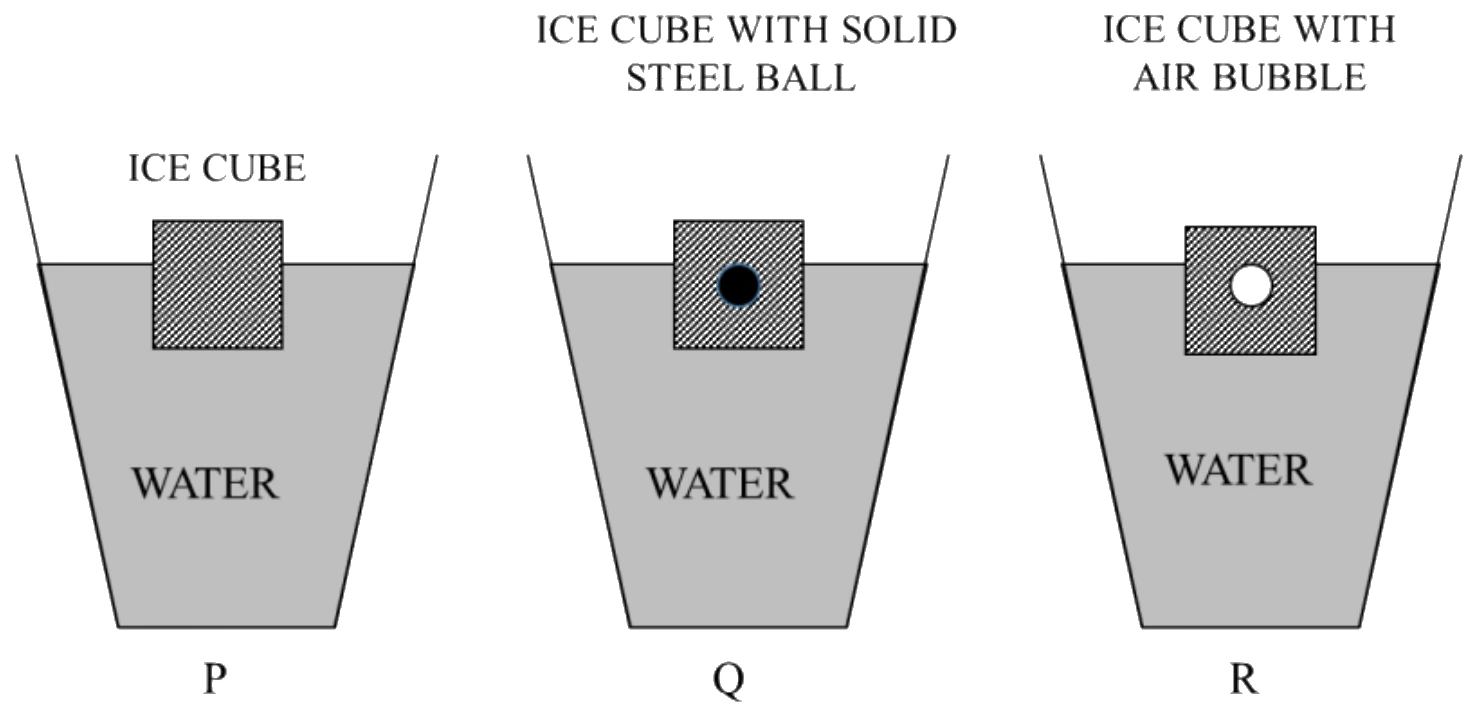
The figure shows three glasses P, Q and R with water and floating ice cube. Glass P has a solid ice cube, glass Q has an ice cube with a small solid steel ball embedded in it and glass R has an ice cube with an air bubble. After the ice cube melts, the level of water in glasses P, Q and R, respectively:

Figure for GATE 2021 AE question 37 (Aerodynamics)

  • (A)
    remains same, increases, and decreases
  • (B)
    increases, decreases, and increases
  • (C)
    remains same, decreases, and decreases
  • (D)
    remains same, decreases, and increases

Answer (official key): C

Solution

P: floating ice displaces its own weight of water, which it becomes on melting — level unchanged. Q: while floating the ice buoys up the steel ball (displacing water equal to the ball's weight); once it melts the ball sinks and displaces only its own volume — level falls. For R the official key also takes the level as decreasing (the trapped air, which added displaced volume while floating, escapes).

The other 60 questions are solved in your report when you take GATE 2021 AE as a 3-hour test.

Take GATE 2021 AE as a test

Official answer key

GATE 2021 AE answer key

All 65 answers from the official key. Numerical answers are ranges; “or” means the key accepts either answer.

Download the official GATE 2021 AE answer key (PDF)
QTopicTypeMarksAnswer
1Verbal AptitudeMCQ1B
2Spatial AptitudeMCQ1B
3Quantitative AptitudeMCQ1D
4Quantitative AptitudeMCQ1D
5Quantitative AptitudeMCQ1C
6Quantitative AptitudeMCQ2C
7Verbal AptitudeMCQ2A
8Analytical AptitudeMCQ2B
9Quantitative AptitudeMCQ2C
10Quantitative AptitudeMCQ2D
11Differential EquationsMCQ1D
12Differential EquationsMCQ1B
13AerodynamicsMCQ1B
14AerodynamicsMCQ1A
15PropulsionMCQ1B
16PropulsionMCQ1A
17PropulsionMCQ1D
18PropulsionMCQ1C
19AerodynamicsMCQ1D
20StructuresMCQ1B
21StructuresMCQ1D
22Flight MechanicsMCQ1C
23Flight MechanicsMCQ1B
24AerodynamicsMSQ1A, B, C
25AerodynamicsMSQ1A, B, D
26AerodynamicsMSQ1A, B
27CalculusNumerical10
28CalculusNot in GATE 2027 syllabus: Contour integrals and residuesNumerical10.02 to 0.03
29StructuresNumerical1264 or 833 to 835
30StructuresNot in GATE 2027 syllabus: Vibration of beamsNumerical14
31AerodynamicsNumerical10
32StructuresNumerical10.2
33Flight MechanicsNumerical164.3 to 64.6
34Flight MechanicsNumerical16.5 to 6.6
35Space DynamicsNumerical17.75 to 7.77 or 7750 to 7770
36StructuresMCQ2A
37AerodynamicsMCQ2C
38AerodynamicsMCQ2B
39AerodynamicsNot in GATE 2027 syllabus: Wind tunnel testing and flow visualisationMCQ2C
40Flight MechanicsMCQ2D
41CalculusMSQ2B, D
42StructuresMSQ2B, C
43AerodynamicsMSQ2D
44Flight MechanicsMSQ2A, C, D
45Flight MechanicsMSQ2B, C, D
46Flight MechanicsMSQ2A, D
47Linear AlgebraNumerical28
48CalculusNumerical20.66 to 0.68
49StructuresNumerical20.41 to 0.43
50AerodynamicsNumerical298 to 98.5
51AerodynamicsNumerical20.005 to 0.009
52AerodynamicsNumerical24.8 to 5.2
53PropulsionNumerical2605 to 607
54PropulsionNumerical2216 to 220
55PropulsionNumerical220 to 22
56PropulsionNumerical2274 to 282
57PropulsionNumerical218 to 19.5
58PropulsionNumerical22.35 to 2.5
59StructuresNumerical214 to 16
60StructuresNumerical22.1 to 2.5
61StructuresNumerical22.2 to 2.6
62StructuresNumerical2232 to 238
63Flight MechanicsNumerical214.8 to 15.2
64Flight MechanicsNumerical29735 to 9797
65Flight MechanicsNumerical2-0.025 to -0.023

Questions about GATE 2021 AE

How many questions are in the GATE 2021 AE paper?

65 questions for 100 marks: 10 General Aptitude questions worth 15 marks and 55 Aerospace Engineering questions worth 85 marks. By type, there were 28 MCQs, 9 MSQs, 28 numerical answer (NAT) questions. The paper lasted 3 hours.

Is there negative marking in GATE 2021 AE?

Yes, for MCQs only. A wrong MCQ answer costs one-third of its marks (−⅓ for a 1-mark question, −⅔ for a 2-mark question). MSQ and numerical (NAT) questions have no negative marking, and an MSQ earns marks only when every correct option is chosen.

Which topics carried the most marks in GATE 2021 AE?

Outside General Aptitude, the biggest topics were Aerodynamics (21 marks), Structures (19 marks), Flight Mechanics (18 marks). The full topic-wise split is in the table on this page.

Were any GATE 2021 AE questions awarded marks to all?

No. Every question was graded with the answer in the official key.

Where does this GATE 2021 AE answer key come from?

From the official answer key published by IIT Bombay, which organised GATE 2021. Range answers for numerical questions and questions with more than one accepted answer are kept exactly as the key gives them.

More GATE papers