
GATE 2021 CE (Set 2) question paper PDF and answer key

The official GATE 2021 Civil Engineering (Set 2) paper, organised by IIT Bombay: 65 questions for 100 marks in 3 hours. Download the official question paper and answer key as PDFs. Below is how the marks were split by topic, the complete official answer key and 5 questions solved step by step.

Source: the official paper and answer key published by IIT Bombay for GATE 2021 (official GATE site). Spotted a mistake? Email team@lemyte.com.

General Aptitude
10 · 15 marks
Civil Engineering
55 · 85 marks
MCQ / MSQ / NAT
36 / 1 / 28
Marks to all
None

Not in 2027 2 questions (Q 17, 48) are on topics removed from the GATE 2027 syllabus. They are marked in the answer key below. What changed for CE

Where the marks were

GATE 2021 CE (Set 2) topic-wise marks

Civil Engineering questions only; General Aptitude adds 15 marks on top. The top three topics carried 42 of the 85 subject marks.

TopicQuestionsMarks
Structural Engineering1016
Geotechnical Engineering813
Water Resources Engineering813
Environmental Engineering711
Transportation Engineering58
Construction Materials and Management57
Calculus45
Linear Algebra34
Geomatics Engineering34
Ordinary Differential Equations12
Numerical Methods12

Free solved questions

5 solved questions from GATE 2021 CE (Set 2)

Question text and figures as in the official paper, the answer from the official key, and a worked solution. The other 60 solutions are in your report after you take the paper.

Q3 · General Aptitude · MCQ · 1 mark

Two identical cube shaped dice each with faces numbered 1 to 6 are rolled simultaneously. The probability that an even number is rolled out on each dice is:

  • (A)
    136\frac{1}{36}
  • (B)
    112\frac{1}{12}
  • (C)
    18\frac{1}{8}
  • (D)
    14\frac{1}{4}

Answer (official key): D

Solution

Each die has three even faces, so the probability for one die is 3/6=1/2. The rolls are independent; hence the required probability is (1/2)(1/2)=1/4.

Therefore, the correct answer is D.
Q5 · General Aptitude · MCQ · 1 mark

Four persons P, Q, R and S are to be seated in a row. R should not be seated at the second position from the left end of the row. The number of distinct seating arrangements possible is:

  • (A)
    6
  • (B)
    9
  • (C)
    18
  • (D)
    24

Answer (official key): C

Solution

There are 4!=24 unrestricted arrangements. With R fixed in the second position there are 3!=6 arrangements. The required count is 24−6=18.

Therefore, the correct answer is C.

Q27 · Environmental Engineering · MSQ · 1 mark

Which of the following statement(s) is/are correct?

  • (A)
    Increased levels of carbon monoxide in the indoor environment result in the formation of carboxyhemoglobin and the long term exposure becomes a cause of cardiovascular diseases.
  • (B)
    Volatile organic compounds act as one of the precursors to the formation of photochemical smog in the presence of sunlight.
  • (C)
    Long term exposure to the increased level of photochemical smog becomes a cause of chest constriction and irritation of the mucous membrane.
  • (D)
    Increased levels of volatile organic compounds in the indoor environment will result in the formation of photochemical smog which is a cause of cardiovascular diseases.

Answer (official key): A, B, C

Solution

Carbon monoxide forms carboxyhemoglobin and can cause cardiovascular effects. VOCs participate in photochemical-smog formation in sunlight, and photochemical smog irritates the respiratory system and mucous membranes. Statement D incorrectly links indoor VOC exposure directly to cardiovascular disease through photochemical smog.

Therefore, the correct answers are A, B, C.

Q46 · Calculus · Numerical · 2 marks

A function is defined in Cartesian coordinate system as f(x,y)=xeyf(x, y) = xe^y. The value of the directional derivative of the function (in integer) at the point (2, 0) along the direction of the straight line segment from point (2, 0) to point (12,2)\left(\frac{1}{2}, 2\right) is _________________

Answer (official key): 1

Solution

At (2,0), ∇f=(ey,xey)=(1,2)\nabla f=(e^y,xe^y)=(1,2). The direction vector is (−3/2,2), whose unit vector is (−3/5,4/5). The directional derivative is (1,2)⋅(−3/5,4/5)=1(1,2)\cdot(−3/5,4/5)=1.

Therefore, the answer is 1.

Q47 · Structural Engineering · Numerical · 2 marks

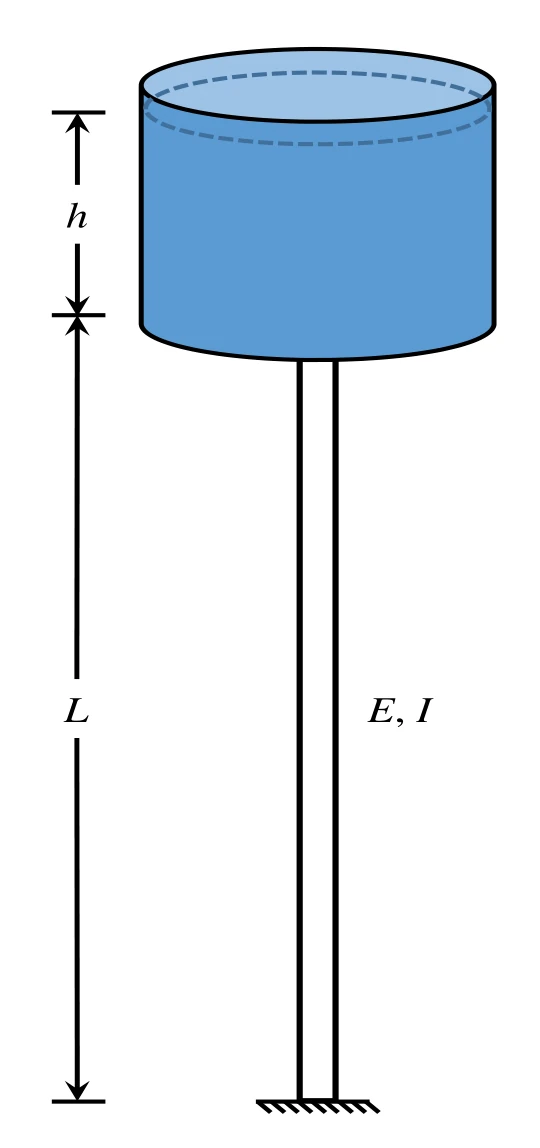
An elevated cylindrical water storage tank is shown in the figure. The tank has inner diameter of 1.5 m. It is supported on a solid steel circular column of diameter 75 mm and total height (L) of 4 m. Take, water density = 1000 kg/m³ and acceleration due to gravity = 10 m/s².

Figure for GATE 2021 CE (Set 2) question 47 (Structural Engineering)

If elastic modulus (E) of steel is 200 GPa, ignoring self-weight of the tank, for the supporting steel column to remain unbuckled, the maximum depth (h) of the water permissible (in m, round off to one decimal place) is ___________

Answer (official key): 2.5 to 2.9

Solution

For a fixed-free column, the effective length is 2L=8 m. Euler load is Pcr=π2EI/(2L)2P_{cr}=\pi^2EI/(2L)^2, with I=πd4/64I=\pi d^4/64, giving Pcr=47.90P_{cr}=47.90 kN. Water weight per metre depth is 1000(10)π(1.5)2/4=17.671000(10)\pi(1.5)^2/4=17.67 kN/m. Thus h=47.90/17.67=2.71 m, or 2.7 m.

Therefore, the answer lies in the range 2.5 to 2.9.

The other 60 questions are solved in your report when you take GATE 2021 CE (Set 2) as a 3-hour test.

Take GATE 2021 CE (Set 2) as a test

Official answer key

GATE 2021 CE (Set 2) answer key

All 65 answers from the official key. Numerical answers are ranges; “or” means the key accepts either answer.

Download the official GATE 2021 CE (Set 2) answer key (PDF)
QTopicTypeMarksAnswer
1Verbal AptitudeMCQ1B
2Spatial AptitudeMCQ1B
3Quantitative AptitudeMCQ1D
4Analytical AptitudeMCQ1D
5Analytical AptitudeMCQ1C
6Analytical AptitudeMCQ2C
7Verbal AptitudeMCQ2A
8Analytical AptitudeMCQ2B
9Quantitative AptitudeMCQ2C
10Quantitative AptitudeMCQ2D
11CalculusMCQ1A
12Linear AlgebraMCQ1C
13CalculusMCQ1B
14Linear AlgebraMCQ1A
15Geomatics EngineeringMCQ1C
16Structural EngineeringMCQ1A
17Structural EngineeringNot in GATE 2027 syllabus: Free vibration of undamped SDOF systemsMCQ1A
18Construction Materials and ManagementMCQ1A
19Construction Materials and ManagementMCQ1A
20Geotechnical EngineeringMCQ1A
21Geotechnical EngineeringMCQ1A
22Water Resources EngineeringMCQ1B
23Transportation EngineeringMCQ1C
24Environmental EngineeringMCQ1D
25Environmental EngineeringMCQ1D
26Construction Materials and ManagementMCQ1B
27Environmental EngineeringMSQ1A, B, C
28CalculusNumerical10
29Structural EngineeringNumerical114 to 16
30Structural EngineeringNumerical130
31Geotechnical EngineeringNumerical117.25 to 17.45
32Water Resources EngineeringNumerical1595 to 598
33Water Resources EngineeringNumerical1677.5 to 679.5
34Transportation EngineeringNumerical148 to 52
35Geomatics EngineeringNumerical136
36Ordinary Differential EquationsMCQ2A
37Linear AlgebraMCQ2A
38Structural EngineeringMCQ2C
39Structural EngineeringMCQ2C
40Geotechnical EngineeringMCQ2B
41Water Resources EngineeringMCQ2B
42Environmental EngineeringMCQ2D
43Environmental EngineeringMCQ2B
44Geomatics EngineeringMCQ2A
45Geotechnical EngineeringMCQ2C
46CalculusNumerical21
47Structural EngineeringNumerical22.5 to 2.9
48Structural EngineeringNot in GATE 2027 syllabus: Free vibration of undamped SDOF systemsNumerical210
49Structural EngineeringNumerical28.1 to 8.4
50Water Resources EngineeringNumerical263.5 to 63.9
51Structural EngineeringNumerical2129 to 130
52Construction Materials and ManagementNumerical256
53Construction Materials and ManagementNumerical220000
54Geotechnical EngineeringNumerical2439 to 442
55Geotechnical EngineeringNumerical20.32 to 0.34
56Numerical MethodsNumerical20.38 to 0.42
57Geotechnical EngineeringNumerical20.09 to 0.105
58Water Resources EngineeringNumerical24.2
59Water Resources EngineeringNumerical249 to 50
60Water Resources EngineeringNumerical2689 to 693
61Environmental EngineeringNumerical237 to 38
62Environmental EngineeringNumerical29
63Transportation EngineeringNumerical22.58 to 2.61
64Transportation EngineeringNumerical21.9 to 2.1
65Transportation EngineeringNumerical255 to 59

Questions about GATE 2021 CE (Set 2)

How many questions are in the GATE 2021 CE (Set 2) paper?

65 questions for 100 marks: 10 General Aptitude questions worth 15 marks and 55 Civil Engineering questions worth 85 marks. By type, there were 36 MCQs, 1 MSQs, 28 numerical answer (NAT) questions. The paper lasted 3 hours.

Is there negative marking in GATE 2021 CE (Set 2)?

Yes, for MCQs only. A wrong MCQ answer costs one-third of its marks (−⅓ for a 1-mark question, −⅔ for a 2-mark question). MSQ and numerical (NAT) questions have no negative marking, and an MSQ earns marks only when every correct option is chosen.

Which topics carried the most marks in GATE 2021 CE (Set 2)?

Outside General Aptitude, the biggest topics were Structural Engineering (16 marks), Geotechnical Engineering (13 marks), Water Resources Engineering (13 marks). The full topic-wise split is in the table on this page.

Were any GATE 2021 CE (Set 2) questions awarded marks to all?

No. Every question was graded with the answer in the official key.

Where does this GATE 2021 CE (Set 2) answer key come from?

From the official answer key published by IIT Bombay, which organised GATE 2021. Range answers for numerical questions and questions with more than one accepted answer are kept exactly as the key gives them.

More GATE papers