GATE 2025 CE (Set 1) question paper PDF and answer key

The official GATE 2025 Civil Engineering (Set 1) paper, organised by IIT Roorkee: 65 questions for 100 marks in 3 hours. Download the official question paper and answer key as PDFs. Below is how the marks were split by topic, the complete official answer key and 5 questions solved step by step.

Source: the official paper and answer key published by IIT Roorkee for GATE 2025 (official GATE site). Spotted a mistake? Email team@lemyte.com.

General Aptitude
10 · 15 marks
Civil Engineering
55 · 85 marks
MCQ / MSQ / NAT
32 / 11 / 22
Marks to all
None

Where the marks were

GATE 2025 CE (Set 1) topic-wise marks

Civil Engineering questions only; General Aptitude adds 15 marks on top. The top three topics carried 44 of the 85 subject marks.

TopicQuestionsMarks
Structural Engineering916
Geotechnical Engineering814
Water Resources Engineering914
Environmental Engineering710
Transportation Engineering710
Construction Materials and Management34
Geomatics Engineering34
Calculus24
Linear Algebra22
Partial Differential Equations22
Ordinary Differential Equations12
Numerical Methods12
Probability and Statistics11

Free solved questions

5 solved questions from GATE 2025 CE (Set 1)

Question text and figures as in the official paper, the answer from the official key, and a worked solution. The other 60 solutions are in your report after you take the paper.

Q7 · General Aptitude · MCQ · 2 marks

Rohit goes to a restaurant for lunch at about 1 PM. When he enters the restaurant, he notices that the hour and minute hands on the wall clock are exactly coinciding. After about an hour, when he leaves the restaurant, he notices that the clock hands are again exactly coinciding. How much time (in minutes) did Rohit spend at the restaurant?

  • (A)
    6461164\dfrac6{11}
  • (B)
    6651366\dfrac5{13}
  • (C)
    6551165\dfrac5{11}
  • (D)
    6661366\dfrac6{13}

Answer (official key): C

Solution

The minute hand gains on the hour hand at

6−0.5=5.5∘/min.6-0.5=5.5^\circ/\text{min}.

Successive coincidences require a relative gain of 360∘360^\circ, so the interval is

3605.5=72011=65511 min.\frac{360}{5.5} = \frac{720}{11} = 65\frac5{11}\text{ min}.

Therefore, the correct answer is Option C.
Q8 · General Aptitude · MCQ · 2 marks

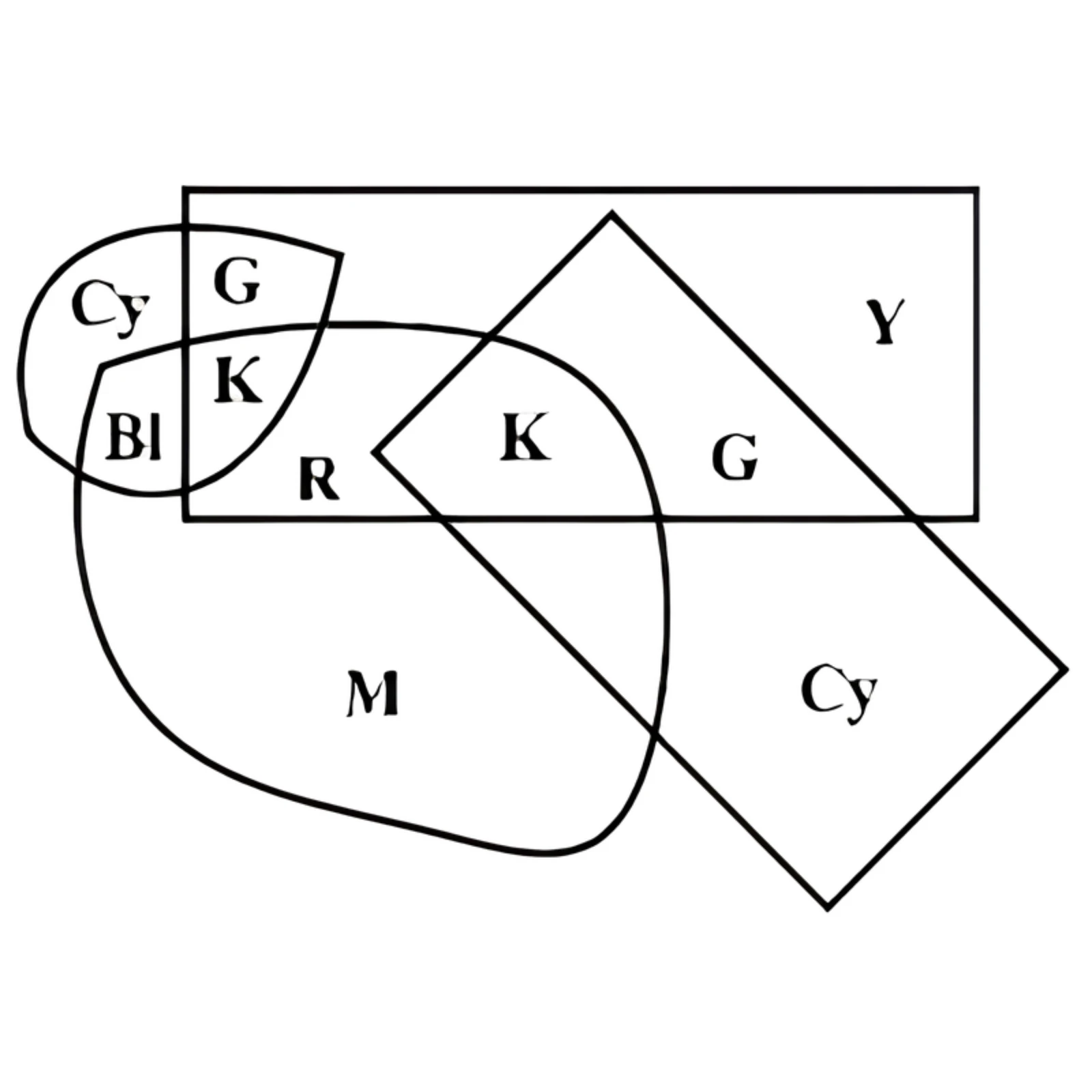
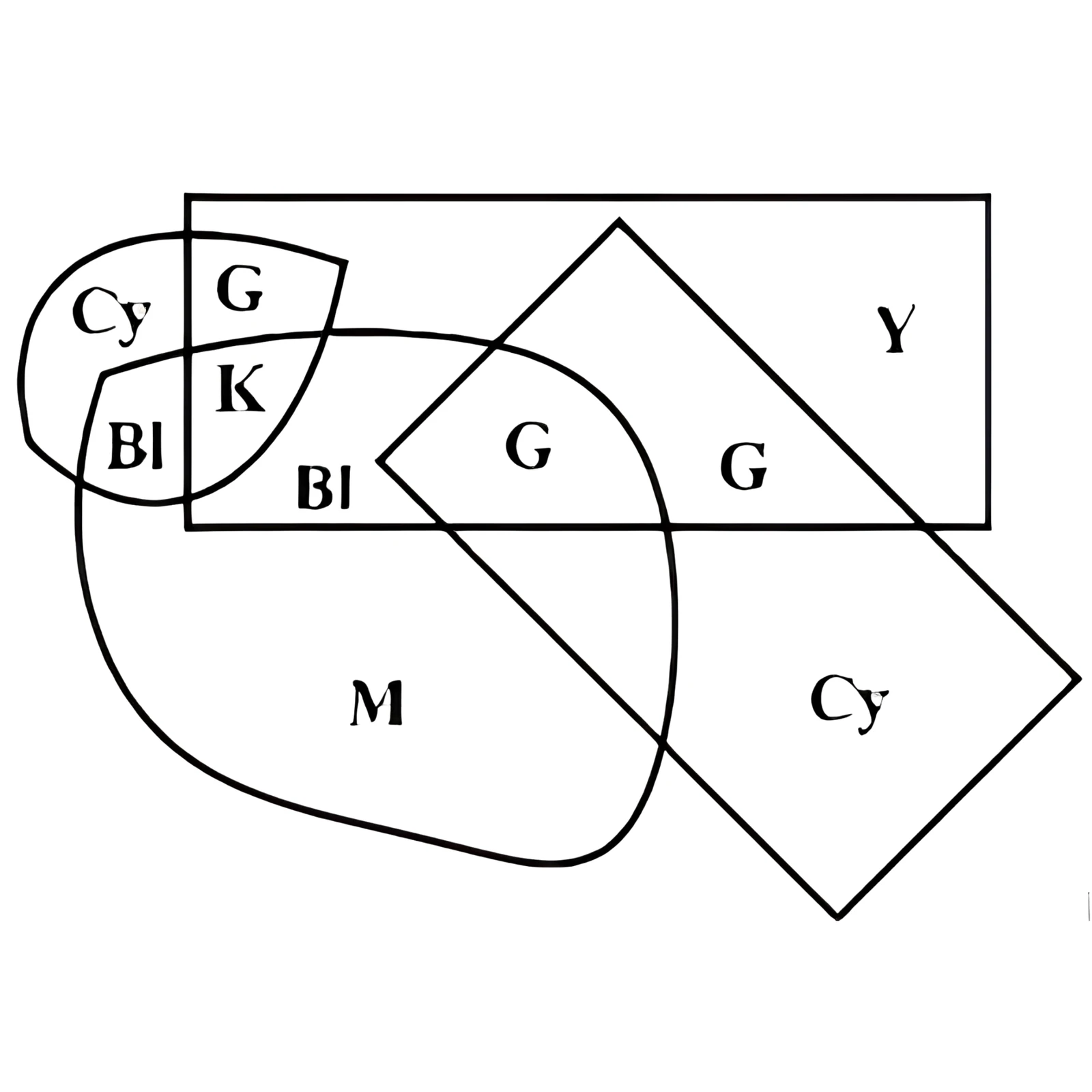
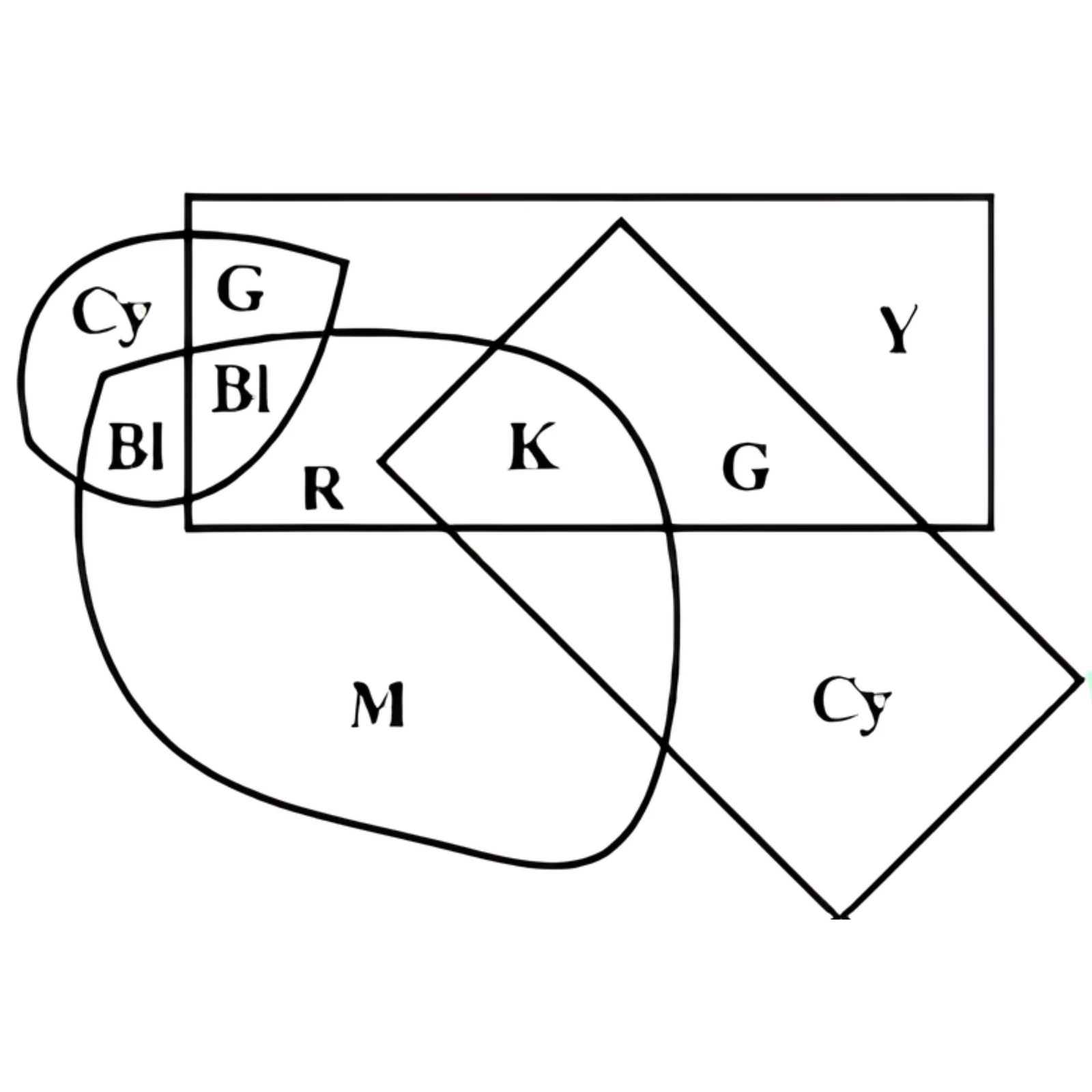
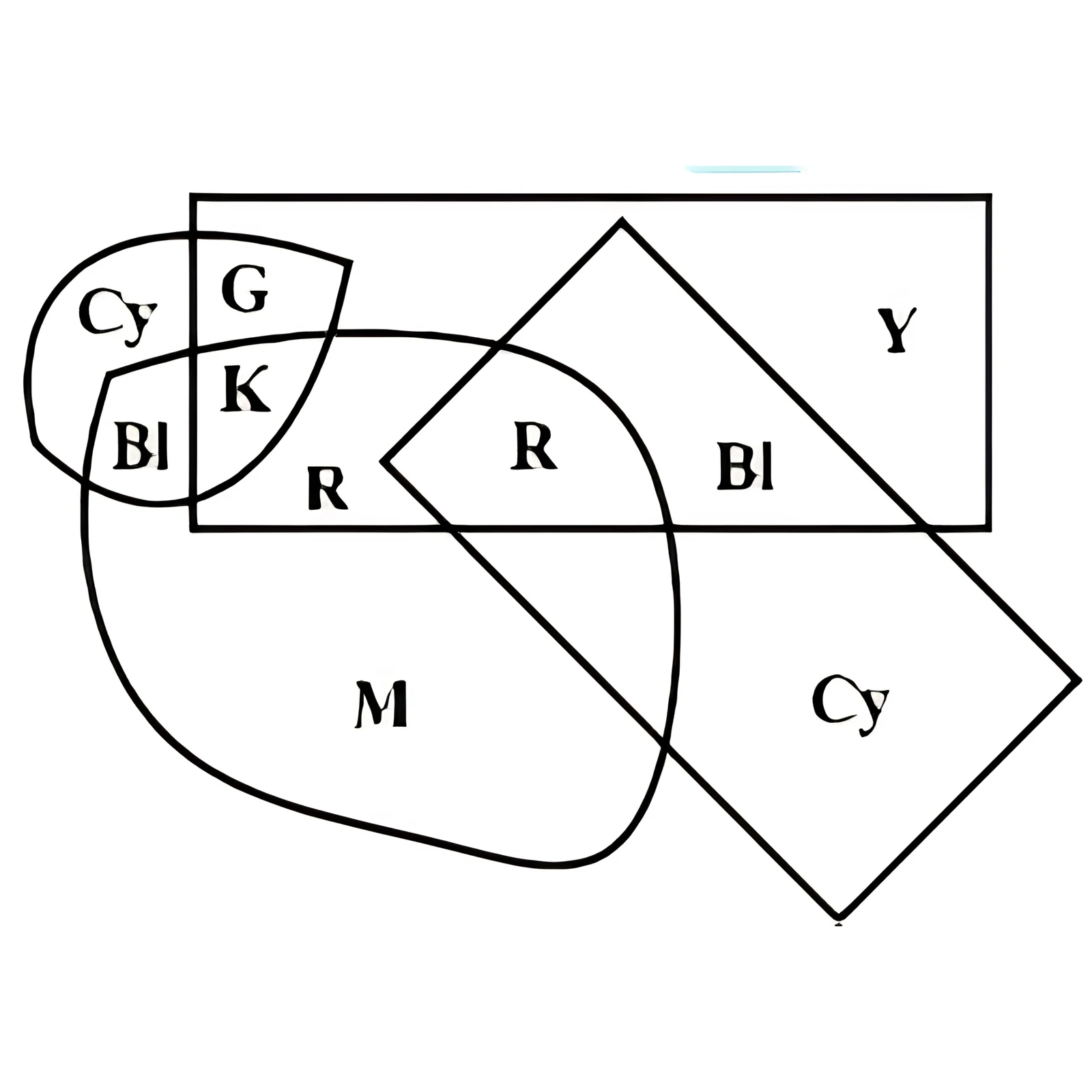
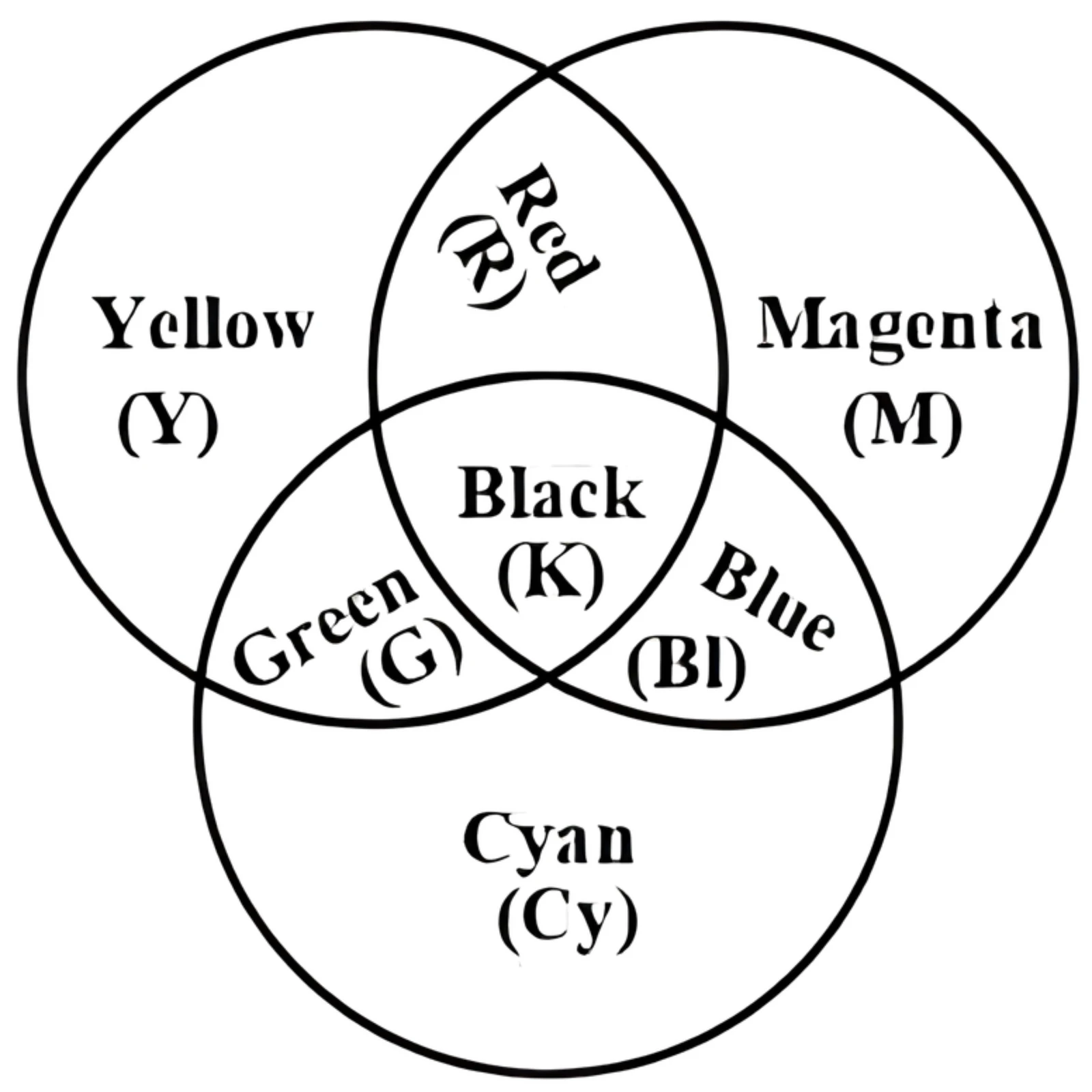
A color model is shown in the figure with color codes: Yellow (Y), Magenta (M), Cyan (Cy), Red (R), Blue (Bl), Green (G), and Black (K).

Color model for Q8

Which one of the following options displays the color codes that are consistent with the color model?

  • (A)
    GATE 2025 CE (Set 1) question 8 (Spatial Aptitude), option A
  • (B)
    GATE 2025 CE (Set 1) question 8 (Spatial Aptitude), option B
  • (C)
    GATE 2025 CE (Set 1) question 8 (Spatial Aptitude), option C
  • (D)
    GATE 2025 CE (Set 1) question 8 (Spatial Aptitude), option D

Answer (official key): A

Solution

The model is the subtractive CMY color model:

  • Yellow + Magenta gives Red.
  • Magenta + Cyan gives Blue.
  • Cyan + Yellow gives Green.
  • Yellow + Magenta + Cyan gives Black.

Only option (A) places all four derived colors in the corresponding overlap regions.

Therefore, the correct answer is Option A.

Q17 · Geotechnical Engineering · MCQ · 1 mark

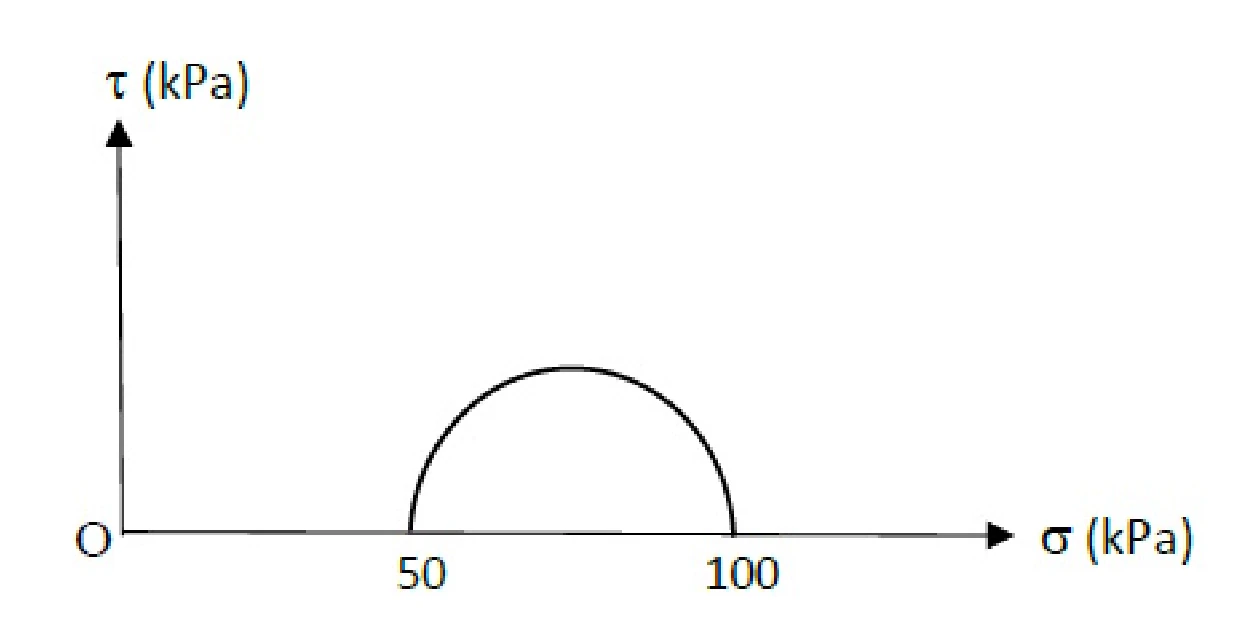
The results of a consolidated drained triaxial test on a normally consolidated clay are shown in the figure.

Mohr circle from drained triaxial test for Q17

The angle of internal friction is

  • (A)
    sin⁡−1(1/2)\sin^{-1}(1/2)
  • (B)
    sin⁡−1(1/3)\sin^{-1}(1/3)
  • (C)
    sin⁡−1(2/3)\sin^{-1}(2/3)
  • (D)
    sin⁡−1(3/4)\sin^{-1}(3/4)

Answer (official key): B

Solution

From the Mohr circle, the principal stresses at failure are

σ3=50 kPa,σ1=100 kPa.\sigma_3=50\text{ kPa}, \qquad \sigma_1=100\text{ kPa}.

For a normally consolidated clay in a drained test, take c′=0c'=0. Then

sin⁡ϕ′=σ1−σ3σ1+σ3.\sin\phi' = \frac{\sigma_1-\sigma_3}{\sigma_1+\sigma_3}.

Hence

sin⁡ϕ′=100−50100+50=13.\sin\phi' = \frac{100-50}{100+50} = \frac13.

Therefore,

ϕ′=sin⁡−1(13).\phi'=\sin^{-1}\left(\frac13\right).

Therefore, the correct answer is Option B.

Q28 · Partial Differential Equations · MSQ · 1 mark

Which of the following equations belong/belongs to the class of second-order, linear, homogeneous partial differential equations?

  • (A)
    ∂2u∂t2=c2(∂2u∂x2+∂2u∂y2)+xy\dfrac{\partial^2u}{\partial t^2}=c^2\left(\dfrac{\partial^2u}{\partial x^2}+\dfrac{\partial^2u}{\partial y^2}\right)+xy
  • (B)
    ∂2u∂x2+∂2u∂y2+∂2u∂z2=0\dfrac{\partial^2u}{\partial x^2}+\dfrac{\partial^2u}{\partial y^2}+\dfrac{\partial^2u}{\partial z^2}=0
  • (C)
    ∂u∂t=c∂u∂x\dfrac{\partial u}{\partial t}=c\dfrac{\partial u}{\partial x}
  • (D)
    (∂2u∂t2)2=c2∂2u∂x2\left(\dfrac{\partial^2u}{\partial t^2}\right)^2=c^2\dfrac{\partial^2u}{\partial x^2}

Answer (official key): B

Solution

A second-order linear homogeneous PDE must:

  1. contain derivatives up to second order,
  2. be linear in the dependent variable and all its derivatives, and
  3. have zero forcing term.

Option (B),

uxx+uyy+uzz=0,u_{xx}+u_{yy}+u_{zz}=0,

satisfies all three requirements.

Option (A) contains the nonzero forcing term xyxy, so it is nonhomogeneous. Option (C) is only first order. Option (D) is nonlinear because a second derivative is squared.

Therefore, the correct answer is Option B.

Q33 · Construction Materials and Management · Numerical · 1 mark

If the weights retained on the 2.36 mm, 1.18 mm, 600 µm, and 300 µm sieves are 30%, 35%, 15%, and 20%, respectively, of the total weight of an aggregate sample, then the fineness modulus of the sample is __________________ (rounded off to 2 decimal places).

Answer (official key): 3.74 to 3.76

Solution

For fineness modulus, add the cumulative percentages retained on the standard sieves and divide by 100.

The cumulative percentages retained are:

  • 4.75 mm: 00
  • 2.36 mm: 3030
  • 1.18 mm: 30+35=6530+35=65
  • 600 µm: 8080
  • 300 µm: 100100
  • 150 µm: 100100

Therefore,

FM=0+30+65+80+100+100100=3.75.FM = \frac{0+30+65+80+100+100}{100} = 3.75.

Therefore, the answer is 3.75 (official accepted range 3.74 to 3.76).

The other 60 questions are solved in your report when you take GATE 2025 CE (Set 1) as a 3-hour test.

Take GATE 2025 CE (Set 1) as a test

Official answer key

GATE 2025 CE (Set 1) answer key

All 65 answers from the official key. Numerical answers are ranges; “or” means the key accepts either answer.

Download the official GATE 2025 CE (Set 1) answer key (PDF)
QTopicTypeMarksAnswer
1Verbal AptitudeMCQ1D
2Verbal AptitudeMCQ1D
3Quantitative AptitudeMCQ1C
4Analytical AptitudeMCQ1A
5Spatial AptitudeMCQ1B
6Verbal AptitudeMCQ2B
7Quantitative AptitudeMCQ2C
8Spatial AptitudeMCQ2A
9Quantitative AptitudeMCQ2B
10Spatial AptitudeMCQ2B
11Linear AlgebraMCQ1D
12Linear AlgebraMCQ1B
13Partial Differential EquationsMCQ1C
14Probability and StatisticsMCQ1A
15Structural EngineeringMCQ1D
16Construction Materials and ManagementMCQ1B
17Geotechnical EngineeringMCQ1B
18Geotechnical EngineeringMCQ1C
19Water Resources EngineeringMCQ1A
20Water Resources EngineeringMCQ1A
21Environmental EngineeringMCQ1C
22Environmental EngineeringMCQ1D
23Transportation EngineeringMCQ1A
24Transportation EngineeringMCQ1C
25Transportation EngineeringMCQ1D
26Geomatics EngineeringMCQ1C
27Geomatics EngineeringMCQ1D
28Partial Differential EquationsMSQ1B
29Structural EngineeringMSQ1B, C
30Water Resources EngineeringMSQ1A, B, C
31Environmental EngineeringMSQ1A, B
32Environmental EngineeringMSQ1A, C
33Construction Materials and ManagementNumerical13.74 to 3.76
34Water Resources EngineeringNumerical1476 to 500
35Transportation EngineeringNumerical148 to 51
36CalculusMCQ2B
37Structural EngineeringMCQ2C
38Geotechnical EngineeringMCQ2B
39Water Resources EngineeringMCQ2A
40Transportation EngineeringMCQ2A
41Structural EngineeringMSQ2A, D
42Construction Materials and ManagementMSQ2B, D
43Water Resources EngineeringMSQ2B, D
44Environmental EngineeringMSQ2C, D
45Environmental EngineeringMSQ2A, B
46Environmental EngineeringMSQ2A, B
47Ordinary Differential EquationsNumerical25.7 to 5.9
48CalculusNumerical22.9 to 3.1
49Numerical MethodsNumerical22.4 to 2.8
50Structural EngineeringNumerical23
51Structural EngineeringNumerical214
52Structural EngineeringNumerical2125 to 127
53Structural EngineeringNumerical21.8 to 1.82
54Structural EngineeringNumerical221 to 24
55Geotechnical EngineeringNumerical20.96 to 0.98
56Geotechnical EngineeringNumerical24.62 to 4.7
57Geotechnical EngineeringNumerical223.3 to 23.7
58Geotechnical EngineeringNumerical215 to 16
59Geotechnical EngineeringNumerical28.44 to 8.56
60Water Resources EngineeringNumerical269 to 75
61Water Resources EngineeringNumerical2120 to 180
62Water Resources EngineeringNumerical20.45 to 0.51
63Transportation EngineeringNumerical261 to 63
64Geomatics EngineeringNumerical2150.47 to 150.48
65Transportation EngineeringNumerical24.22 to 4.56

Questions about GATE 2025 CE (Set 1)

How many questions are in the GATE 2025 CE (Set 1) paper?

65 questions for 100 marks: 10 General Aptitude questions worth 15 marks and 55 Civil Engineering questions worth 85 marks. By type, there were 32 MCQs, 11 MSQs, 22 numerical answer (NAT) questions. The paper lasted 3 hours.

Is there negative marking in GATE 2025 CE (Set 1)?

Yes, for MCQs only. A wrong MCQ answer costs one-third of its marks (−⅓ for a 1-mark question, −⅔ for a 2-mark question). MSQ and numerical (NAT) questions have no negative marking, and an MSQ earns marks only when every correct option is chosen.

Which topics carried the most marks in GATE 2025 CE (Set 1)?

Outside General Aptitude, the biggest topics were Structural Engineering (16 marks), Geotechnical Engineering (14 marks), Water Resources Engineering (14 marks). The full topic-wise split is in the table on this page.

Were any GATE 2025 CE (Set 1) questions awarded marks to all?

No. Every question was graded with the answer in the official key.

Where does this GATE 2025 CE (Set 1) answer key come from?

From the official answer key published by IIT Roorkee, which organised GATE 2025. Range answers for numerical questions and questions with more than one accepted answer are kept exactly as the key gives them.

More GATE papers