
GATE 2026 CS (Set 2) question paper PDF and answer key

The official GATE 2026 Computer Science & Information Technology (Set 2) paper, organised by IIT Guwahati: 65 questions for 100 marks in 3 hours. Download the official question paper and answer key as PDFs. Below is how the marks were split by topic, the complete official answer key and 5 questions solved step by step.

Source: the official paper and answer key published by IIT Guwahati for GATE 2026 (official GATE site). Spotted a mistake? Email team@lemyte.com.

General Aptitude
10 · 15 marks
Computer Science & Information Technology
55 · 85 marks
MCQ / MSQ / NAT
35 / 11 / 19
Marks to all
None

Not in 2027 1 question (Q 29) is on topics removed from the GATE 2027 syllabus. They are marked in the answer key below. What changed for CS

Where the marks were

GATE 2026 CS (Set 2) topic-wise marks

Computer Science & Information Technology questions only; General Aptitude adds 15 marks on top. The top three topics carried 31 of the 85 subject marks.

TopicQuestionsMarks
Programming and Data Structures711
Computer Organization and Architecture610
Algorithms710
Operating System59
Computer Networks69
Databases46
Theory of Computation46
Digital Logic46
Compiler Design35
Discrete Mathematics34
Probability and Statistics23
Calculus23
Linear Algebra23

Free solved questions

5 solved questions from GATE 2026 CS (Set 2)

Question text and figures as in the official paper, the answer from the official key, and a worked solution. The other 60 solutions are in your report after you take the paper.

Q9 · General Aptitude · MCQ · 2 marks

Figures (i) and (ii) represent intercity highway systems. The black dots represent cities and the line segments between them represent intercity highways.

A salesperson needs to make a trip. She needs to start from a city, visit each of the remaining cities exactly once, and finally return to the same city from which she started.

Which one of the following options is then true?
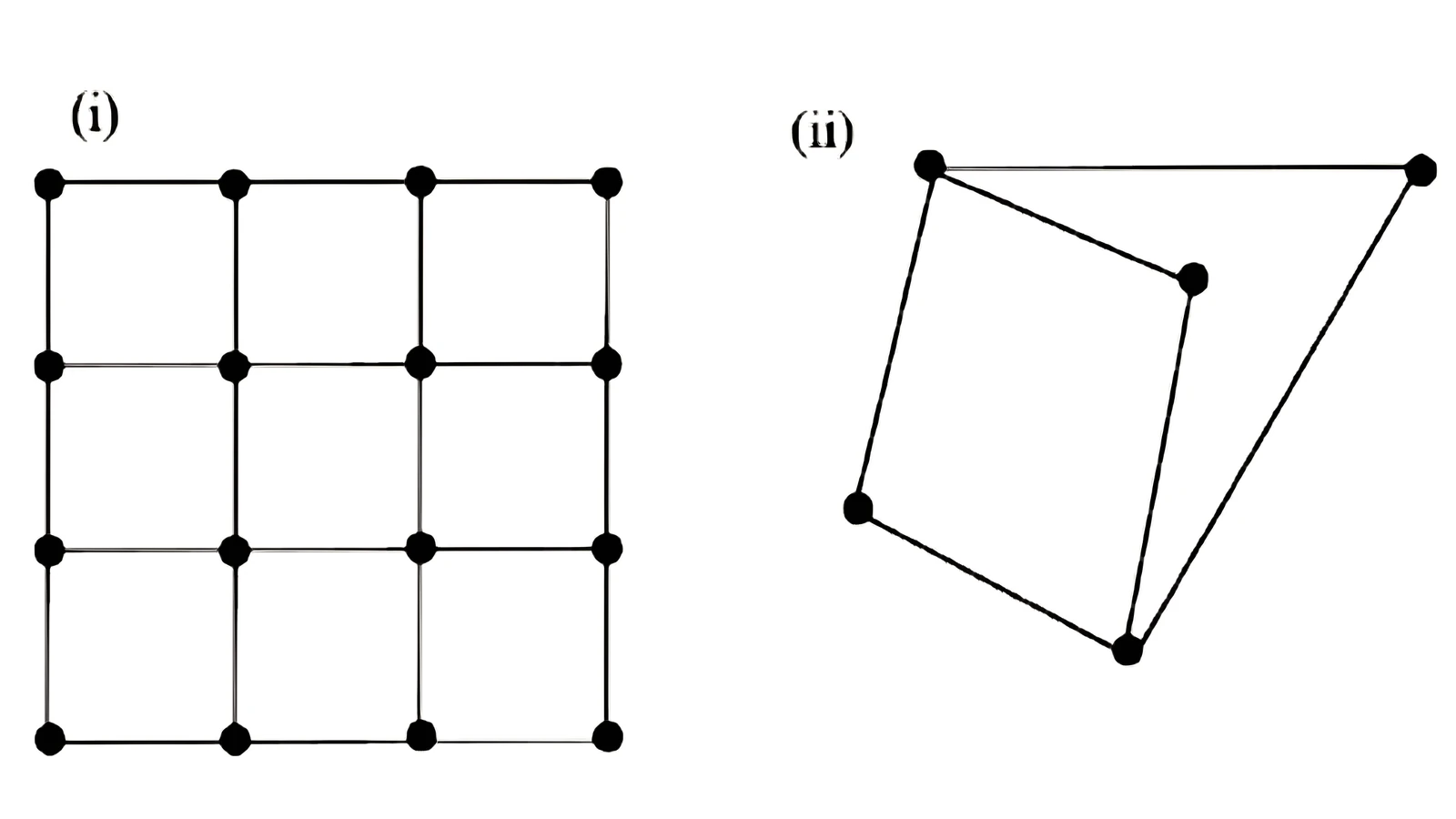
Figure for GATE 2026 CS (Set 2) question 9 (Analytical Aptitude)

  • (A)
    Such a trip is possible for (i), but not for (ii).
  • (B)
    Such a trip is possible for (ii), but not for (i).
  • (C)
    Such a trip is possible for both (i) and (ii).
  • (D)
    Such a trip is possible neither for (i) nor for (ii).

Answer (official key): A

Solution

This is a figure-dependent Hamiltonian-cycle question. The official accepted answer is Option A.

A full graph-theoretic justification can be added later if you want the final polished explanation.
Q10 · General Aptitude · MCQ · 2 marks

An unbiased six-faced dice whose faces are marked with numbers 1, 2, 3, 4, 5, and 6 is rolled twice in succession and the number on the top face is recorded each time. The probability that the sum of the two recorded numbers is a prime number is ________

  • (A)
    3/36
  • (B)
    13/36
  • (C)
    15/36
  • (D)
    19/36

Answer (official key): C

Solution

Possible prime sums are

2,3,5,7,11.2,3,5,7,11.

Counts:

  • sum 2: 1 way
  • sum 3: 2 ways
  • sum 5: 4 ways
  • sum 7: 6 ways
  • sum 11: 2 ways

Total favorable outcomes:

1+2+4+6+2=15.1+2+4+6+2=15.

Total outcomes:

6×6=36.6 \times 6=36.

So the probability is

1536.\frac{15}{36}.

Therefore, the correct answer is Option C.

Q43 · Compiler Design · MCQ · 2 marks

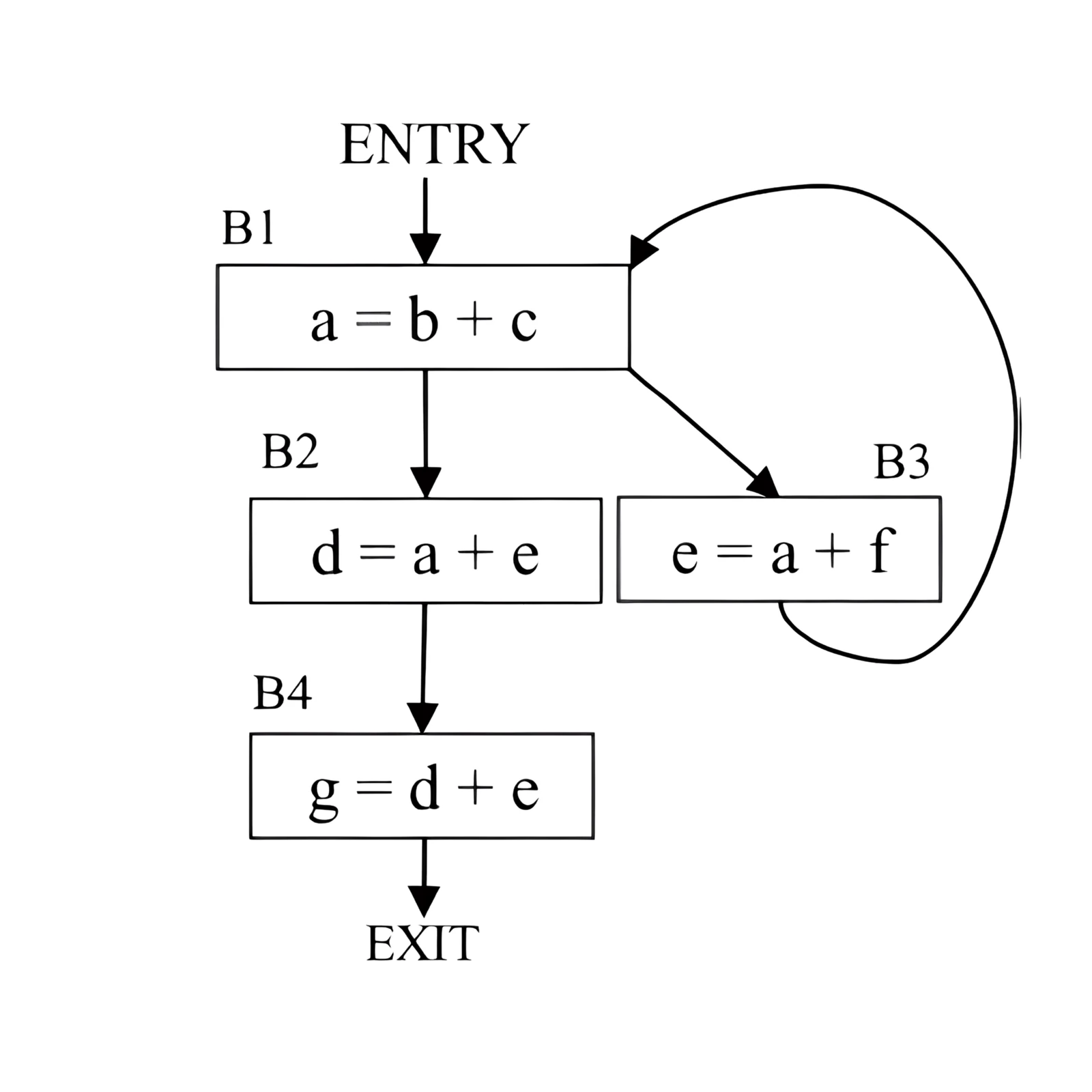
Consider the control flow graph given below.

Control Flow Graph for Q45

Which one of the following options is the set of live variables at the exit point of each basic block?

  • (A)
    B1:{a,b,c,e,f}, B2:{d,e}, B3:{b,c,e,f}, B4:∅B1:\{a,b,c,e,f\},\ B2:\{d,e\},\ B3:\{b,c,e,f\},\ B4:\emptyset
  • (B)
    B1:∅, B2:{d,e}, B3:{a,c,f}, B4:∅B1:\emptyset,\ B2:\{d,e\},\ B3:\{a,c,f\},\ B4:\emptyset
  • (C)
    B1:{a,b,c,e,f}, B2:{d,e}, B3:{c,e,f}, B4:∅B1:\{a,b,c,e,f\},\ B2:\{d,e\},\ B3:\{c,e,f\},\ B4:\emptyset
  • (D)
    B1:∅, B2:{d,e,f}, B3:{a,b,c,e,f}, B4:∅B1:\emptyset,\ B2:\{d,e,f\},\ B3:\{a,b,c,e,f\},\ B4:\emptyset

Answer (official key): A

Solution

This is a figure-dependent liveness-analysis question. The official accepted answer is Option A.

A full IN/OUT set derivation for each block can be added later if you want the complete data-flow solution.

Q44 · Theory of Computation · MSQ · 2 marks

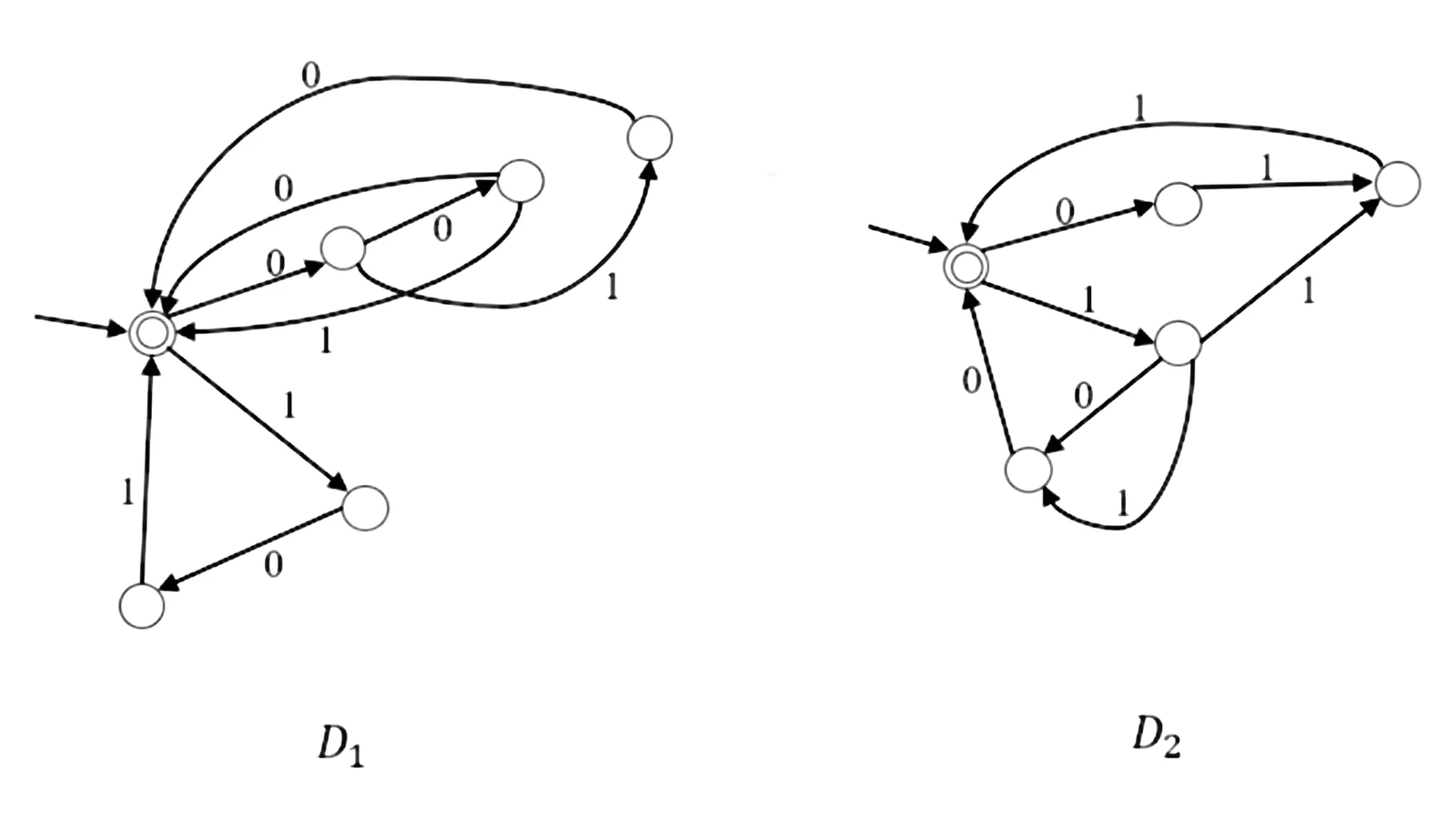
Consider the following two finite automata D1D_1 and D2D_2.

Finite Automata for Q47

Which of the following statements is/are true?

  • (A)
    L(D1)=L(D2)L(D_1) = L(D_2)
  • (B)
    L(D1)L(D_1) is a proper subset of L(D2)L(D_2)
  • (C)
    L(D1)∩L(D2)={ϵ}L(D_1) \cap L(D_2) = \{\epsilon\}
  • (D)
    (L(D1)∪L(D2))∗(L(D_1) \cup L(D_2))^* consists of all strings in {0,1}∗\{0,1\}^* whose length is divisible by 3

Answer (official key): C, D

Solution

This is a figure-dependent finite-automata language question. The official accepted answers are C and D.

A full language characterization for both automata can be added later if you want the final polished explanation.

Q51 · Computer Networks · Numerical · 2 marks

Consider a new TCP connection between a sender and a receiver. The receiver advertised window is constant at 48 KB, the maximum segment size (MSS) is 2 KB, and the slow start threshold for TCP congestion control is 16 KB. Assume that there are no timeouts or duplicate acknowledgements. The number of rounds of transmission required for the congestion control algorithm of the TCP connection to reach the congestion avoidance phase is ____________. (answer in integer)

Note: 1K = 2102^{10}

Answer (official key): 4

Solution

Initially TCP slow start begins with

cwnd=1 MSS=2 KB.\text{cwnd} = 1 \text{ MSS} = 2 \text{ KB}.

The slow start threshold is:

16 KB=8 MSS.16 \text{ KB} = 8 \text{ MSS}.

So the congestion window grows across rounds as:

  • Round 1: 1 MSS
  • Round 2: 2 MSS
  • Round 3: 4 MSS
  • Round 4: 8 MSS

At this point the threshold is reached and the algorithm enters congestion avoidance. The receiver window of 48 KB does not constrain this early growth.

Therefore, the answer is 4.

The other 60 questions are solved in your report when you take GATE 2026 CS (Set 2) as a 3-hour test.

Take GATE 2026 CS (Set 2) as a test

Official answer key

GATE 2026 CS (Set 2) answer key

All 65 answers from the official key. Numerical answers are ranges; “or” means the key accepts either answer.

Download the official GATE 2026 CS (Set 2) answer key (PDF)
QTopicTypeMarksAnswer
1Analytical AptitudeMCQ1C
2Quantitative AptitudeMCQ1A
3Verbal AptitudeMCQ1A
4Quantitative AptitudeMCQ1A
5Spatial AptitudeMCQ1C
6Verbal AptitudeMCQ2A
7Analytical AptitudeMCQ2B
8Spatial AptitudeMCQ2A
9Analytical AptitudeMCQ2A
10Quantitative AptitudeMCQ2C
11Programming and Data StructuresMCQ1C
12DatabasesMCQ1A
13Theory of ComputationMCQ1D
14Probability and StatisticsMCQ1B
15Programming and Data StructuresMCQ1A
16Computer Organization and ArchitectureMCQ1C
17Programming and Data StructuresMCQ1A
18DatabasesMCQ1C
19Digital LogicMCQ1B
20Discrete MathematicsMCQ1A
21Operating SystemMCQ1B
22CalculusMSQ1A, C
23AlgorithmsNumerical13
24Discrete MathematicsMSQ1A, B, C
25Digital LogicMSQ1B, D
26Computer NetworksMCQ1B
27AlgorithmsMSQ1A, B
28Theory of ComputationMSQ1B, C
29Computer NetworksNot in GATE 2027 syllabus: ARP, DHCP and ICMPMCQ1C
30AlgorithmsMCQ1A
31Linear AlgebraNumerical124
32Compiler DesignNumerical113
33Computer Organization and ArchitectureNumerical1-60.25
34Computer NetworksNumerical14094
35AlgorithmsNumerical13
36Digital LogicMCQ2B
37Discrete MathematicsMCQ2C
38AlgorithmsMCQ2A
39AlgorithmsMCQ2A
40AlgorithmsMCQ2A
41DatabasesMCQ2A
42Computer Organization and ArchitectureMCQ2B
43Compiler DesignMCQ2A
44Theory of ComputationMSQ2C, D
45DatabasesMCQ2D
46Programming and Data StructuresMSQ2A, B
47Compiler DesignMCQ2D
48Theory of ComputationMSQ2A, C, D
49Computer NetworksMCQ2D
50Programming and Data StructuresMSQ2A, C
51Computer NetworksNumerical24
52Linear AlgebraNumerical248
53Computer Organization and ArchitectureNumerical2128
54Programming and Data StructuresNumerical21
55Digital LogicNumerical26
56Operating SystemNumerical216417
57Probability and StatisticsNumerical20.5
58Operating SystemMSQ2A, B, C
59Programming and Data StructuresNumerical29
60Operating SystemNumerical23
61Operating SystemNumerical21536
62CalculusNumerical240
63Computer Organization and ArchitectureMSQ2A, B
64Computer NetworksNumerical230
65Computer Organization and ArchitectureNumerical22.3 to 2.4

Questions about GATE 2026 CS (Set 2)

How many questions are in the GATE 2026 CS (Set 2) paper?

65 questions for 100 marks: 10 General Aptitude questions worth 15 marks and 55 Computer Science & Information Technology questions worth 85 marks. By type, there were 35 MCQs, 11 MSQs, 19 numerical answer (NAT) questions. The paper lasted 3 hours.

Is there negative marking in GATE 2026 CS (Set 2)?

Yes, for MCQs only. A wrong MCQ answer costs one-third of its marks (−⅓ for a 1-mark question, −⅔ for a 2-mark question). MSQ and numerical (NAT) questions have no negative marking, and an MSQ earns marks only when every correct option is chosen.

Which topics carried the most marks in GATE 2026 CS (Set 2)?

Outside General Aptitude, the biggest topics were Programming and Data Structures (11 marks), Computer Organization and Architecture (10 marks), Algorithms (10 marks). The full topic-wise split is in the table on this page.

Were any GATE 2026 CS (Set 2) questions awarded marks to all?

No. Every question was graded with the answer in the official key.

Where does this GATE 2026 CS (Set 2) answer key come from?

From the official answer key published by IIT Guwahati, which organised GATE 2026. Range answers for numerical questions and questions with more than one accepted answer are kept exactly as the key gives them.

More GATE papers