GATE 2014 CS (Set 3) question paper PDF and answer key

The official GATE 2014 Computer Science & Information Technology (Set 3) paper, organised by IIT Kharagpur: 65 questions for 100 marks in 3 hours. Download the official question paper and answer key as PDFs. Below is how the marks were split by topic, the complete official answer key and 5 questions solved step by step.

Source: the official paper and answer key published by IIT Kharagpur for GATE 2014. Spotted a mistake? Email team@lemyte.com.

General Aptitude
10 · 15 marks
Computer Science & Information Technology
55 · 85 marks
MCQ / MSQ / NAT
47 / 0 / 18
Marks to all
None

Not in 2027 1 question (Q 18) is on topics removed from the GATE 2027 syllabus. They are marked in the answer key below. What changed for CS

Where the marks were

GATE 2014 CS (Set 3) topic-wise marks

Computer Science & Information Technology questions only; General Aptitude adds 15 marks on top. The top three topics carried 34 of the 85 subject marks.

TopicQuestionsMarks
Discrete Mathematics813
Programming and Data Structures812
Computer Networks69
Databases58
Calculus58
Operating System47
Algorithms46
Theory of Computation46
Digital Logic46
Computer Organization and Architecture35
Compiler Design34
Linear Algebra11

Free solved questions

5 solved questions from GATE 2014 CS (Set 3)

Question text and figures as in the official paper, the answer from the official key, and a worked solution. The other 60 solutions are in your report after you take the paper.

Q5 · General Aptitude · MCQ · 1 mark

Which number does not belong in the series below?

2, 5, 10, 17, 26, 37, 50, 642,\ 5,\ 10,\ 17,\ 26,\ 37,\ 50,\ 64
  • (A)
    17
  • (B)
    37
  • (C)
    64
  • (D)
    26

Answer (official key): C

Solution

The intended pattern is:

12+1=2,22+1=5,32+1=10,42+1=17,1^2+1=2,\quad 2^2+1=5,\quad 3^2+1=10,\quad 4^2+1=17, 52+1=26,62+1=37,72+1=50,82+1=65.5^2+1=26,\quad 6^2+1=37,\quad 7^2+1=50,\quad 8^2+1=65.

So the last term should be 65, not 64.

Therefore, the number that does not belong is 64, i.e. Option C.

Q6 · General Aptitude · MCQ · 2 marks

By the beginning of the 20th century, several hypotheses were being proposed, suggesting a paradigm shift in our understanding of the universe. However, the clinching evidence was provided by experimental measurements of the position of a star which was directly behind our sun.

Which of the following inference(s) may be drawn from the above passage?

(i) Our understanding of the universe changes based on the positions of stars.
(ii) Paradigm shifts usually occur at the beginning of centuries.
(iii) Stars are important objects in the universe.
(iv) Experimental evidence was important in confirming this paradigm shift.

  • (A)
    (i), (ii) and (iv)
  • (B)
    (iii) only
  • (C)
    (i) and (iv)
  • (D)
    (iv) only

Answer (official key): D

Solution

The passage states that experimental measurements provided the clinching evidence for the paradigm shift. It does not imply that understanding changes based on star positions in general, nor that paradigm shifts usually occur at the beginning of centuries.

Therefore, only statement (iv) can be inferred.

The correct answer is Option D.

Q12 · Algorithms · Numerical · 1 mark

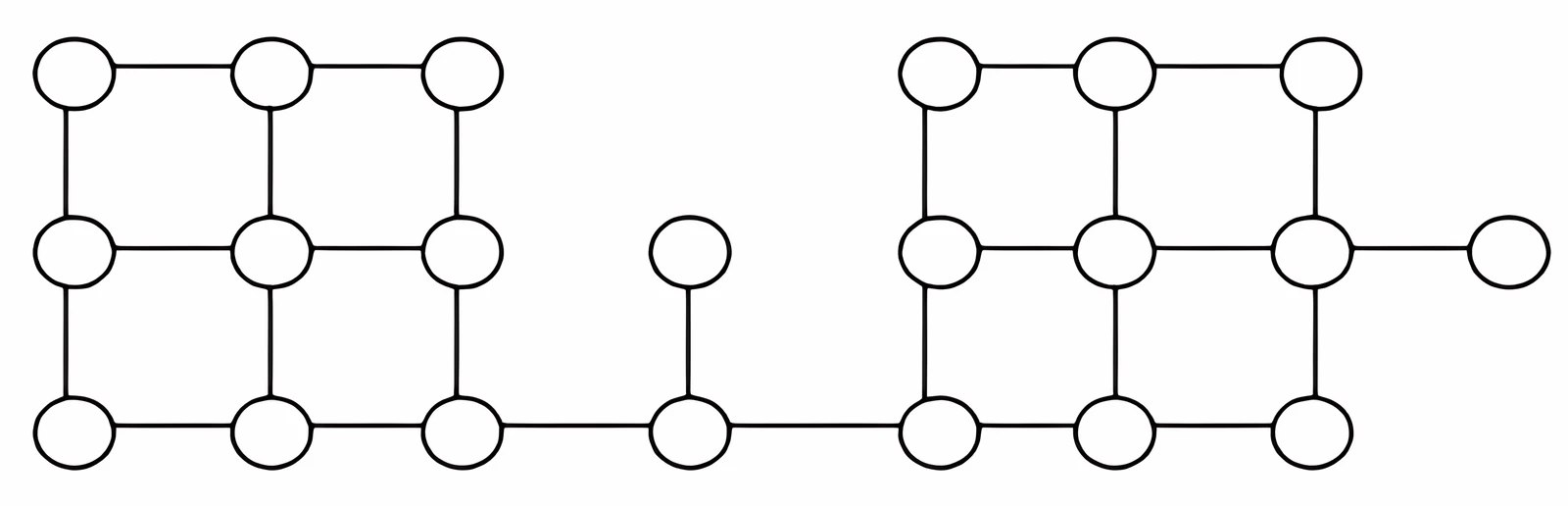
Suppose depth first search is executed on the graph below starting at some unknown vertex. Assume that a recursive call to visit a vertex is made only after first checking that the vertex has not been visited earlier.

DFS graph for CS Q13

Then the maximum possible recursion depth, including the initial call, is __________.

Answer (official key): 19

Solution

This is a figure-dependent DFS recursion-depth question. The maximum possible recursion depth for the given graph is 19.

Therefore, the answer is 19.

Q59 · Algorithms · MCQ · 2 marks

Consider the decision problem 2CNFSAT defined as follows:

{Φ∣Φ is a satisfiable propositional formula in CNF with at most two literals per clause}\{\Phi \mid \Phi \text{ is a satisfiable propositional formula in CNF with at most two literals per clause}\}

For example,

Φ=(x1∨x2)∧(x1∨x3‾)∧(x2∨x4)\Phi=(x_1\lor x_2)\land(x_1\lor \overline{x_3})\land(x_2\lor x_4)

is a Boolean formula and it is in 2CNFSAT.

The decision problem 2CNFSAT is:

  • (A)
    NP-Complete.
  • (B)
    solvable in polynomial time by reduction to directed graph reachability.
  • (C)
    solvable in constant time since any input instance is satisfiable.
  • (D)
    NP-hard, but not NP-complete.

Answer (official key): B

Solution

2-SAT can be solved in polynomial time by constructing the implication graph and checking reachability / strongly connected components.

Therefore, 2CNFSAT is solvable in polynomial time.

The correct answer is Option B.

Q62 · Algorithms · Numerical · 2 marks

Suppose you want to move from 0 to 100 on the number line. In each step, you either move right by a unit distance or you take a shortcut. A shortcut is simply a pre-specified pair of integers i,ji,j with i<ji<j. Given a shortcut i,ji,j, if you are at position ii on the number line, you may directly move to jj.

Suppose T(k)T(k) denotes the smallest number of steps needed to move from kk to 100. Suppose further that there is at most one shortcut involving any number, and in particular from 9 there is a shortcut to 15. Let yy and zz be such that

T(9)=1+min⁡(T(y),T(z)).T(9)=1+\min(T(y),T(z)).

Then the value of the product yzyz is __________.

(Answer in integer)

Answer (official key): 150

Solution

From position 9, there are two possible moves:

  • move right by one unit to 10
  • take the shortcut from 9 to 15

So:

T(9)=1+min⁡(T(10),T(15)).T(9)=1+\min(T(10),T(15)).

Hence:

y=10,z=15.y=10,\quad z=15.

Therefore:

yz=10×15=150.yz=10\times15=150.

The answer is 150.

The other 60 questions are solved in your report when you take GATE 2014 CS (Set 3) as a 3-hour test.

Take GATE 2014 CS (Set 3) as a test

Official answer key

GATE 2014 CS (Set 3) answer key

All 65 answers from the official key. Numerical answers are ranges; “or” means the key accepts either answer.

Download the official GATE 2014 CS (Set 3) answer key (PDF)
QTopicTypeMarksAnswer
1Verbal AptitudeMCQ1C
2Quantitative AptitudeMCQ1C
3Verbal AptitudeMCQ1D
4Verbal AptitudeMCQ1C
5Analytical AptitudeMCQ1C
6Analytical AptitudeMCQ2D
7Quantitative AptitudeMCQ2D
8Quantitative AptitudeMCQ2C
9Analytical AptitudeMCQ2B
10Quantitative AptitudeMCQ2C
11Programming and Data StructuresNumerical17
12AlgorithmsNumerical119
13Compiler DesignMCQ1D
14Computer NetworksMCQ1D
15DatabasesMCQ1A
16Theory of ComputationNumerical13
17Theory of ComputationMCQ1C
18Computer NetworksNot in GATE 2027 syllabus: Framing (data link layer)MCQ1B
19Compiler DesignMCQ1C
20Computer Organization and ArchitectureMCQ1C
21Discrete MathematicsMCQ1D
22Discrete MathematicsMCQ1D
23Computer NetworksMCQ1B
24CalculusNumerical12
25Operating SystemNumerical16
26DatabasesMCQ1B
27Digital LogicMCQ1C
28Programming and Data StructuresMCQ1A
29Linear AlgebraMCQ1A
30Programming and Data StructuresMCQ1A
31Discrete MathematicsNumerical15
32CalculusNumerical14
33AlgorithmsMCQ1A
34Programming and Data StructuresMCQ1B
35Digital LogicMCQ1B
36DatabasesMCQ2D
37Theory of ComputationMCQ2A
38Computer NetworksNumerical21
39Discrete MathematicsMCQ2A
40Operating SystemNumerical2122
41Computer Organization and ArchitectureNumerical21.68
42Programming and Data StructuresMCQ2A
43Programming and Data StructuresNumerical2110
44DatabasesMCQ2A
45Digital LogicMCQ2D
46Discrete MathematicsMCQ2C
47Digital LogicMCQ2C
48Operating SystemNumerical25.5
49Programming and Data StructuresMCQ2B
50Theory of ComputationMCQ2C
51Computer NetworksMCQ2A
52CalculusNumerical20.25
53Discrete MathematicsMCQ2D
54Compiler DesignMCQ2A
55Computer Organization and ArchitectureNumerical21.5 to 1.6
56CalculusMCQ2A
57Discrete MathematicsNumerical24
58Computer NetworksNumerical2256
59AlgorithmsMCQ2B
60DatabasesMCQ2D
61CalculusMCQ2C
62AlgorithmsNumerical2150
63Programming and Data StructuresMCQ2D
64Discrete MathematicsMCQ2B
65Operating SystemNumerical27

Questions about GATE 2014 CS (Set 3)

How many questions are in the GATE 2014 CS (Set 3) paper?

65 questions for 100 marks: 10 General Aptitude questions worth 15 marks and 55 Computer Science & Information Technology questions worth 85 marks. By type, there were 47 MCQs, 18 numerical answer (NAT) questions. The paper lasted 3 hours.

Is there negative marking in GATE 2014 CS (Set 3)?

Yes, for MCQs only. A wrong MCQ answer costs one-third of its marks (−⅓ for a 1-mark question, −⅔ for a 2-mark question). MSQ and numerical (NAT) questions have no negative marking, and an MSQ earns marks only when every correct option is chosen.

Which topics carried the most marks in GATE 2014 CS (Set 3)?

Outside General Aptitude, the biggest topics were Discrete Mathematics (13 marks), Programming and Data Structures (12 marks), Computer Networks (9 marks). The full topic-wise split is in the table on this page.

Were any GATE 2014 CS (Set 3) questions awarded marks to all?

No. Every question was graded with the answer in the official key.

Where does this GATE 2014 CS (Set 3) answer key come from?

From the official answer key published by IIT Kharagpur, which organised GATE 2014. Range answers for numerical questions and questions with more than one accepted answer are kept exactly as the key gives them.

More GATE papers