
GATE 2016 CS (Set 2) question paper PDF and answer key

The official GATE 2016 Computer Science & Information Technology (Set 2) paper, organised by IISc Bengaluru: 65 questions for 100 marks in 3 hours. Download the official question paper and answer key as PDFs. Below is how the marks were split by topic, the complete official answer key and 5 questions solved step by step.

Source: the official paper and answer key published by IISc Bengaluru for GATE 2016. Spotted a mistake? Email team@lemyte.com.

General Aptitude
10 · 15 marks
Computer Science & Information Technology
55 · 85 marks
MCQ / MSQ / NAT
38 / 0 / 27
Marks to all
None

Where the marks were

GATE 2016 CS (Set 2) topic-wise marks

Computer Science & Information Technology questions only; General Aptitude adds 15 marks on top. The top three topics carried 33 of the 85 subject marks.

TopicQuestionsMarks
Programming and Data Structures712
Computer Organization and Architecture711
Discrete Mathematics610
Theory of Computation69
Computer Networks69
Algorithms69
Operating System59
Databases46
Compiler Design35
Linear Algebra22
Calculus11
Digital Logic11
Probability and Statistics11

Free solved questions

5 solved questions from GATE 2016 CS (Set 2)

Question text and figures as in the official paper, the answer from the official key, and a worked solution. The other 60 solutions are in your report after you take the paper.

Q6 · General Aptitude · MCQ · 2 marks

Among 150 faculty members in an institute, 55 are connected with each other through Facebook and 85 are connected through WhatsApp. 30 faculty members do not have Facebook or WhatsApp accounts.

The number of faculty members connected only through Facebook accounts is ______________.

  • (A)
    35
  • (B)
    45
  • (C)
    65
  • (D)
    90

Answer (official key): A

Solution

Total faculty members:

150.150.

Faculty members with neither Facebook nor WhatsApp:

30.30.

So faculty members having at least one of the two accounts:

150−30=120.150-30=120.

Let FF be Facebook users and WW be WhatsApp users.

Given:

∣F∣=55,∣W∣=85,∣F∪W∣=120.|F|=55,\quad |W|=85,\quad |F\cup W|=120.

Using inclusion-exclusion:

∣F∩W∣=∣F∣+∣W∣−∣F∪W∣=55+85−120=20.|F\cap W|=|F|+|W|-|F\cup W| = 55+85-120 = 20.

Only Facebook users:

∣F∣−∣F∩W∣=55−20=35.|F|-|F\cap W| = 55-20 = 35.

Therefore, the correct answer is Option A.
Q7 · General Aptitude · MCQ · 2 marks

Computers were invented for performing only high-end useful computations. However, it is no understatement that they have taken over our world today. The internet, for example, is ubiquitous. Many believe that the internet itself is an unintended consequence of the original invention. With the advent of mobile computing on our phones, a whole new dimension is now enabled. One is left wondering if all these developments are good or, more importantly, required.

Which of the statement(s) below is/are logically valid and can be inferred from the above paragraph?

(i) The author believes that computers are not good for us.
(ii) Mobile computers and the internet are both intended inventions.

  • (A)
    (i) only
  • (B)
    (ii) only
  • (C)
    both (i) and (ii)
  • (D)
    neither (i) nor (ii)

Answer (official key): D

Solution

The paragraph says that one may wonder whether all these developments are good or required. It does not state that the author believes computers are not good for us.

It also says that many believe the internet was an unintended consequence of the original invention. So statement (ii), which says that mobile computers and the internet are both intended inventions, cannot be inferred.

Therefore, neither statement follows logically.

The correct answer is Option D.

Q50 · Algorithms · Numerical · 2 marks

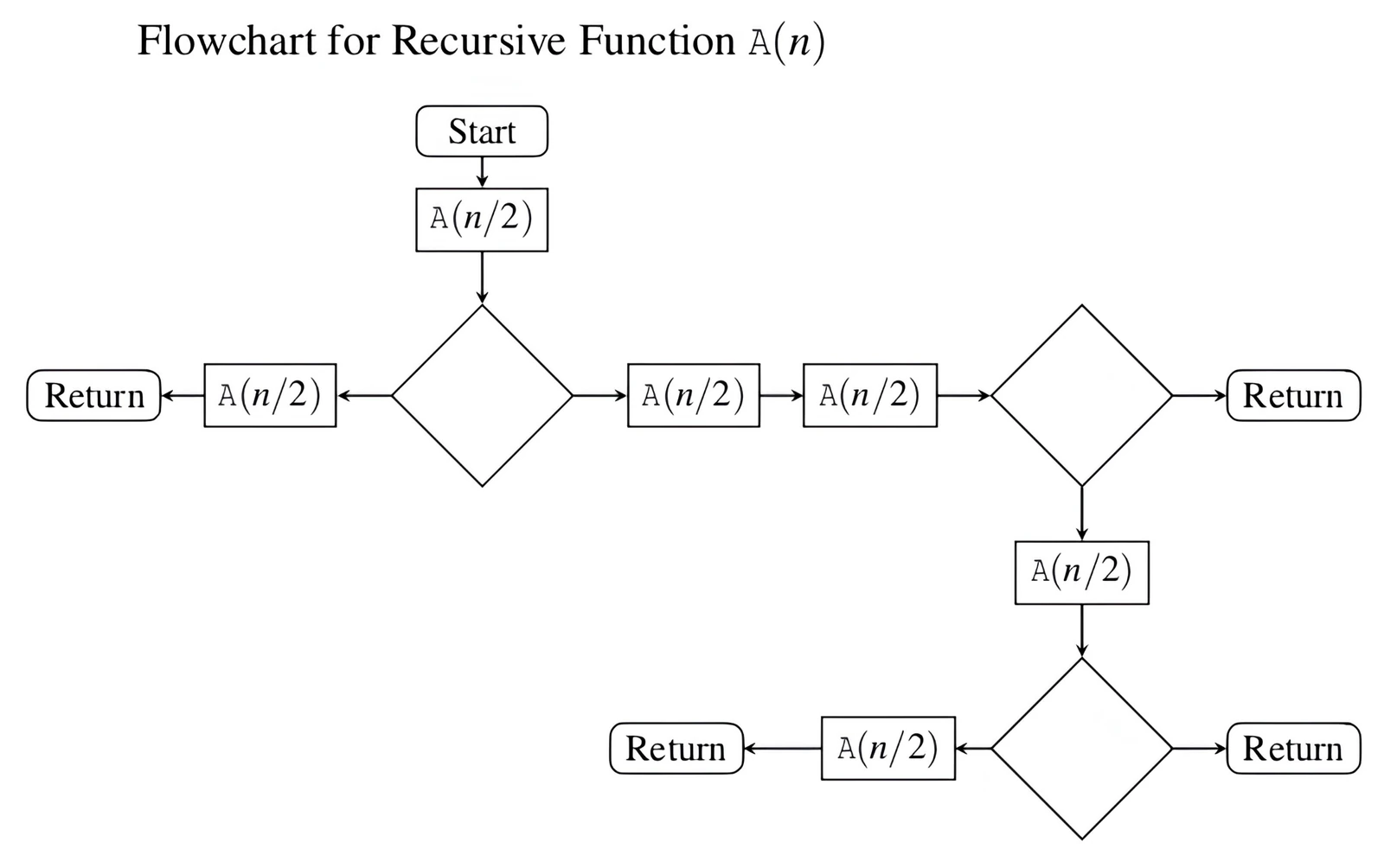
The given diagram shows the flowchart for a recursive function A(n)A(n).

Assume that all statements, except for the recursive calls, have O(1)O(1) time complexity.

Flowchart for recursive function A(n)

If the worst-case time complexity of this function is O(nα)O(n^\alpha), then the least possible value of α\alpha, accurate up to two decimal places, is __________.

Answer (official key): 2.2 to 2.4

Solution

From the flowchart, in the worst case the function makes five recursive calls on input size:

n2.\frac{n}{2}.

Therefore, the recurrence is:

T(n)=5T(n/2)+O(1).T(n)=5T(n/2)+O(1).

By the Master Theorem:

T(n)=O(nlog⁡25).T(n)=O(n^{\log_2 5}).

So,

α=log⁡25≈2.3219.\alpha=\log_2 5\approx 2.3219.

Rounded to two decimal places:

α≈2.32.\alpha\approx 2.32.

The accepted range is 2.2 to 2.4.

Q61 · Operating System · Numerical · 2 marks

Consider a non-negative counting semaphore SS.

The operation P(S)P(S) decrements SS, and V(S)V(S) increments SS.

During an execution, 20 P(S)P(S) operations and 12 V(S)V(S) operations are issued in some order.

The largest initial value of SS for which at least one P(S)P(S) operation will remain blocked is __________.

Answer (official key): 7

Solution

There are:

2020

decrement operations and:

1212

increment operations.

If the initial value of the semaphore is S0S_0, then the total number of successful P(S)P(S) operations that can be supported over the whole execution is:

S0+12.S_0+12.

For at least one of the 20 P(S)P(S) operations to remain blocked, we need:

S0+12<20.S_0+12 < 20.

So:

S0<8.S_0 < 8.

The largest integer value satisfying this is:

S0=7.S_0=7.

Therefore, the answer is 7.

Q62 · Databases · Numerical · 2 marks

Consider the following database table named water_schemes.

scheme_nodistrict_namecapacity
1Ajmer20
1Bikaner10
2Bikaner10
3Bikaner20
1Churu10
2Churu20
1Dungargarh10

The number of tuples returned by the following SQL query is __________.

WITH total(name, capacity) AS (
  SELECT district_name, SUM(capacity)
  FROM water_schemes
  GROUP BY district_name
),
total_avg(capacity) AS (
  SELECT AVG(capacity)
  FROM total
)
SELECT name
FROM total, total_avg
WHERE total.capacity >= total_avg.capacity;

Answer (official key): 2

Solution

First compute total capacity for each district:

district_nametotal capacity
Ajmer20
Bikaner40
Churu30
Dungargarh10

Average of these totals:

20+40+30+104=25.\frac{20+40+30+10}{4} = 25.

The query returns districts whose total capacity is at least 25.

These are:

  • Bikaner: 40
  • Churu: 30

So the number of tuples returned is:

2.2.

Therefore, the answer is 2.

The other 60 questions are solved in your report when you take GATE 2016 CS (Set 2) as a 3-hour test.

Take GATE 2016 CS (Set 2) as a test

Official answer key

GATE 2016 CS (Set 2) answer key

All 65 answers from the official key. Numerical answers are ranges; “or” means the key accepts either answer.

Download the official GATE 2016 CS (Set 2) answer key (PDF)
QTopicTypeMarksAnswer
1Quantitative AptitudeMCQ1B
2Verbal AptitudeMCQ1B
3Verbal AptitudeMCQ1A
4Verbal AptitudeMCQ1C
5Analytical AptitudeMCQ1D
6Quantitative AptitudeMCQ2A
7Verbal AptitudeMCQ2D
8Spatial AptitudeMCQ2C
9Quantitative AptitudeMCQ2C
10Analytical AptitudeMCQ2D
11Theory of ComputationMCQ1D
12Linear AlgebraNumerical10.124 to 0.126
13Computer NetworksMCQ1C
14DatabasesMCQ1A
15Programming and Data StructuresMCQ1C
16Computer Organization and ArchitectureNumerical1-1
17Computer NetworksMCQ1D
18CalculusNumerical19
19AlgorithmsNumerical131
20Digital LogicMCQ1C
21Theory of ComputationMCQ1C
22AlgorithmsMCQ1C
23Computer Organization and ArchitectureNumerical116
24Computer NetworksMCQ1A
25DatabasesMCQ1A
26Computer Organization and ArchitectureNumerical11
27Linear AlgebraMCQ1C
28Discrete MathematicsNumerical14
29Discrete MathematicsNumerical14
30Programming and Data StructuresNumerical130
31Theory of ComputationNumerical12
32AlgorithmsMCQ1D
33Probability and StatisticsNumerical10.55
34Operating SystemMCQ1D
35Compiler DesignMCQ1B
36Computer Organization and ArchitectureNumerical2500
37Discrete MathematicsMCQ2B
38AlgorithmsMCQ2B
39Programming and Data StructuresNumerical23
40Programming and Data StructuresMCQ2C
41Programming and Data StructuresNumerical28
42Theory of ComputationMCQ2B
43Computer Organization and ArchitectureNumerical228
44Discrete MathematicsMCQ2B
45Discrete MathematicsMCQ2D
46Computer Organization and ArchitectureNumerical224
47Programming and Data StructuresMCQ2C
48Programming and Data StructuresNumerical264
49AlgorithmsNumerical21500
50AlgorithmsNumerical22.2 to 2.4
51Discrete MathematicsNumerical24
52Computer Organization and ArchitectureNumerical23.9 to 4.1
53Operating SystemMCQ2C
54Operating SystemNumerical230
55Computer NetworksNumerical2200
56Theory of ComputationMCQ2C
57Computer NetworksNumerical24
58Compiler DesignMCQ2A
59Computer NetworksMCQ2B
60DatabasesMCQ2C
61Operating SystemNumerical27
62DatabasesNumerical22
63Theory of ComputationMCQ2B
64Operating SystemNumerical28.2 to 8.3
65Compiler DesignMCQ2B

Questions about GATE 2016 CS (Set 2)

How many questions are in the GATE 2016 CS (Set 2) paper?

65 questions for 100 marks: 10 General Aptitude questions worth 15 marks and 55 Computer Science & Information Technology questions worth 85 marks. By type, there were 38 MCQs, 27 numerical answer (NAT) questions. The paper lasted 3 hours.

Is there negative marking in GATE 2016 CS (Set 2)?

Yes, for MCQs only. A wrong MCQ answer costs one-third of its marks (−⅓ for a 1-mark question, −⅔ for a 2-mark question). MSQ and numerical (NAT) questions have no negative marking, and an MSQ earns marks only when every correct option is chosen.

Which topics carried the most marks in GATE 2016 CS (Set 2)?

Outside General Aptitude, the biggest topics were Programming and Data Structures (12 marks), Computer Organization and Architecture (11 marks), Discrete Mathematics (10 marks). The full topic-wise split is in the table on this page.

Were any GATE 2016 CS (Set 2) questions awarded marks to all?

No. Every question was graded with the answer in the official key.

Where does this GATE 2016 CS (Set 2) answer key come from?

From the official answer key published by IISc Bengaluru, which organised GATE 2016. Range answers for numerical questions and questions with more than one accepted answer are kept exactly as the key gives them.

More GATE papers