
GATE 2015 CS (Set 2) question paper PDF and answer key

The official GATE 2015 Computer Science & Information Technology (Set 2) paper, organised by IIT Kanpur: 65 questions for 100 marks in 3 hours. Download the official question paper and answer key as PDFs. Below is how the marks were split by topic, the complete official answer key and 5 questions solved step by step.

Source: the official paper and answer key published by IIT Kanpur for GATE 2015. Spotted a mistake? Email team@lemyte.com.

General Aptitude
10 · 15 marks
Computer Science & Information Technology
55 · 85 marks
MCQ / MSQ / NAT
43 / 0 / 22
Marks to all
None

Not in 2027 1 question (Q 38) is on topics removed from the GATE 2027 syllabus. They are marked in the answer key below. What changed for CS

Where the marks were

GATE 2015 CS (Set 2) topic-wise marks

Computer Science & Information Technology questions only; General Aptitude adds 15 marks on top. The top three topics carried 36 of the 85 subject marks.

TopicQuestionsMarks
Programming and Data Structures1115
Discrete Mathematics812
Computer Networks69
Theory of Computation58
Operating System47
Databases46
Computer Organization and Architecture46
Digital Logic35
Compiler Design34
Algorithms24
Calculus24
Linear Algebra23
Probability and Statistics12

Free solved questions

5 solved questions from GATE 2015 CS (Set 2)

Question text and figures as in the official paper, the answer from the official key, and a worked solution. The other 60 solutions are in your report after you take the paper.

Q5 · General Aptitude · MCQ · 1 mark

Based on the given statements, select the most appropriate option to solve the given question.

What will be the total weight of 10 poles each of same weight?

Statements:

I. One fourth of the weight of a pole is 5 kg.
II. The total weight of these poles is 160 kg more than the total weight of two poles.

  • (A)
    Statement I alone is not sufficient.
  • (B)
    Statement II alone is not sufficient.
  • (C)
    Either I or II alone is sufficient.
  • (D)
    Both statements I and II together are not sufficient.

Answer (official key): C

Solution

Let the weight of one pole be ww kg.

From Statement I:

w4=5⇒w=20.\frac{w}{4}=5 \Rightarrow w=20.

So the total weight of 10 poles is:

10w=200.10w=200.

Thus, Statement I alone is sufficient.

From Statement II:

The total weight of 10 poles is 160 kg more than the total weight of 2 poles:

10w=2w+160.10w = 2w + 160.

So,

8w=160⇒w=20.8w=160 \Rightarrow w=20.

Again, total weight is:

10w=200.10w=200.

Thus, Statement II alone is also sufficient.

Therefore, either I or II alone is sufficient.

The correct answer is Option C.
Q6 · General Aptitude · MCQ · 2 marks

Out of the following four sentences, select the most suitable sentence with respect to grammar and usage.

  • (A)
    Since the report lacked needed information, it was of no use to them.
  • (B)
    The report was useless to them because there were no needed information in it.
  • (C)
    Since the report did not contain the needed information, it was not real useful to them.
  • (D)
    Since the report lacked needed information, it would not had been useful to them.

Answer (official key): A

Solution

Option A is grammatically correct and natural.

Option B is incorrect because information is uncountable, so there were no information is wrong.

Option C is incorrect because real useful should be really useful.

Option D is incorrect because would not had been should be would not have been.

Therefore, the correct answer is Option A.

Q22 · Databases · Numerical · 1 mark

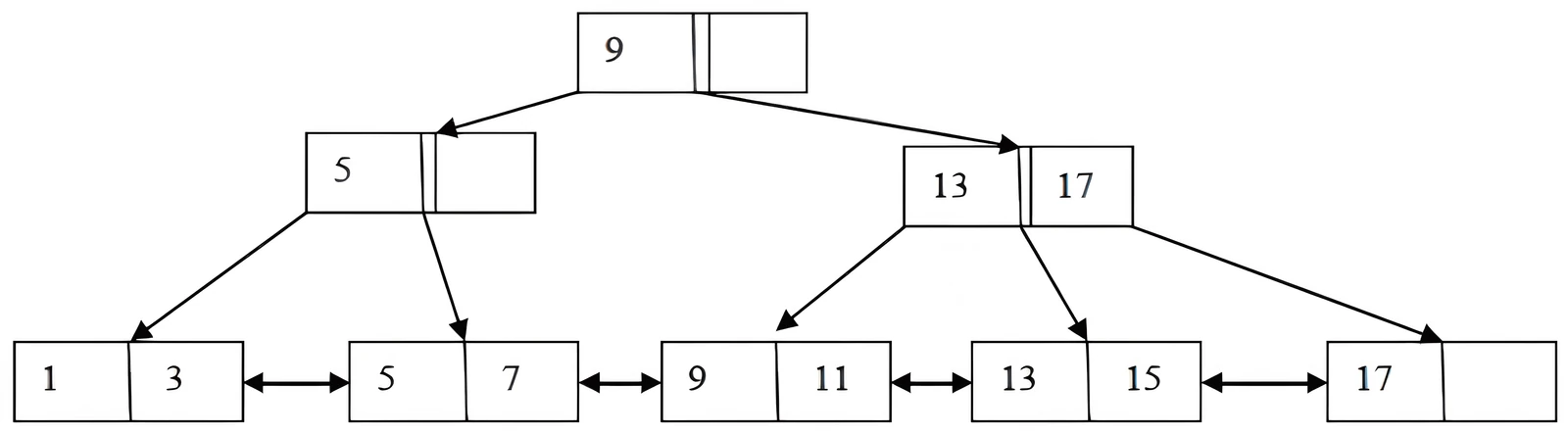
With reference to the B+ tree index of order 1 shown below, the minimum number of nodes, including the root node, that must be fetched in order to satisfy the following query is __________.

Query: Get all records with a search key greater than or equal to 7 and less than 15.

B+ tree for Q32

Answer (official key): 5

Solution

To answer the range query:

7≤key<15,7 \le key < 15,

we first traverse from the root to the leaf containing 7.

The required nodes are:

  1. Root node.
  2. Internal node on the search path.
  3. Leaf node containing keys 5 and 7.
  4. Next leaf node containing keys 9 and 11.
  5. Next leaf node containing keys 13 and 15.

The search stops before including key 15, but the leaf containing 13 and 15 must still be fetched to know the range boundary.

Therefore, the minimum number of nodes fetched is 5.

Q44 · Programming and Data Structures · Numerical · 2 marks

A Young tableau is a 2D array of integers increasing from left to right and from top to bottom.

Any unfilled entries are marked with ∞\infty, and hence there cannot be any entry to the right of, or below, an ∞\infty.

The following Young tableau consists of unique entries.

12514
34623
10121825
31∞\infty∞\infty∞\infty

When an element is removed from a Young tableau, other elements should be moved into its place so that the resulting table is still a Young tableau.

The minimum number of entries, other than 1, to be shifted to remove 1 from the given Young tableau is __________.

Answer (official key): 5

Solution

After removing 1, the empty position is repaired by repeatedly moving the smaller of the right and lower neighbours into the empty cell.

Start at the top-left cell.

  1. Compare 2 and 3. Move 2.
  2. Compare 5 and 4. Move 4.
  3. Compare 6 and 12. Move 6.
  4. Compare 23 and 18. Move 18.
  5. Compare 25 and ∞\infty. Move 25.

Then the empty cell reaches a position that can be filled with ∞\infty.

So the number of shifted entries, other than 1, is:

5.5.

Therefore, the answer is 5.

Q45 · Databases · MCQ · 2 marks

Consider two relations R1(A,B)R_1(A,B) with tuples (1,5),(3,7)(1,5),(3,7) and R2(A,C)=(1,7),(4,9)R_2(A,C)=(1,7),(4,9).

Assume that R(A,B,C)R(A,B,C) is the full natural outer join of R1R_1 and R2R_2.

Consider the following tuples of the form (A,B,C)(A,B,C):

a=(1,5,null),b=(1,null,7),c=(3,null,9),a=(1,5,null),\quad b=(1,null,7),\quad c=(3,null,9), d=(4,7,null),e=(1,5,7),f=(3,7,null),g=(4,null,9).d=(4,7,null),\quad e=(1,5,7),\quad f=(3,7,null),\quad g=(4,null,9).

Which one of the following statements is correct?

  • (A)
    RR contains a,b,e,f,ga,b,e,f,g but not c,dc,d.
  • (B)
    RR contains all of a,b,c,d,e,f,ga,b,c,d,e,f,g.
  • (C)
    RR contains e,f,ge,f,g but not a,ba,b.
  • (D)
    RR contains ee but not f,gf,g.

Answer (official key): C

Solution

The natural join is on the common attribute AA.

For A=1A=1, both relations have a matching tuple:

(1,5)∈R1,(1,7)∈R2.(1,5)\in R_1,\quad (1,7)\in R_2.

So the joined tuple is:

(1,5,7)=e.(1,5,7)=e.

For A=3A=3, R1R_1 has a tuple but R2R_2 does not, so full outer join gives:

(3,7,null)=f.(3,7,null)=f.

For A=4A=4, R2R_2 has a tuple but R1R_1 does not, so full outer join gives:

(4,null,9)=g.(4,null,9)=g.

Therefore, RR contains e,f,ge,f,g but not a,ba,b.

The correct answer is Option C.

The other 60 questions are solved in your report when you take GATE 2015 CS (Set 2) as a 3-hour test.

Take GATE 2015 CS (Set 2) as a test

Official answer key

GATE 2015 CS (Set 2) answer key

All 65 answers from the official key. Numerical answers are ranges; “or” means the key accepts either answer.

Download the official GATE 2015 CS (Set 2) answer key (PDF)
QTopicTypeMarksAnswer
1Verbal AptitudeMCQ1C
2Verbal AptitudeMCQ1C
3Quantitative AptitudeMCQ1C
4Verbal AptitudeMCQ1D
5Analytical AptitudeMCQ1C
6Verbal AptitudeMCQ2A
7Quantitative AptitudeMCQ2B
8Spatial AptitudeMCQ2A
9Analytical AptitudeNumerical28
10Quantitative AptitudeMCQ2B
11Compiler DesignMCQ1C
12Computer NetworksMCQ1B
13Linear AlgebraNumerical16
14Discrete MathematicsNumerical12048
15Discrete MathematicsMCQ1C
16Programming and Data StructuresNumerical119
17Discrete MathematicsNumerical136
18Computer NetworksNumerical112
19Operating SystemMCQ1D
20Compiler DesignMCQ1C
21Programming and Data StructuresMCQ1C
22DatabasesNumerical15
23Programming and Data StructuresNumerical151
24Theory of ComputationMCQ1D
25Theory of ComputationMCQ1A
26Digital LogicNumerical13
27Computer NetworksMCQ1A
28Programming and Data StructuresMCQ1D
29Computer Organization and ArchitectureNumerical114
30DatabasesMCQ1B
31Computer Organization and ArchitectureNumerical122
32Programming and Data StructuresMCQ1D
33Programming and Data StructuresMCQ1A
34Programming and Data StructuresMCQ1A
35Discrete MathematicsMCQ1D
36Theory of ComputationNumerical23
37Operating SystemNumerical236
38Operating SystemNot in GATE 2027 syllabus: Secondary storage (magnetic disk)Numerical26.1 to 6.2
39Computer NetworksMCQ2C
40Compiler DesignMCQ2B
41Theory of ComputationMCQ2A
42Computer NetworksMCQ2C
43DatabasesMCQ2A
44Programming and Data StructuresNumerical25
45DatabasesMCQ2C
46Computer NetworksMCQ2A
47AlgorithmsMCQ2C
48Operating SystemMCQ2A
49Programming and Data StructuresMCQ2B
50AlgorithmsMCQ2B
51Computer Organization and ArchitectureMCQ2D
52Digital LogicNumerical219.2
53Probability and StatisticsNumerical20.95
54Theory of ComputationMCQ2C
55CalculusMCQ2C
56Linear AlgebraNumerical20
57Digital LogicNumerical21
58Programming and Data StructuresNumerical215
59CalculusMCQ2C
60Discrete MathematicsMCQ2D
61Discrete MathematicsMCQ2C
62Programming and Data StructuresMCQ2C
63Discrete MathematicsNumerical236
64Computer Organization and ArchitectureNumerical213
65Discrete MathematicsMCQ2B

Questions about GATE 2015 CS (Set 2)

How many questions are in the GATE 2015 CS (Set 2) paper?

65 questions for 100 marks: 10 General Aptitude questions worth 15 marks and 55 Computer Science & Information Technology questions worth 85 marks. By type, there were 43 MCQs, 22 numerical answer (NAT) questions. The paper lasted 3 hours.

Is there negative marking in GATE 2015 CS (Set 2)?

Yes, for MCQs only. A wrong MCQ answer costs one-third of its marks (−⅓ for a 1-mark question, −⅔ for a 2-mark question). MSQ and numerical (NAT) questions have no negative marking, and an MSQ earns marks only when every correct option is chosen.

Which topics carried the most marks in GATE 2015 CS (Set 2)?

Outside General Aptitude, the biggest topics were Programming and Data Structures (15 marks), Discrete Mathematics (12 marks), Computer Networks (9 marks). The full topic-wise split is in the table on this page.

Were any GATE 2015 CS (Set 2) questions awarded marks to all?

No. Every question was graded with the answer in the official key.

Where does this GATE 2015 CS (Set 2) answer key come from?

From the official answer key published by IIT Kanpur, which organised GATE 2015. Range answers for numerical questions and questions with more than one accepted answer are kept exactly as the key gives them.

More GATE papers