
GATE 2015 CS (Set 1) question paper PDF and answer key

The official GATE 2015 Computer Science & Information Technology (Set 1) paper, organised by IIT Kanpur: 65 questions for 100 marks in 3 hours. Download the official question paper and answer key as PDFs. Below is how the marks were split by topic, the complete official answer key and 5 questions solved step by step.

Source: the official paper and answer key published by IIT Kanpur for GATE 2015. Spotted a mistake? Email team@lemyte.com.

General Aptitude
10 · 15 marks
Computer Science & Information Technology
55 · 85 marks
MCQ / MSQ / NAT
45 / 0 / 20
Marks to all
None

Not in 2027 2 questions (Q 35, 52) are on topics removed from the GATE 2027 syllabus. They are marked in the answer key below. What changed for CS

Where the marks were

GATE 2015 CS (Set 1) topic-wise marks

Computer Science & Information Technology questions only; General Aptitude adds 15 marks on top. The top three topics carried 35 of the 85 subject marks.

TopicQuestionsMarks
Programming and Data Structures1015
Operating System610
Discrete Mathematics610
Computer Networks79
Algorithms58
Databases46
Calculus46
Compiler Design35
Theory of Computation35
Digital Logic35
Computer Organization and Architecture23
Linear Algebra23

Free solved questions

5 solved questions from GATE 2015 CS (Set 1)

Question text and figures as in the official paper, the answer from the official key, and a worked solution. The other 60 solutions are in your report after you take the paper.

Q5 · General Aptitude · MCQ · 1 mark

Didn't you buy __________ when you went shopping?

  • (A)
    any paper
  • (B)
    much paper
  • (C)
    no paper
  • (D)
    a few paper

Answer (official key): A

Solution

In negative and interrogative sentences, any is the natural determiner.

The sentence becomes:

Didn't you buy any paper when you went shopping?

Therefore, the correct answer is Option A.
Q6 · General Aptitude · MCQ · 2 marks

The given statement is followed by some courses of action. Assuming the statement to be true, decide the correct option.

Statement:

There has been a significant drop in the water level in the lakes supplying water to the city.

Courses of action:

I. The water supply authority should impose a partial cut in supply to tackle the situation.
II. The government should appeal to all the residents through mass media for minimal use of water.
III. The government should ban the water supply in lower areas.

  • (A)
    Statements I and II follow.
  • (B)
    Statements I and III follow.
  • (C)
    Statements II and III follow.
  • (D)
    All statements follow.

Answer (official key): A

Solution

A significant drop in water level justifies conservation-oriented action.

Statement I follows because a partial cut in supply can help manage scarcity.

Statement II follows because public appeal through mass media can reduce unnecessary water usage.

Statement III does not follow because completely banning water supply in lower areas is extreme and discriminatory without further information.

Therefore, only statements I and II follow.

The correct answer is Option A.

Q27 · Computer Networks · MCQ · 1 mark

Suppose two hosts use a TCP connection to transfer a large file.

Which of the following statements is/are FALSE with respect to the TCP connection?

I. If the sequence number of a segment is mm, then the sequence number of the subsequent segment is always m+1m+1.

II. If the estimated round trip time at any given point of time is tt seconds, then the value of the retransmission timeout is always set to greater than or equal to tt seconds.

III. The size of the advertised window never changes during the course of the TCP connection.

IV. The number of unacknowledged bytes at the sender is always less than or equal to the advertised window.

  • (A)
    III only
  • (B)
    I and III only
  • (C)
    I and IV only
  • (D)
    II and IV only

Answer (official key): B

Solution

TCP sequence numbers count bytes, not segment numbers.

So if a segment has sequence number mm, the next segment does not necessarily have sequence number m+1m+1. Statement I is false.

The retransmission timeout is normally chosen to be at least the estimated RTT with margin for variation, so statement II is true in this context.

The advertised window can change during a TCP connection depending on receiver buffer availability. Statement III is false.

The amount of unacknowledged data at the sender must be within the advertised window. Statement IV is true.

Therefore, the false statements are I and III.

The correct answer is Option B.

Q30 · Operating System · Numerical · 1 mark

Consider a system with byte-addressable memory, 32-bit logical addresses, 4 kilobyte page size and page table entries of 4 bytes each.

The size of the page table in the system in megabytes is __________.

Answer (official key): 4

Solution

Logical address size is 32 bits, so logical address space is:

2322^{32}

bytes.

Page size:

4 KB=212 bytes.4\text{ KB}=2^{12}\text{ bytes}.

Number of pages:

232212=220.\frac{2^{32}}{2^{12}}=2^{20}.

Each page table entry is 4 bytes.

So page table size:

220×4=222 bytes.2^{20}\times4=2^{22}\text{ bytes}.

Since

1 MB=220 bytes,1\text{ MB}=2^{20}\text{ bytes},

the size is:

222220=4 MB.\frac{2^{22}}{2^{20}}=4\text{ MB}.

Therefore, the answer is 4.

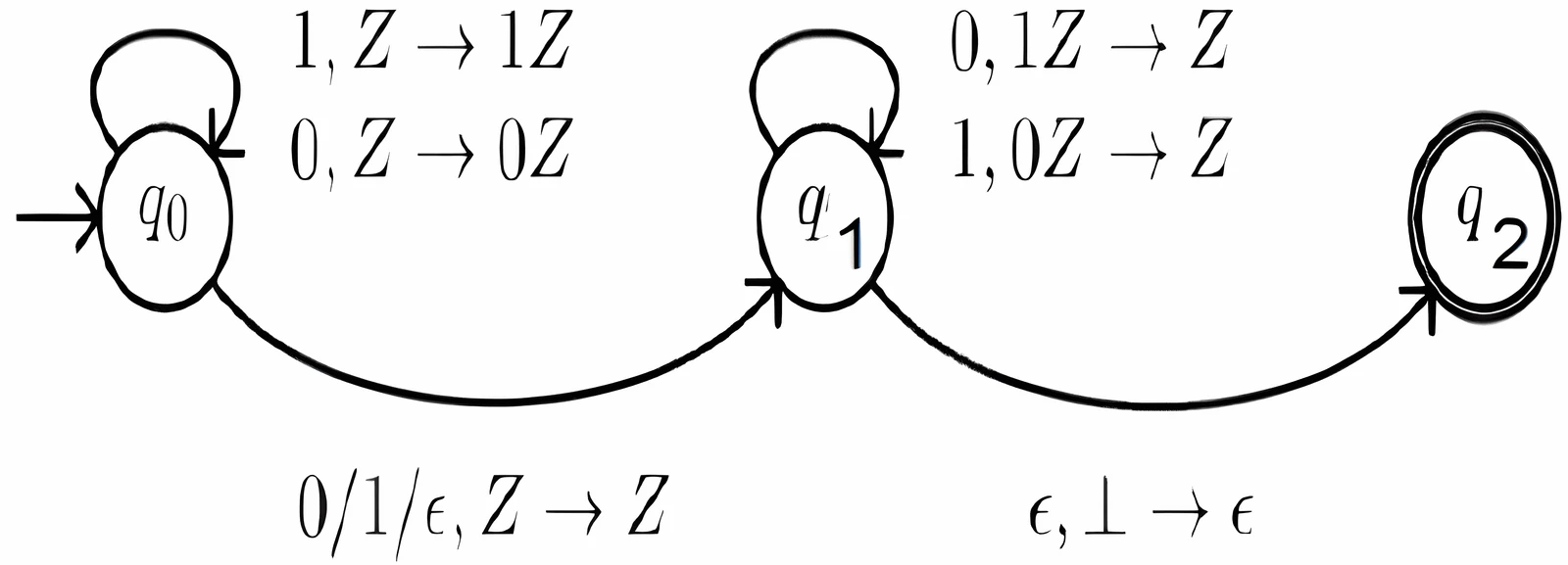
Q37 · Theory of Computation · MCQ · 2 marks

Consider the NPDA shown below:

NPDA for Q50

Which one of the following sequences must follow the string 101100 so that the overall string is accepted by the automaton?

  • (A)
    10110
  • (B)
    10010
  • (C)
    01010
  • (D)
    01001

Answer (official key): B

Solution

In the first phase, the NPDA stores the prefix information on the stack.

After the transition to the second phase, the automaton consumes symbols while popping stack symbols according to the transition conditions.

Simulating the automaton on the prefix:

101100

shows that the required continuation for acceptance is:

10010

Thus the complete accepted string has 10010 following 101100.

Therefore, the correct answer is Option B.

The other 60 questions are solved in your report when you take GATE 2015 CS (Set 1) as a 3-hour test.

Take GATE 2015 CS (Set 1) as a test

Official answer key

GATE 2015 CS (Set 1) answer key

All 65 answers from the official key. Numerical answers are ranges; “or” means the key accepts either answer.

Download the official GATE 2015 CS (Set 1) answer key (PDF)
QTopicTypeMarksAnswer
1Verbal AptitudeMCQ1C
2Verbal AptitudeMCQ1B
3Quantitative AptitudeMCQ1A
4Analytical AptitudeMCQ1A
5Verbal AptitudeMCQ1A
6Analytical AptitudeMCQ2A
7Quantitative AptitudeNumerical232
8Verbal AptitudeMCQ2C
9Quantitative AptitudeMCQ2C
10Quantitative AptitudeMCQ2D
11Programming and Data StructuresMCQ1B
12AlgorithmsMCQ1C
13Computer Organization and ArchitectureMCQ1A
14Programming and Data StructuresMCQ1C
15Compiler DesignMCQ1C
16Programming and Data StructuresNumerical1-5
17Theory of ComputationMCQ1D
18Computer NetworksMCQ1B
19DatabasesMCQ1D
20Programming and Data StructuresMCQ1A
21AlgorithmsMCQ1B
22CalculusMCQ1C
23Computer NetworksMCQ1B
24Linear AlgebraNumerical15
25Operating SystemNumerical13
26Discrete MathematicsMCQ1C
27Computer NetworksMCQ1B
28Computer NetworksMCQ1C
29Programming and Data StructuresMCQ1A
30Operating SystemNumerical14
31Digital LogicMCQ1D
32CalculusMCQ1C
33DatabasesMCQ1C
34Discrete MathematicsMCQ1C
35Computer NetworksNot in GATE 2027 syllabus: SMTP, FTP and e-mail protocolsMCQ1A
36Computer NetworksNumerical20.4 to 0.46
37Theory of ComputationMCQ2B
38Discrete MathematicsMCQ2D
39Programming and Data StructuresMCQ2B
40Discrete MathematicsMCQ2A
41CalculusNumerical20.99
42Discrete MathematicsMCQ2A
43Compiler DesignNumerical28
44Digital LogicMCQ2B
45Discrete MathematicsNumerical224
46Theory of ComputationNumerical21
47Compiler DesignMCQ2C
48DatabasesNumerical24
49Programming and Data StructuresNumerical25
50Computer NetworksNumerical2160
51AlgorithmsNumerical269
52Operating SystemNot in GATE 2027 syllabus: Secondary storage (magnetic disk)Numerical214020
53Computer Organization and ArchitectureNumerical23.2
54CalculusNumerical2-1
55Operating SystemNumerical210
56Programming and Data StructuresMCQ2B
57Linear AlgebraMCQ2D
58AlgorithmsMCQ2D
59AlgorithmsMCQ2D
60Programming and Data StructuresMCQ2A
61Digital LogicMCQ2A
62Operating SystemNumerical212
63Operating SystemMCQ2A
64DatabasesNumerical22
65Programming and Data StructuresMCQ2A

Questions about GATE 2015 CS (Set 1)

How many questions are in the GATE 2015 CS (Set 1) paper?

65 questions for 100 marks: 10 General Aptitude questions worth 15 marks and 55 Computer Science & Information Technology questions worth 85 marks. By type, there were 45 MCQs, 20 numerical answer (NAT) questions. The paper lasted 3 hours.

Is there negative marking in GATE 2015 CS (Set 1)?

Yes, for MCQs only. A wrong MCQ answer costs one-third of its marks (−⅓ for a 1-mark question, −⅔ for a 2-mark question). MSQ and numerical (NAT) questions have no negative marking, and an MSQ earns marks only when every correct option is chosen.

Which topics carried the most marks in GATE 2015 CS (Set 1)?

Outside General Aptitude, the biggest topics were Programming and Data Structures (15 marks), Operating System (10 marks), Discrete Mathematics (10 marks). The full topic-wise split is in the table on this page.

Were any GATE 2015 CS (Set 1) questions awarded marks to all?

No. Every question was graded with the answer in the official key.

Where does this GATE 2015 CS (Set 1) answer key come from?

From the official answer key published by IIT Kanpur, which organised GATE 2015. Range answers for numerical questions and questions with more than one accepted answer are kept exactly as the key gives them.

More GATE papers