Q7 · General Aptitude · MCQ · 2 marks
If
which of the following is a factor of ?
- (A)
- (B)
- (C)
- (D)
Answer (official key): B
Solution
Use the factor theorem.
If is a factor, then:
Now,
Therefore, is a factor of .
The correct answer is Option B.

The official GATE 2016 Computer Science & Information Technology (Set 1) paper, organised by IISc Bengaluru: 65 questions for 100 marks in 3 hours. Download the official question paper and answer key as PDFs. Below is how the marks were split by topic, the complete official answer key and 5 questions solved step by step.
Source: the official paper and answer key published by IISc Bengaluru for GATE 2016. Spotted a mistake? Email team@lemyte.com.
Not in 2027 2 questions (Q 18, 25) are on topics removed from the GATE 2027 syllabus. They are marked in the answer key below. What changed for CS
Where the marks were
Computer Science & Information Technology questions only; General Aptitude adds 15 marks on top. The top three topics carried 29 of the 85 subject marks.
| Topic | Questions | Marks |
|---|---|---|
| Computer Networks | 6 | 10 |
| Programming and Data Structures | 6 | 10 |
| Theory of Computation | 6 | 9 |
| Algorithms | 6 | 9 |
| Operating System | 5 | 9 |
| Discrete Mathematics | 5 | 8 |
| Compiler Design | 5 | 8 |
| Computer Organization and Architecture | 4 | 6 |
| Digital Logic | 4 | 6 |
| Databases | 4 | 5 |
| Probability and Statistics | 2 | 3 |
| Calculus | 1 | 1 |
| Linear Algebra | 1 | 1 |
Free solved questions
Question text and figures as in the official paper, the answer from the official key, and a worked solution. The other 60 solutions are in your report after you take the paper.
Q7 · General Aptitude · MCQ · 2 marks
If
which of the following is a factor of ?
Answer (official key): B
Solution
Use the factor theorem.
If is a factor, then:
Now,
Therefore, is a factor of .
The correct answer is Option B.
Q8 · General Aptitude · MCQ · 2 marks
A shaving set company sells 4 different types of razors: Elegance, Smooth, Soft and Executive.
Elegance sells at Rs. 48, Smooth at Rs. 63, Soft at Rs. 78 and Executive at Rs. 173 per piece.
The table below shows the numbers of each razor sold in each quarter of a year.
| Quarter | Elegance | Smooth | Soft | Executive |
|---|---|---|---|---|
| Q1 | 27300 | 20009 | 17602 | 9999 |
| Q2 | 25222 | 19392 | 18445 | 8942 |
| Q3 | 28976 | 22429 | 19544 | 10234 |
| Q4 | 21012 | 18229 | 16595 | 10109 |
Which product contributes the greatest fraction to the revenue of the company in that year?
Answer (official key): B
Solution
Compute yearly revenue for each product.
Elegance:
Smooth:
Soft:
Executive:
Executive contributes the greatest revenue.
Therefore, the correct answer is Option B.
Q30 · Operating System · MCQ · 1 mark
Consider an arbitrary set of CPU-bound processes with unequal CPU burst lengths submitted at the same time to a computer system.
Which one of the following process scheduling algorithms would minimize the average waiting time in the ready queue?
Answer (official key): A
Solution
When all processes arrive at the same time and CPU burst lengths are known, executing the shortest job first minimizes average waiting time.
Shortest Remaining Time First is the preemptive version of Shortest Job First. Since all processes are submitted at the same time, it behaves like shortest-job-first ordering.
Therefore, it minimizes the average waiting time.
The correct answer is Option A.
Q31 · Digital Logic · Numerical · 1 mark
We want to design a synchronous counter that counts the sequence:
and then repeats.
The minimum number of J-K flip-flops required to implement this counter is __________.
Answer (official key): 3 to 4
Solution
The output sequence is:
and then it repeats.
Although only the values 0, 1, 2 and 3 appear, the state corresponding to output 0 must occur in different positions of the cycle because it is followed by different next outputs: 1, 2 and 3.
So the counter requires 6 distinct states in the cycle.
The number of flip-flops required for 6 states is:
Therefore, the minimum required number of J-K flip-flops is 3.
The official accepted range is 3 to 4.
Q50 · Digital Logic · MCQ · 2 marks
Consider the two cascaded 2-to-1 multiplexers as shown in the figure.
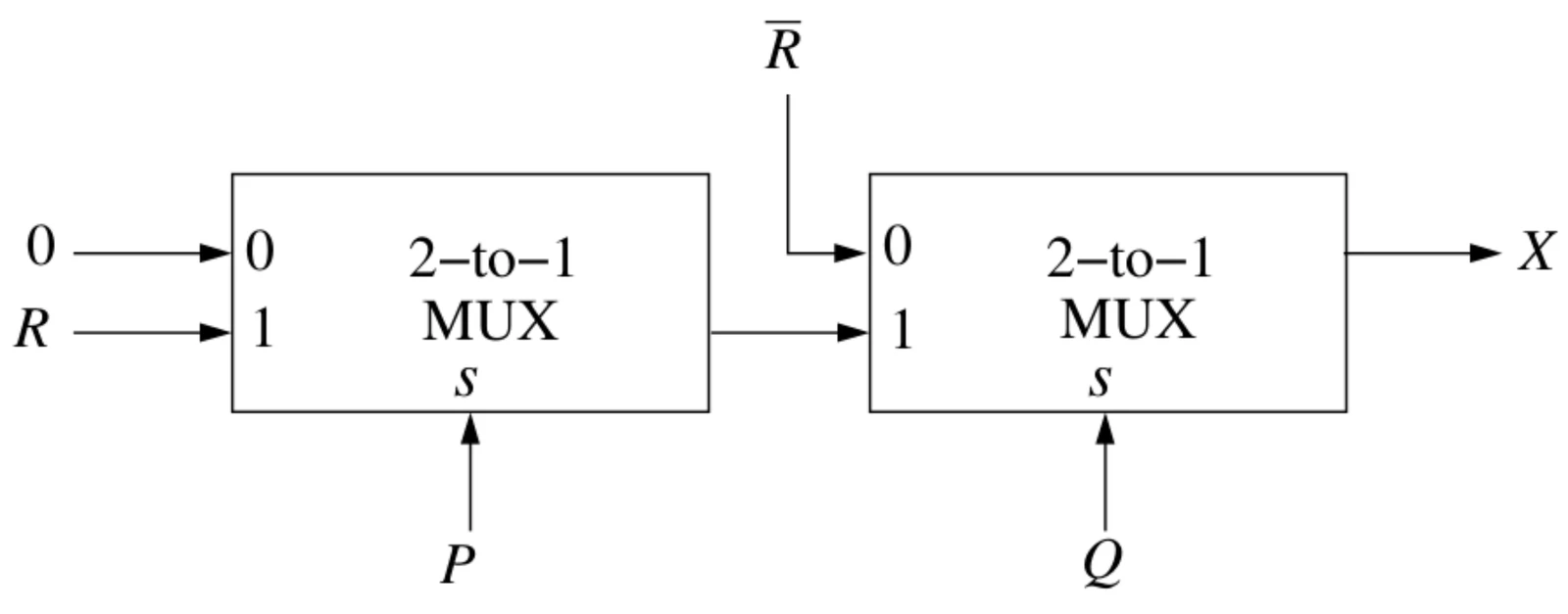
The minimal sum of products form of the output is:
Answer (official key): D
Solution
Trace the two multiplexers from the given figure.
The output is 1 in the following cases:
Therefore, the minimal sum of products form is:
The correct answer is Option D.
The other 60 questions are solved in your report when you take GATE 2016 CS (Set 1) as a 3-hour test.
Take GATE 2016 CS (Set 1) as a testOfficial answer key
All 65 answers from the official key. Numerical answers are ranges; “or” means the key accepts either answer.
Download the official GATE 2016 CS (Set 1) answer key (PDF)| Q | Topic | Type | Marks | Answer |
|---|---|---|---|---|
| 1 | Verbal Aptitude | MCQ | 1 | A |
| 2 | Spatial Aptitude | MCQ | 1 | D |
| 3 | Verbal Aptitude | MCQ | 1 | A |
| 4 | Analytical Aptitude | MCQ | 1 | A |
| 5 | Verbal Aptitude | MCQ | 1 | D |
| 6 | Quantitative Aptitude | MCQ | 2 | B |
| 7 | Quantitative Aptitude | MCQ | 2 | B |
| 8 | Quantitative Aptitude | MCQ | 2 | B |
| 9 | Analytical Aptitude | MCQ | 2 | D |
| 10 | Verbal Aptitude | MCQ | 2 | D |
| 11 | Databases | MCQ | 1 | B |
| 12 | Theory of Computation | MCQ | 1 | D |
| 13 | Databases | MCQ | 1 | B |
| 14 | Algorithms | MCQ | 1 | D |
| 15 | Algorithms | MCQ | 1 | A |
| 16 | Discrete Mathematics | MCQ | 1 | B |
| 17 | Theory of Computation | MCQ | 1 | C |
| 18 | Computer NetworksNot in GATE 2027 syllabus: SMTP, FTP and e-mail protocols | MCQ | 1 | C |
| 19 | Calculus | Numerical | 1 | 1 |
| 20 | Theory of Computation | MCQ | 1 | B |
| 21 | Algorithms | Numerical | 1 | 6 |
| 22 | Computer Organization and Architecture | Numerical | 1 | -11 |
| 23 | Programming and Data Structures | Numerical | 1 | 2016 |
| 24 | Digital Logic | MCQ | 1 | A |
| 25 | Computer NetworksNot in GATE 2027 syllabus: ARP, DHCP and ICMP | MCQ | 1 | C |
| 26 | Compiler Design | MCQ | 1 | D |
| 27 | Compiler Design | Numerical | 1 | 10 |
| 28 | Computer Organization and Architecture | Numerical | 1 | 31 |
| 29 | Linear Algebra | Numerical | 1 | 15 |
| 30 | Operating System | MCQ | 1 | A |
| 31 | Digital Logic | Numerical | 1 | 3 to 4 |
| 32 | Programming and Data Structures | MCQ | 1 | A |
| 33 | Discrete Mathematics | Numerical | 1 | 11 |
| 34 | Probability and Statistics | Numerical | 1 | 0.5 |
| 35 | Databases | MCQ | 1 | D |
| 36 | Programming and Data Structures | MCQ | 2 | D |
| 37 | Digital Logic | MCQ | 2 | B |
| 38 | Compiler Design | MCQ | 2 | D |
| 39 | Programming and Data Structures | Numerical | 2 | 256 |
| 40 | Discrete Mathematics | Numerical | 2 | 10 |
| 41 | Computer Organization and Architecture | Numerical | 2 | 33 to 34 |
| 42 | Probability and Statistics | Numerical | 2 | 0.33 to 0.34 |
| 43 | Computer Organization and Architecture | Numerical | 2 | 456 |
| 44 | Discrete Mathematics | Numerical | 2 | 197.9 to 198.1 |
| 45 | Algorithms | Numerical | 2 | 12 |
| 46 | Discrete Mathematics | Numerical | 2 | 2 |
| 47 | Algorithms | Numerical | 2 | 7 |
| 48 | Theory of Computation | MCQ | 2 | D |
| 49 | Algorithms | MCQ | 2 | B |
| 50 | Digital Logic | MCQ | 2 | D |
| 51 | Programming and Data Structures | MCQ | 2 | B |
| 52 | Programming and Data Structures | MCQ | 2 | A |
| 53 | Databases | MCQ | 2 | A |
| 54 | Operating System | Numerical | 2 | 1 |
| 55 | Theory of Computation | MCQ | 2 | C |
| 56 | Compiler Design | Numerical | 2 | 9 |
| 57 | Computer Networks | Numerical | 2 | 2500 |
| 58 | Computer Networks | MCQ | 2 | B |
| 59 | Computer Networks | Numerical | 2 | 13 |
| 60 | Computer Networks | Numerical | 2 | 1.1 |
| 61 | Theory of Computation | MCQ | 2 | D |
| 62 | Operating System | MCQ | 2 | A |
| 63 | Compiler Design | MCQ | 2 | C |
| 64 | Operating System | Numerical | 2 | 346 |
| 65 | Operating System | Numerical | 2 | 384 |
65 questions for 100 marks: 10 General Aptitude questions worth 15 marks and 55 Computer Science & Information Technology questions worth 85 marks. By type, there were 39 MCQs, 26 numerical answer (NAT) questions. The paper lasted 3 hours.
Yes, for MCQs only. A wrong MCQ answer costs one-third of its marks (−⅓ for a 1-mark question, −⅔ for a 2-mark question). MSQ and numerical (NAT) questions have no negative marking, and an MSQ earns marks only when every correct option is chosen.
Outside General Aptitude, the biggest topics were Computer Networks (10 marks), Programming and Data Structures (10 marks), Theory of Computation (9 marks). The full topic-wise split is in the table on this page.
No. Every question was graded with the answer in the official key.
From the official answer key published by IISc Bengaluru, which organised GATE 2016. Range answers for numerical questions and questions with more than one accepted answer are kept exactly as the key gives them.
Other GATE CS papers
GATE CS topic-wise weightage and 2027 syllabus