Q4 · General Aptitude · MCQ · 1 markReal numbers yyy, ppp, and nnn (all greater than 1) satisfy (logp1/ny)(logy1/np)=16,\left(\log_{p^{1/n}} y\right)\left(\log_{y^{1/n}} p\right) = 16,(logp1/ny)(logy1/np)=16, where the logarithms are taken to the bases p1/np^{1/n}p1/n and y1/ny^{1/n}y1/n. The value of nnn is ________(A)2(B)4(C)8(D)16Answer (official key): BSolutionlogp1/ny=logy1nlogp=nlogpy,logy1/np=nlogyp\log_{p^{1/n}} y = \frac{\log y}{\frac{1}{n}\log p} = n\log_p y, \qquad \log_{y^{1/n}} p = n\log_y plogp1/ny=n1logplogy=nlogpy,logy1/np=nlogyp So the product is n2(logpy)(logyp)=n2=16n^2 (\log_p y)(\log_y p) = n^2 = 16n2(logpy)(logyp)=n2=16, giving n=4n = 4n=4 (since n>1n > 1n>1).
Q5 · General Aptitude · MCQ · 1 markThe following observation is made about the scores obtained by 100 students in an exam: ‘For each student, there exists another student in the class such that their scores are at most ten marks away.’ If the above statement is false, which one of the following statements is necessarily true?(A)For each student, the scores of all the other students are more than 10 marks away.(B)There exists at least one student in the class for whom the scores of all the other students are more than 10 marks away.(C)There is exactly one student in the class for whom the scores of some students are more than 10 marks away.(D)For each student, the score of exactly one other student is more than 10 marks away.Answer (official key): BSolutionThe statement has the form "for every student sss, there exists a student ttt with ∣s−t∣≤10|s - t| \le 10∣s−t∣≤10". Its negation is "there exists a student sss such that for every other student ttt, ∣s−t∣>10|s - t| > 10∣s−t∣>10", which is option (B).
Q25 · Electronic Devices · MSQ · 1 markConsider a p-n junction diode when it is forward biased with 2 V. Which of the following is/are the correct magnitude(s) of the energy difference between quasi Fermi-levels, EfnE_{fn}Efn in the n-side and EfpE_{fp}Efp in the p-side?(A)2 eV(B)1 eV(C)2 V(D)1 VAnswer (official key): ASolutionUnder an applied forward bias VaV_aVa, the quasi-Fermi levels separate by Efn−Efp=qVa=2E_{fn} - E_{fp} = qV_a = 2Efn−Efp=qVa=2 eV. Option (C) is in volts, which is not a unit of energy.
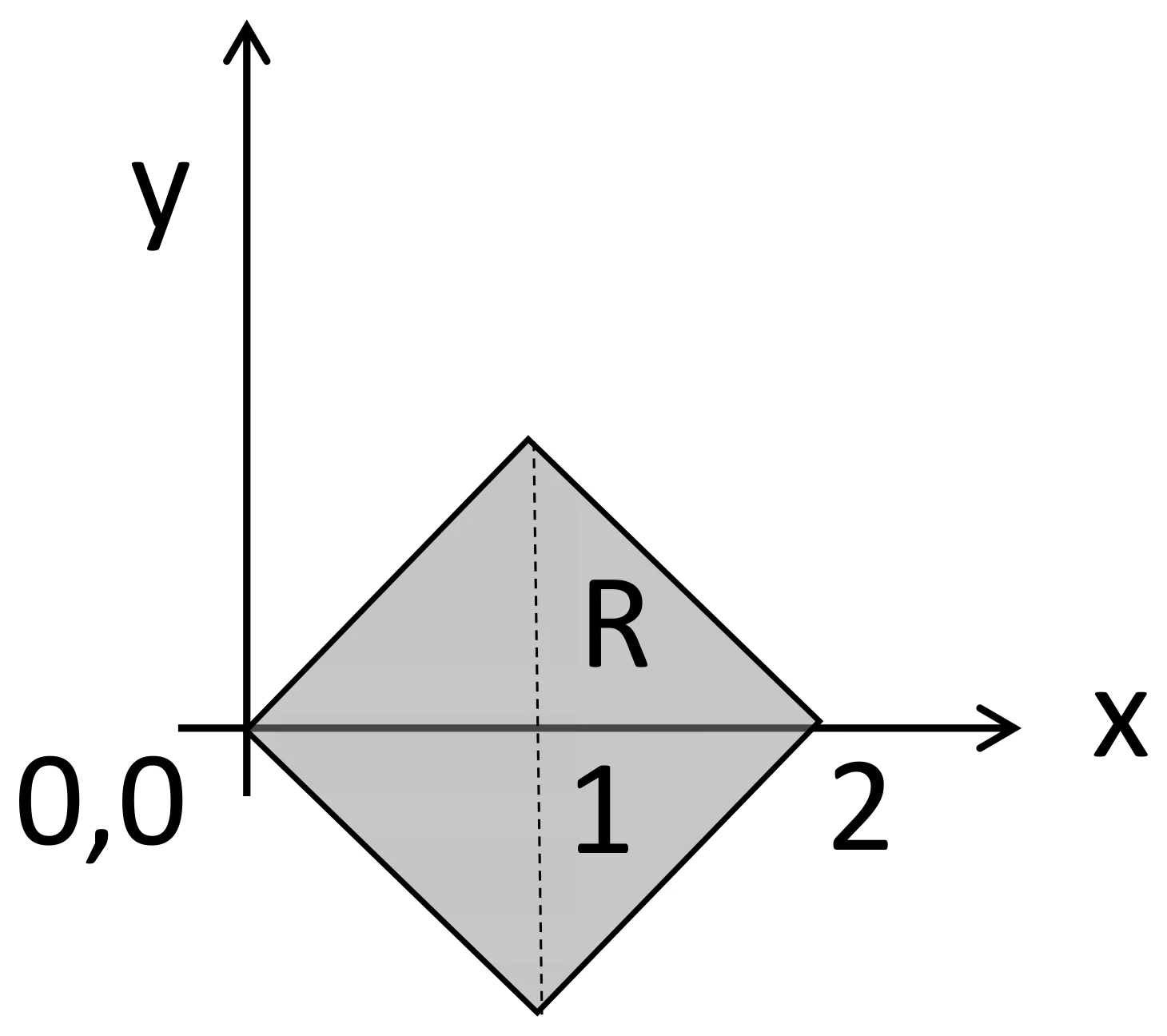
Q61 · Calculus · Numerical · 2 marksConsider the square region RRR in the XXX-YYY plane as shown with the dark shading in the Figure. The value of ∬R(x2+y2−1) dx dy\iint_R (x^2 + y^2 - 1)\,dx\,dy∬R(x2+y2−1)dxdy is ____. (rounded off to two decimal places) Answer (official key): 0.6 to 0.7SolutionRRR is the square with vertices (0,0),(1,1),(2,0),(1,−1)(0,0), (1,1), (2,0), (1,-1)(0,0),(1,1),(2,0),(1,−1), i.e. ∣x−1∣+∣y∣≤1|x - 1| + |y| \le 1∣x−1∣+∣y∣≤1, with area 2. Put u=x−1u = x - 1u=x−1: ∬R(x2+y2−1) dA=∬(u2+2u+y2) dA\iint_R (x^2 + y^2 - 1)\,dA = \iint (u^2 + 2u + y^2)\,dA∬R(x2+y2−1)dA=∬(u2+2u+y2)dA By symmetry ∬2u dA=0\iint 2u\,dA = 0∬2udA=0, and ∬u2 dA=∫−11u2⋅2(1−∣u∣) du=13\iint u^2\,dA = \int_{-1}^{1} u^2 \cdot 2(1 - |u|)\,du = \frac{1}{3}∬u2dA=∫−11u2⋅2(1−∣u∣)du=31. Likewise ∬y2 dA=13\iint y^2\,dA = \frac{1}{3}∬y2dA=31. Result=23≈0.67\text{Result} = \frac{2}{3} \approx 0.67Result=32≈0.67
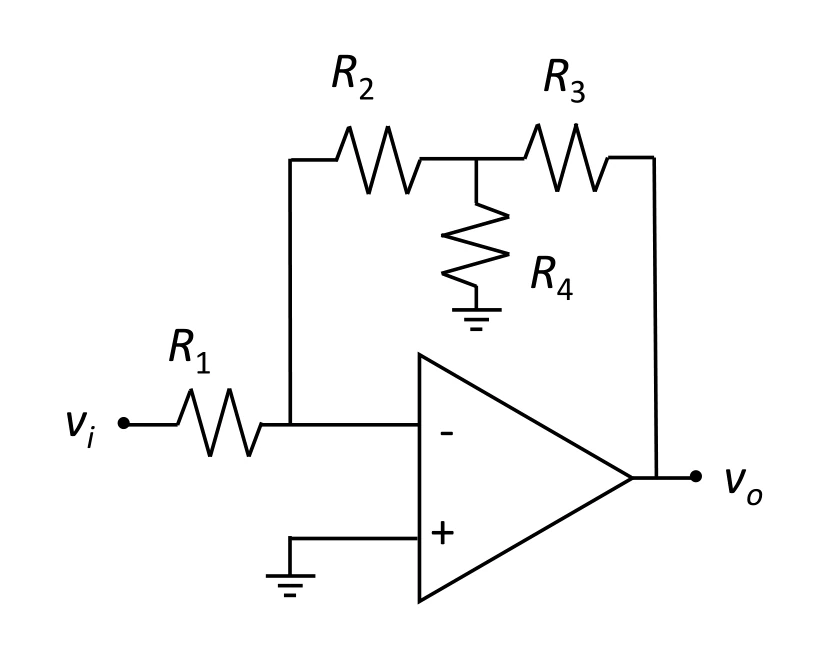
Q62 · Analog Circuits · Numerical · 2 marksConsider an ideal OP-AMP circuit as shown in the Figure. The resistances R1=R2=R3=R4=50R_1 = R_2 = R_3 = R_4 = 50R1=R2=R3=R4=50 kΩ. The magnitude of the closed loop gain is ___. (rounded off to two decimal places) Answer (official key): 2.9 to 3.1SolutionFor an inverting amplifier with a T-network in the feedback path: vovi=−R2+R3+R2R3R4R1=−50+50+5050=−3\frac{v_o}{v_i} = -\frac{R_2 + R_3 + \frac{R_2 R_3}{R_4}}{R_1} = -\frac{50 + 50 + 50}{50} = -3vivo=−R1R2+R3+R4R2R3=−5050+50+50=−3 The magnitude is 3.00.