GATE 2026 DA question paper PDF and answer key

The official GATE 2026 Data Science & Artificial Intelligence paper, organised by IIT Guwahati: 65 questions for 100 marks in 3 hours. Download the official question paper and answer key as PDFs. Below is how the marks were split by topic, the complete official answer key and 5 questions solved step by step.

Source: the official paper and answer key published by IIT Guwahati for GATE 2026 (official GATE site). Spotted a mistake? Email team@lemyte.com.

General Aptitude
10 · 15 marks
Data Science & Artificial Intelligence
55 · 85 marks
MCQ / MSQ / NAT
33 / 14 / 18
Marks to all
None

Where the marks were

GATE 2026 DA topic-wise marks

Data Science & Artificial Intelligence questions only; General Aptitude adds 15 marks on top. The top three topics carried 53 of the 85 subject marks.

TopicQuestionsMarks
Probability and Statistics1321
Database Management and Warehousing1118
Programming, Data Structures and Algorithms914
Machine Learning914
Artificial Intelligence68
Linear Algebra58
Calculus and Optimization22

Free solved questions

5 solved questions from GATE 2026 DA

Question text and figures as in the official paper, the answer from the official key, and a worked solution. The other 60 solutions are in your report after you take the paper.

Q8 · General Aptitude · MCQ · 2 marks

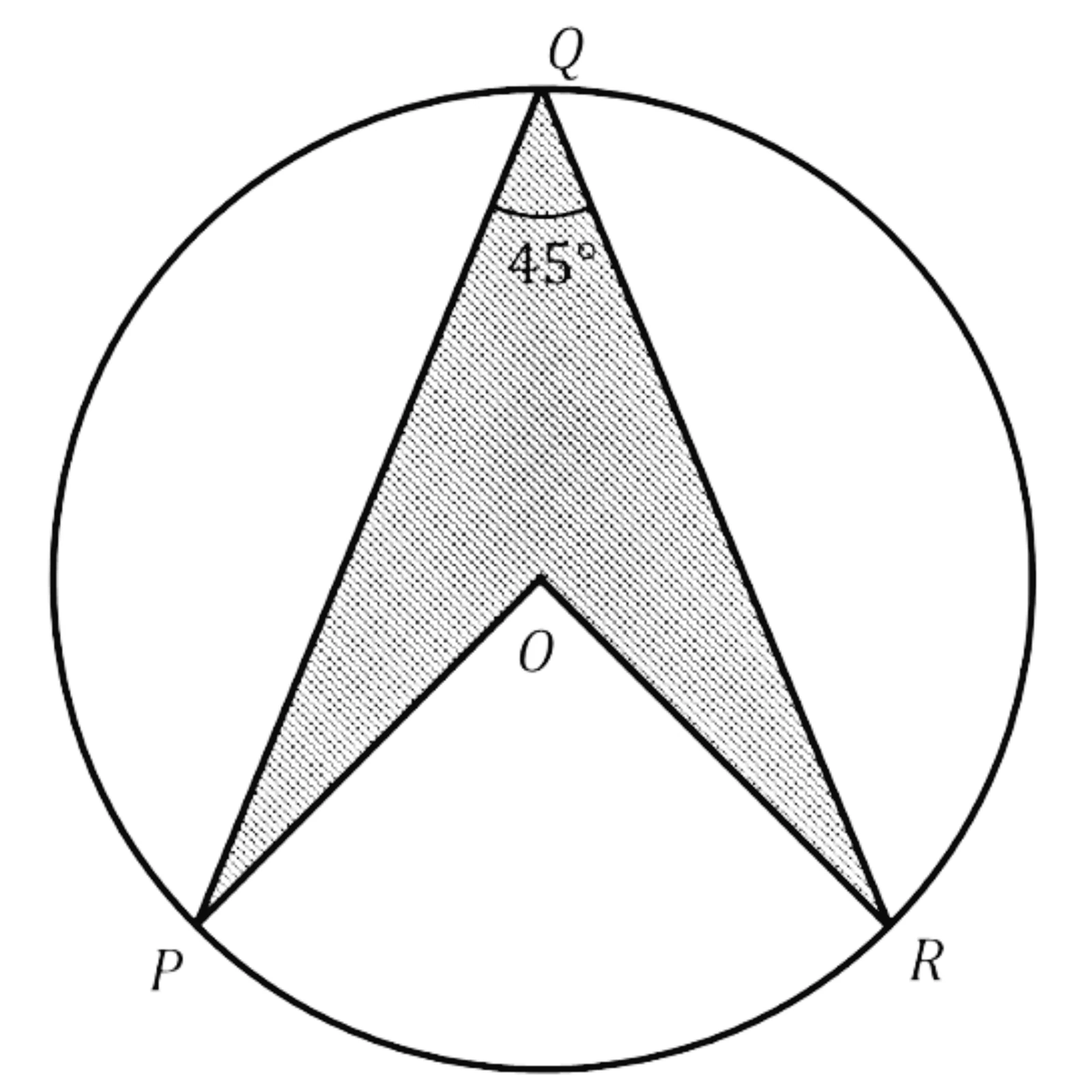
In the given figure, PP, QQ, and RR are three points on a circle of radius 10 cm with OO as its center, PQ‾=RQ‾\overline{PQ} = \overline{RQ}, and ∠PQR=45∘\angle PQR = 45^\circ. The figure is representative.

The area of the shaded region PQROPQRO is ______________ cm2^2.

Figure for GATE 2026 DA question 8 (Quantitative Aptitude)

  • (A)
    50
  • (B)
    25225\sqrt{2}
  • (C)
    50250\sqrt{2}
  • (D)
    100

Answer (official key): C

Solution

Since ∠PQR=45∘\angle PQR = 45^\circ, the subtended central angle is

∠POR=90∘.\angle POR = 90^\circ.

With radius 10, triangle PORPOR is right isosceles with legs 10 and 10, and the geometry of the symmetric outer triangle formed with apex QQ gives the shaded area as

502.50\sqrt{2}.

Therefore, the correct answer is Option C.

Q9 · General Aptitude · MCQ · 2 marks

Rishi and Swathi are students of Class 5. Pavan and Tanvi are students of Class 4. Rishi and Pavan are boys. Swathi and Tanvi are girls. The four students played a total of three games of chess. The games were played one after another. A player who lost a game did not participate in any more games. It was observed that:

(i) the first game was the only game where two students of the same class played against each other,
(ii) the students of Class 5 won more games than the students of Class 4, and
(iii) the boys won two games and the girls won one game.

The student who did not lose any game is __________.

  • (A)
    Pavan
  • (B)
    Rishi
  • (C)
    Swathi
  • (D)
    Tanvi

Answer (official key): D

Solution

Let us denote the students as:

  • Rishi (R): Class 5, boy
  • Swathi (S): Class 5, girl
  • Pavan (P): Class 4, boy
  • Tanvi (T): Class 4, girl

A player who loses a game is eliminated permanently, so after 3 games there is exactly one student who never loses.

We use the conditions one by one.

Step 1: The first game must be the only same-class game

If the first game were between the Class 4 students (P vs T), then after one of them loses, the remaining three students would be:

  • one Class 4 student
  • both Class 5 students

Now the last two games must both be cross-class. But after one cross-class game among these three, the loser is eliminated, leaving either:

  • two Class 5 students, or
  • two Class 4 students

That would force the third game to be a same-class game, violating condition (i).

So the first game cannot be P vs T.

Hence the first game must be between the Class 5 students:

R vs S.R \text{ vs } S.

Step 2: Who wins the first game?

Suppose Swathi wins the first game. Then the winners so far are:

  • one Class 5 win
  • one girl win

The remaining players are S, P, T, and the next two games must both be cross-class.

To satisfy condition (ii), Class 5 must win more games than Class 4, so Swathi would need to win at least one more game.

But then girls would have at least two wins, contradicting condition (iii), which says:

  • boys won exactly 2 games
  • girls won exactly 1 game

Therefore, Swathi cannot win the first game.

So the first game must be won by Rishi.

Step 3: Determine the next two games

After Rishi beats Swathi, the active players are:

R, P, T.R,\ P,\ T.

The second game must be cross-class.

  • If Rishi loses the second game, then the remaining two players would be P and T, both from Class 4, so the third game would again be a same-class game. Not allowed.
  • Therefore, Rishi must also win the second game.

So the second game must be:

R beats PR \text{ beats } P

because if R beat T instead, the remaining players would be R and P, and Rishi would then also win the third game, giving boys all 3 wins, which violates condition (iii).

Now only Rishi and Tanvi remain for the third game, and Tanvi must win it.

So the unique valid sequence is:

  1. Rishi beats Swathi
  2. Rishi beats Pavan
  3. Tanvi beats Rishi

The student who never lost any game is therefore Tanvi.

Therefore, the correct answer is Option D.

Q21 · Programming, Data Structures and Algorithms · MSQ · 1 mark

You are given the following Pre-order and In-order traversals of a Binary Tree TT with nodes E, F, G, P, Q, R, S.

Pre-order: P Q S E R F G
In-order: S Q E P F R G

Which of the following statements is/are true about the Binary Tree TT?

  • (A)
    Node P is the root of TT
  • (B)
    The Post-order traversal of TT is: S E Q F G R P
  • (C)
    Node Q has only one child
  • (D)
    The left subtree of node R contains the node G

Answer (official key): A, B

Solution

The first node in pre-order is the root, so PP is the root.

Split the in-order traversal around PP:

  • Left subtree in-order: S Q E
  • Right subtree in-order: F R G

Using pre-order, the left subtree is rooted at QQ with children SS and EE, and the right subtree is rooted at RR with children FF and GG.

Hence the post-order traversal is

S E Q F G R P.S\ E\ Q\ F\ G\ R\ P.

So (A) and (B) are true, while (C) and (D) are false.

Therefore, the correct answers are A and B.

Q24 · Machine Learning · Numerical · 1 mark

Consider that for a supervised learning task, the objective function being minimized is

fw(x)=wx,f_w(x)=wx,

where x∈Rx \in \mathbb{R} is the input and w∈Rw \in \mathbb{R} is the parameter. Stochastic Gradient Descent with learning rate of 0.10 is used for parameter updates.

Suppose that at the end of iteration ii, the value of ww becomes 10.00.

Let x=10.00x=10.00 be the input for iteration (i+1)(i+1).

The value of ww at the end of iteration (i+1)(i+1) is __________ .
(Rounded off to two decimal places)

Answer (official key): 8.9 to 9.1

Solution

For

fw(x)=wx,f_w(x)=wx,

the gradient with respect to ww is

∂fw(x)∂w=x.\frac{\partial f_w(x)}{\partial w}=x.

Using SGD with learning rate η=0.10\eta=0.10:

wnew=wold−ηx.w_{\text{new}} = w_{\text{old}} - \eta x.

Substitute

wold=10.00,x=10.00:w_{\text{old}}=10.00,\quad x=10.00: wnew=10.00−0.10×10.00=10.00−1.00=9.00.w_{\text{new}} = 10.00 - 0.10 \times 10.00 = 10.00 - 1.00 = 9.00.

Therefore, the answer is 9.00.

Q25 · Artificial Intelligence · Numerical · 1 mark

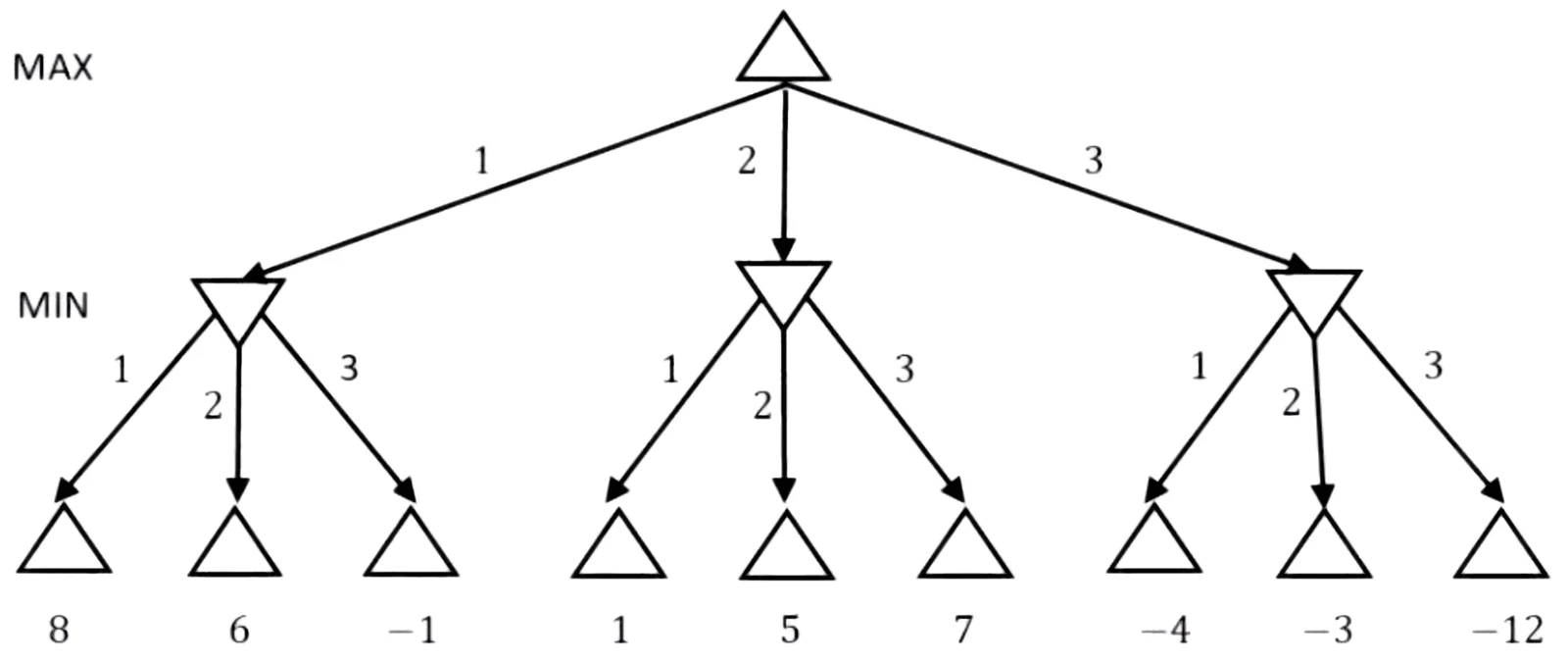
Consider the game tree for a two-player turn-taking minimax game as shown in the figure. The value of a terminal node represents the utility of the game state if the game ends there. The numbers written next to the edges denote the strategies.

There are two players MAX and MIN. At any particular state of the game, MAX prefers to move to a state of maximum value. On the other hand, MIN prefers to move to a state of minimum value.

Suppose MAX starts the game at the root and has three strategies: 1, 2 and 3. Next, MIN plays and also has three strategies: 1, 2 and 3. The game ends there. Both players always take optimal strategies throughout the game.

At the root, the best strategy for MAX is __________ . (Answer in integer)

Game tree for Q30

Answer (official key): 2

Solution

For each strategy chosen by MAX at the root, MIN will then choose the minimum utility among its three children.

  • If MAX chooses strategy 1, MIN chooses min⁡(8,6,−1)=−1\min(8,6,-1)=-1
  • If MAX chooses strategy 2, MIN chooses min⁡(1,5,7)=1\min(1,5,7)=1
  • If MAX chooses strategy 3, MIN chooses min⁡(−4,−3,−12)=−12\min(-4,-3,-12)=-12

Then MAX chooses the maximum among these resulting values:

max⁡(−1,1,−12)=1.\max(-1,1,-12)=1.

This value is achieved by choosing strategy 2 at the root.

Therefore, the answer is 2.

The other 60 questions are solved in your report when you take GATE 2026 DA as a 3-hour test.

Take GATE 2026 DA as a test

Official answer key

GATE 2026 DA answer key

All 65 answers from the official key. Numerical answers are ranges; “or” means the key accepts either answer.

Download the official GATE 2026 DA answer key (PDF)
QTopicTypeMarksAnswer
1Verbal AptitudeMCQ1B
2Quantitative AptitudeMCQ1C
3Spatial AptitudeMCQ1A
4Verbal AptitudeMCQ1D
5Quantitative AptitudeMCQ1B
6Verbal AptitudeMCQ2A
7Quantitative AptitudeMCQ2C
8Quantitative AptitudeMCQ2C
9Analytical AptitudeMCQ2D
10Quantitative AptitudeMCQ2B
11Probability and StatisticsMCQ1C
12Programming, Data Structures and AlgorithmsMCQ1B
13Machine LearningMCQ1B
14Probability and StatisticsMCQ1A
15Programming, Data Structures and AlgorithmsMCQ1D
16Database Management and WarehousingMCQ1D
17Artificial IntelligenceMCQ1C
18Database Management and WarehousingMCQ1A
19Artificial IntelligenceMCQ1C
20Machine LearningMCQ1C
21Programming, Data Structures and AlgorithmsMSQ1A, B
22Database Management and WarehousingMSQ1A, B
23Artificial IntelligenceMSQ1A, B, C
24Machine LearningNumerical18.9 to 9.1
25Artificial IntelligenceNumerical12
26Linear AlgebraMCQ1B
27Linear AlgebraMCQ1A
28Machine LearningMSQ1B
29Calculus and OptimizationMSQ1B, D
30Probability and StatisticsMSQ1A, C
31Probability and StatisticsNumerical110
32Calculus and OptimizationNumerical11
33Programming, Data Structures and AlgorithmsNumerical110
34Database Management and WarehousingNumerical1195
35Probability and StatisticsNumerical10.34 to 0.36
36Artificial IntelligenceMCQ2B
37Machine LearningMCQ2D
38Programming, Data Structures and AlgorithmsMCQ2D
39Machine LearningMCQ2D
40Programming, Data Structures and AlgorithmsMCQ2C
41Programming, Data Structures and AlgorithmsMSQ2B, C, D
42Database Management and WarehousingMCQ2D
43Database Management and WarehousingMCQ2A
44Linear AlgebraMCQ2C
45Probability and StatisticsMCQ2A
46Programming, Data Structures and AlgorithmsMSQ2B, D
47Database Management and WarehousingMCQ2A
48Machine LearningMSQ2A, B
49Artificial IntelligenceMSQ2B, C, D
50Probability and StatisticsMCQ2A
51Probability and StatisticsNumerical20.08 to 0.12
52Machine LearningNumerical2135
53Database Management and WarehousingNumerical22 to 3
54Database Management and WarehousingNumerical24
55Probability and StatisticsMSQ2B, C
56Machine LearningNumerical26.9 to 7.1
57Database Management and WarehousingMSQ2A
58Probability and StatisticsNumerical210
59Probability and StatisticsMSQ2A, B, C
60Linear AlgebraNumerical21
61Database Management and WarehousingNumerical23
62Programming, Data Structures and AlgorithmsNumerical28
63Probability and StatisticsNumerical20
64Linear AlgebraMSQ2A, D
65Probability and StatisticsNumerical20.76 to 0.78

Questions about GATE 2026 DA

How many questions are in the GATE 2026 DA paper?

65 questions for 100 marks: 10 General Aptitude questions worth 15 marks and 55 Data Science & Artificial Intelligence questions worth 85 marks. By type, there were 33 MCQs, 14 MSQs, 18 numerical answer (NAT) questions. The paper lasted 3 hours.

Is there negative marking in GATE 2026 DA?

Yes, for MCQs only. A wrong MCQ answer costs one-third of its marks (−⅓ for a 1-mark question, −⅔ for a 2-mark question). MSQ and numerical (NAT) questions have no negative marking, and an MSQ earns marks only when every correct option is chosen.

Which topics carried the most marks in GATE 2026 DA?

Outside General Aptitude, the biggest topics were Probability and Statistics (21 marks), Database Management and Warehousing (18 marks), Programming, Data Structures and Algorithms (14 marks). The full topic-wise split is in the table on this page.

Were any GATE 2026 DA questions awarded marks to all?

No. Every question was graded with the answer in the official key.

Where does this GATE 2026 DA answer key come from?

From the official answer key published by IIT Guwahati, which organised GATE 2026. Range answers for numerical questions and questions with more than one accepted answer are kept exactly as the key gives them.

More GATE papers