
GATE 2019 AE PYQ: question paper and answer key

The official GATE 2019 Aerospace Engineering paper, organised by IIT Madras: 65 questions for 100 marks in 3 hours. Below is how the marks were split by topic, the complete official answer key and 5 questions solved step by step.

Source: the official paper and answer key published by IIT Madras for GATE 2019 (official GATE site). Spotted a mistake? Email team@lemyte.com.

General Aptitude
10 · 15 marks
Aerospace Engineering
55 · 85 marks
MCQ / MSQ / NAT
28 / 0 / 37
Marks to all
None

Where the marks were

GATE 2019 AE topic-wise marks

Aerospace Engineering questions only; General Aptitude adds 15 marks on top. The top three topics carried 55 of the 85 subject marks.

TopicQuestionsMarks
Structures1321
Aerodynamics1219
Flight Mechanics1015
Propulsion1015
Calculus67
Linear Algebra24
Differential Equations12
Space Dynamics12

Official answer key

GATE 2019 AE answer key

All 65 answers from the official key. Numerical answers are ranges; “or” means the key accepts either answer.

QTopicTypeMarksAnswer
1Verbal AptitudeMCQ1C
2Analytical AptitudeMCQ1C
3Quantitative AptitudeMCQ1C
4Analytical AptitudeMCQ1C
5Verbal AptitudeMCQ1A
6Verbal AptitudeMCQ2C
7Quantitative AptitudeMCQ2A
8Verbal AptitudeMCQ2C
9Quantitative AptitudeMCQ2B
10Verbal AptitudeMCQ2D
11CalculusMCQ1A
12CalculusMCQ1B
13CalculusMCQ1C
14AerodynamicsMCQ1B
15AerodynamicsMCQ1B
16AerodynamicsMCQ1B
17AerodynamicsMCQ1C
18Flight MechanicsMCQ1D
19Flight MechanicsMCQ1A
20PropulsionMCQ1A
21PropulsionMCQ1B
22PropulsionMCQ1B
23StructuresMCQ1A
24CalculusNumerical10.5
25CalculusNumerical10.16 to 0.17
26AerodynamicsNumerical110
27Flight MechanicsNumerical172
28Flight MechanicsNumerical15.98 to 6
29Flight MechanicsNumerical143.05 to 43.15
30PropulsionNumerical13
31PropulsionNumerical10.7 to 0.72
32StructuresNumerical12
33StructuresNumerical10.2
34StructuresNumerical1247 to 255
35StructuresNumerical116
36Linear AlgebraMCQ2D
37AerodynamicsMCQ2B
38Flight MechanicsMCQ2D
39PropulsionMCQ2C
40StructuresMCQ2A
41CalculusNumerical21
42Linear AlgebraNumerical22
43Differential EquationsNumerical20.5
44AerodynamicsNumerical230
45AerodynamicsNumerical210
46AerodynamicsNumerical23.5 to 3.7 or 2.3 to 2.5
47AerodynamicsNumerical25.95 to 6.1
48AerodynamicsNumerical20.24 to 0.3
49AerodynamicsNumerical218 to 19.2
50Flight MechanicsNumerical22.06 to 2.08
51Flight MechanicsNumerical21.32 to 1.35
52Space DynamicsNumerical22.54 to 2.62
53Flight MechanicsNumerical21440 to 1490
54Flight MechanicsNumerical20.96
55PropulsionNumerical21
56PropulsionNumerical21.6 to 1.65
57PropulsionNumerical288 to 90
58PropulsionNumerical22.5 to 2.6
59StructuresNumerical260
60StructuresNumerical2550 to 570
61StructuresNumerical21.8 to 1.9
62StructuresNumerical2310 to 320
63StructuresNumerical217 to 17.5
64StructuresNumerical212.3 to 12.6
65StructuresNumerical225

Free solved questions

5 solved questions from GATE 2019 AE

Question text and figures as in the official paper, the answer from the official key, and a worked solution. The other 60 solutions are in your report after you take the paper.

Q8 · General Aptitude · MCQ · 2 marks

The nomenclature of Hindustani music has changed over the centuries. Since the medieval period dhrupad styles were identified as baanis. Terms like gayaki and baaj were used to refer to vocal and instrumental styles, respectively. With the institutionalization of music education the term gharana became acceptable. Gharana originally referred to hereditary musicians from a particular lineage, including disciples and grand disciples.

Which one of the following pairings is NOT correct?

  • (A)
    dhrupad, baani
  • (B)
    gayaki, vocal
  • (C)
    baaj, institution
  • (D)
    gharana, lineage

Answer (official key): C

Show the worked solution

The passage pairs dhrupad with baani, gayaki with vocal styles and gharana with lineage. Baaj refers to instrumental styles, not to an institution. Therefore, the correct answer is C.
Q10 · General Aptitude · MCQ · 2 marks

“I read somewhere that in ancient times the prestige of a kingdom depended upon the number of taxes that it was able to levy on its people. It was very much like the prestige of a head-hunter in his own community.”

Based on the paragraph above, the prestige of a head-hunter depended upon ___________

  • (A)
    the prestige of the kingdom
  • (B)
    the prestige of the heads
  • (C)
    the number of taxes he could levy
  • (D)
    the number of heads he could gather

Answer (official key): D

Show the worked solution

The analogy matches a kingdom's taxes with a head-hunter's heads: just as a kingdom's prestige depended on how many taxes it could levy, a head-hunter's prestige depended on how many heads he could gather. Therefore, the correct answer is D.

Q41 · Calculus · Numerical · 2 marks

For real xx, the number of points of intersection between the curves y=xy=x and y=cos⁡xy=\cos x is ______.

Answer (official key): 1

Show the worked solution

Any intersection must satisfy x∈[−1,1]x\in[-1,1]. On this interval, f(x)=x−cos⁡xf(x)=x-\cos x has derivative f′(x)=1+sin⁡x>0f'(x)=1+\sin x>0, so it is strictly increasing. Since f(0)=−1f(0)=-1 and f(1)=1−cos⁡1>0f(1)=1-\cos1>0, there is exactly 11 intersection.

Q42 · Linear Algebra · Numerical · 2 marks

One of the eigenvalues of the following matrix is 11. (x2−13)\begin{pmatrix}x&2\\-1&3\end{pmatrix} The other eigenvalue is ______.

Answer (official key): 2

Show the worked solution

Since 11 is an eigenvalue, det⁡(A−I)=2(x−1)+2=2x=0\det(A-I)=2(x-1)+2=2x=0, giving x=0x=0. The trace is then 33, which equals the sum of the eigenvalues. Thus the other eigenvalue is 3−1=23-1=2.

Q44 · Aerodynamics · Numerical · 2 marks

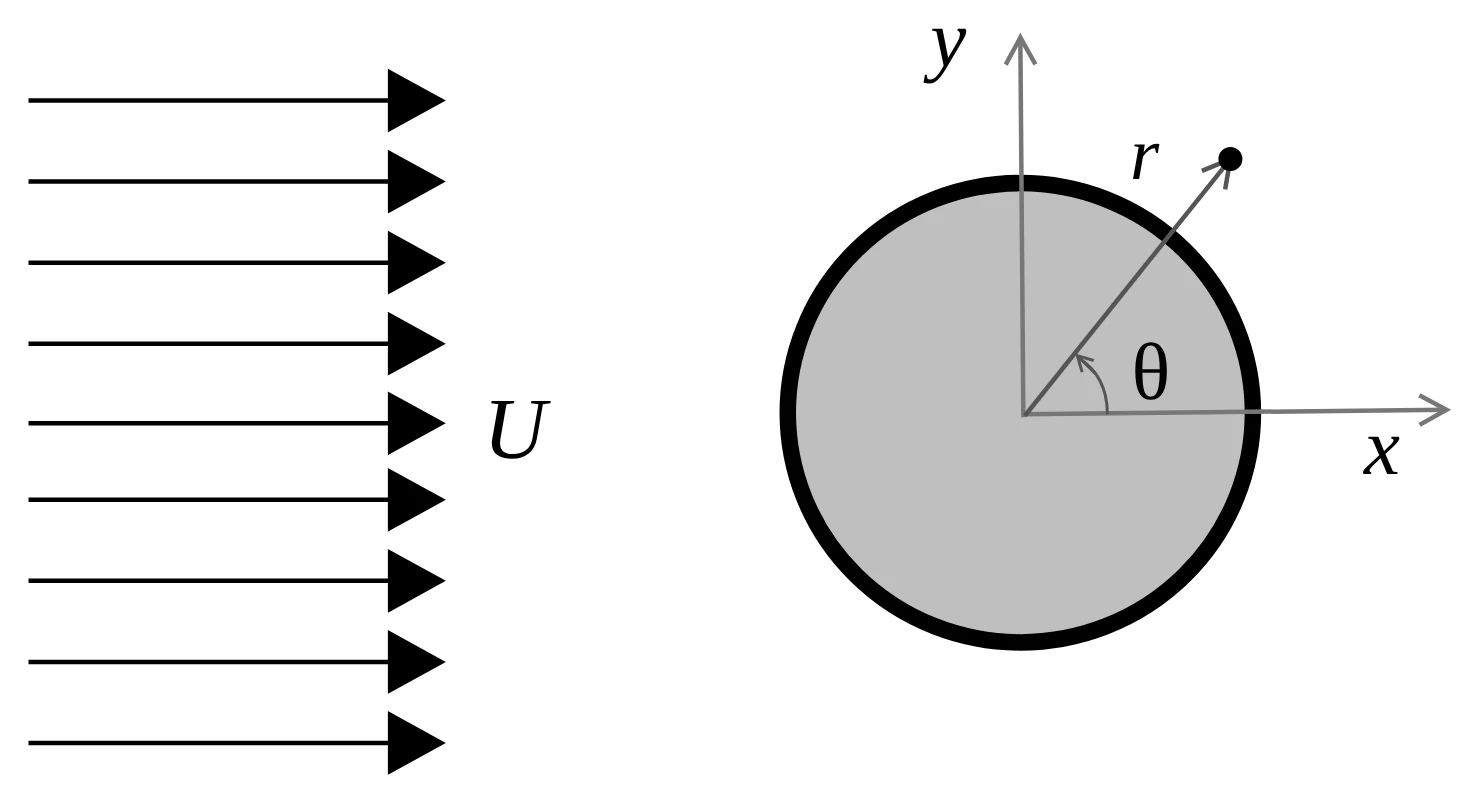
The inviscid, incompressible flow field resulting from a uniform flow past a circular cylinder of radius RR centered at the origin is given by: ur=U(1−R2r2)cos⁡θuθ=−U(1+R2r2)sin⁡θu_r=U\left(1-\frac{R^2}{r^2}\right)\cos\theta\qquad u_\theta=-U\left(1+\frac{R^2}{r^2}\right)\sin\theta

Figure for GATE 2019 AE question 44 (Aerodynamics)

where uru_r and uθu_\theta are the radial and azimuthal velocity components in polar coordinates, (r,θ)(r,\theta), as shown in the figure. UU is the free stream speed. Ignore the effects of gravity. The azimuthal location (in the first quadrant) on the cylinder at which the pressure coefficient is zero is ______ degrees (round off to the nearest integer).

Answer (official key): 30

Show the worked solution

At the cylinder surface r=Rr=R, ur=0u_r=0 and uθ=−2Usin⁡θu_\theta=-2U\sin\theta. Bernoulli's equation gives Cp=1−(V/U)2=1−4sin⁡2θC_p=1-(V/U)^2=1-4\sin^2\theta. Setting Cp=0C_p=0 gives sin⁡θ=1/2\sin\theta=1/2 in the first quadrant, so θ=30∘\theta=30^\circ.

The other 60 questions are solved in your report when you take GATE 2019 AE as a 3-hour test.

Take GATE 2019 AE as a test

Questions about GATE 2019 AE

How many questions are in the GATE 2019 AE paper?

65 questions for 100 marks: 10 General Aptitude questions worth 15 marks and 55 Aerospace Engineering questions worth 85 marks. By type, there were 28 MCQs, 37 numerical answer (NAT) questions. The paper lasted 3 hours.

Is there negative marking in GATE 2019 AE?

Yes, for MCQs only. A wrong MCQ answer costs one-third of its marks (−⅓ for a 1-mark question, −⅔ for a 2-mark question). MSQ and numerical (NAT) questions have no negative marking, and an MSQ earns marks only when every correct option is chosen.

Which topics carried the most marks in GATE 2019 AE?

Outside General Aptitude, the biggest topics were Structures (21 marks), Aerodynamics (19 marks), Flight Mechanics (15 marks). The full topic-wise split is in the table on this page.

Were any GATE 2019 AE questions awarded marks to all?

No. Every question was graded with the answer in the official key.

Where does this GATE 2019 AE answer key come from?

From the official answer key published by IIT Madras, which organised GATE 2019. Range answers for numerical questions and questions with more than one accepted answer are kept exactly as the key gives them.

More GATE papers