GATE 2019 EC PYQ: question paper and answer key

The official GATE 2019 Electronics & Communication Engineering paper, organised by IIT Madras: 65 questions for 100 marks in 3 hours. Below is how the marks were split by topic, the complete official answer key and 5 questions solved step by step.

Source: the official paper and answer key published by IIT Madras for GATE 2019 (official GATE site). Spotted a mistake? Email team@lemyte.com.

General Aptitude
10 · 15 marks
Electronics & Communication Engineering
55 · 85 marks
MCQ / MSQ / NAT
40 / 0 / 25
Marks to all
None

Where the marks were

GATE 2019 EC topic-wise marks

Electronics & Communication Engineering questions only; General Aptitude adds 15 marks on top. The top three topics carried 34 of the 85 subject marks.

TopicQuestionsMarks
Networks, Signals and Systems813
Electronic Devices711
Control Systems610
Communications610
Digital Circuits710
Electromagnetics69
Analog Circuits59
Calculus35
Differential Equations23
Complex Variables22
Probability and Statistics22
Linear Algebra11

Official answer key

GATE 2019 EC answer key

All 65 answers from the official key. Numerical answers are ranges; “or” means the key accepts either answer.

QTopicTypeMarksAnswer
1Verbal AptitudeMCQ1B
2Verbal AptitudeMCQ1B
3Quantitative AptitudeMCQ1C
4Quantitative AptitudeMCQ1B
5Verbal AptitudeMCQ1D
6Analytical AptitudeMCQ2D
7Quantitative AptitudeMCQ2A
8Verbal AptitudeMCQ2C
9Quantitative AptitudeMCQ2B
10Spatial AptitudeMCQ2C
11Complex VariablesMCQ1D
12Differential EquationsMCQ1C
13Networks, Signals and SystemsMCQ1D
14Networks, Signals and SystemsMCQ1B
15Control SystemsMCQ1D or A, D
16Control SystemsMCQ1B
17CommunicationsMCQ1B
18Electronic DevicesMCQ1A
19Electronic DevicesMCQ1A
20Electronic DevicesMCQ1B
21ElectromagneticsMCQ1B
22ElectromagneticsMCQ1B
23Digital CircuitsMCQ1A
24Digital CircuitsMCQ1B
25Digital CircuitsMCQ1B
26Complex VariablesNumerical1-0.0001 to 0.0001
27Linear AlgebraNumerical13
28Probability and StatisticsNumerical111
29CalculusNumerical11.99 to 2.01
30Probability and StatisticsNumerical10.36 to 0.38
31Networks, Signals and SystemsNumerical111.99 to 12.01
32CommunicationsNumerical10.74 to 0.76
33ElectromagneticsNumerical11.98 to 2.02
34Analog CircuitsNumerical1-3.1 to -2.9
35Digital CircuitsNumerical14
36CalculusMCQ2B
37CalculusMCQ2C
38Networks, Signals and SystemsMCQ2C
39Networks, Signals and SystemsMCQ2D
40Networks, Signals and SystemsMCQ2C
41Control SystemsMCQ2B
42Control SystemsMCQ2B
43Control SystemsMCQ2A
44CommunicationsMCQ2D
45Electronic DevicesMCQ2A
46ElectromagneticsMCQ2C
47ElectromagneticsMCQ2D
48Analog CircuitsMCQ2B
49Digital CircuitsMCQ2C
50Digital CircuitsMCQ2C
51Networks, Signals and SystemsNumerical20.23 to 0.27
52Control SystemsNumerical25.99 to 6.01
53Differential EquationsNumerical25.24 to 5.26
54Networks, Signals and SystemsNumerical2-27.01 to -26.99
55CommunicationsNumerical217.4 to 17.6
56CommunicationsNumerical211.8 to 11.82
57CommunicationsNumerical20.1
58Electronic DevicesNumerical20.23 to 0.232
59Electronic DevicesNumerical234 to 38
60Electronic DevicesNumerical225.4 to 25.6
61ElectromagneticsNumerical21.71 to 1.75
62Analog CircuitsNumerical23.2 to 3.4
63Digital CircuitsNumerical20.21 to 0.23
64Analog CircuitsNumerical2-905 to -895 or 895 to 905
65Analog CircuitsNumerical25.9 to 6.1

Free solved questions

5 solved questions from GATE 2019 EC

Question text and figures as in the official paper, the answer from the official key, and a worked solution. The other 60 solutions are in your report after you take the paper.

Q6 · General Aptitude · MCQ · 2 marks

Four people are standing in a line facing you. They are Rahul, Mathew, Seema and Lohit. One is an engineer, one is a doctor, one a teacher and another a dancer. You are told that:

  1. Mathew is not standing next to Seema
  2. There are two people standing between Lohit and the engineer
  3. Rahul is not a doctor
  4. The teacher and the dancer are standing next to each other
  5. Seema is turning to her right to speak to the doctor standing next to her

Who among them is an engineer?

  • (A)
    Seema
  • (B)
    Lohit
  • (C)
    Rahul
  • (D)
    Mathew

Answer (official key): D

Show the worked solution

Lohit and the engineer must occupy opposite ends. If Lohit were at the viewer’s right end, the doctor could only occupy the left end, conflicting with that end being occupied by the engineer. Thus Lohit is at the left end. Seema must be second, with Lohit as the doctor to her right; putting Seema third would make Rahul the doctor or place Mathew next to her. Since Mathew cannot stand next to Seema, the order from the viewer’s left is Lohit, Seema, Rahul, Mathew. Therefore Mathew is the engineer.
Q7 · General Aptitude · MCQ · 2 marks

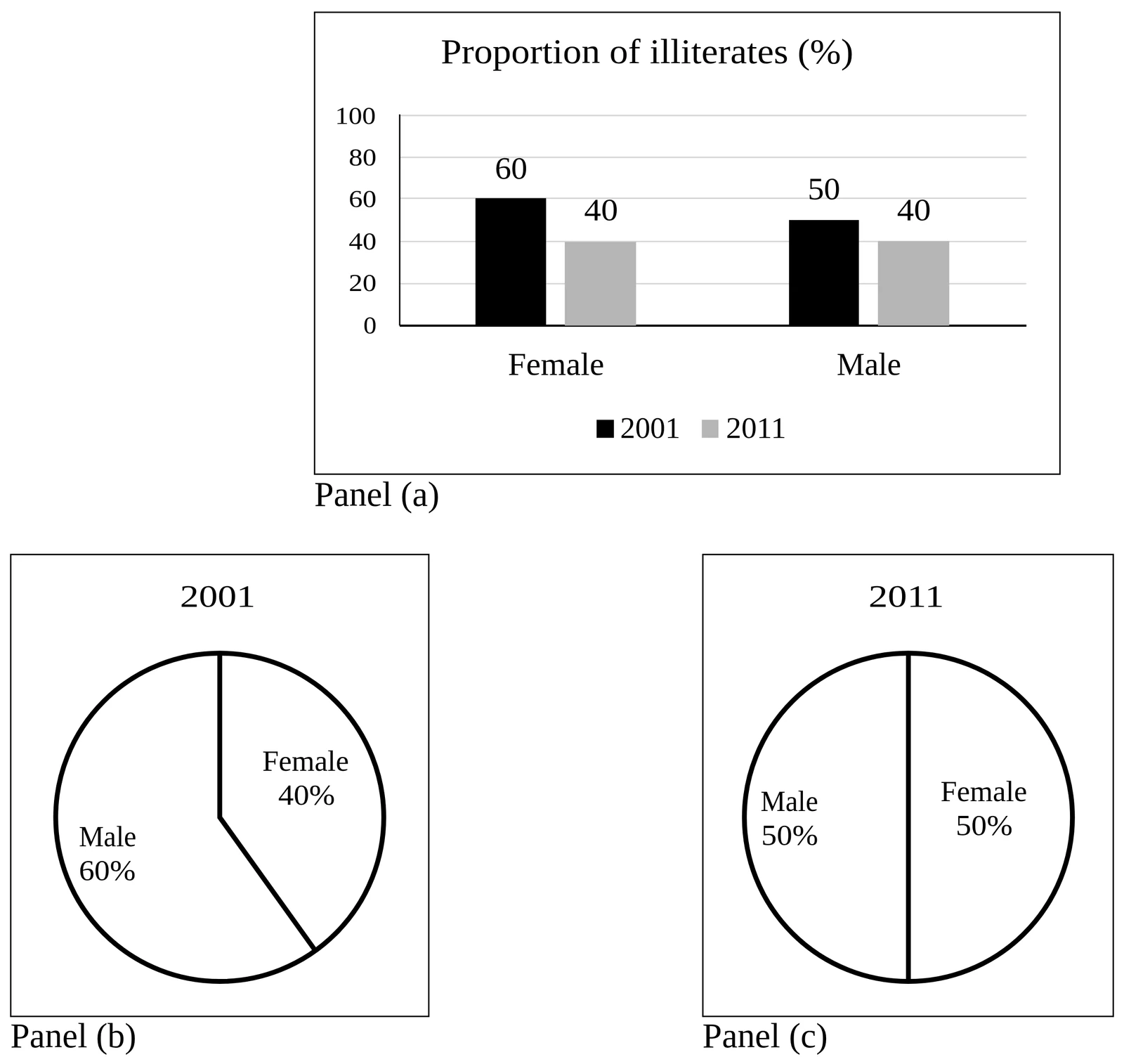
The bar graph in Panel (a) shows the proportion of male and female illiterates in 2001 and 2011. The proportions of males and females in 2001 and 2011 are given in Panel (b) and (c), respectively. The total population did not change during this period. The percentage increase in the number of literates from 2001 to 2011 is ____.

Figure for GATE 2019 EC question 7 (Quantitative Aptitude)

  • (A)
    30.4330.43
  • (B)
    33.4333.43
  • (C)
    34.4334.43
  • (D)
    35.4335.43

Answer (official key): A

Show the worked solution

Take the population as 100100. In 2001, literates numbered 40(1−0.60)+60(1−0.50)=4640(1-0.60)+60(1-0.50)=46. In 2011, both sexes had 40%40\% illiteracy, so literates numbered 6060. The percentage increase is (60−46)×100/46=30.43%(60-46)\times100/46=30.43\%.

Q42 · Control Systems · MCQ · 2 marks

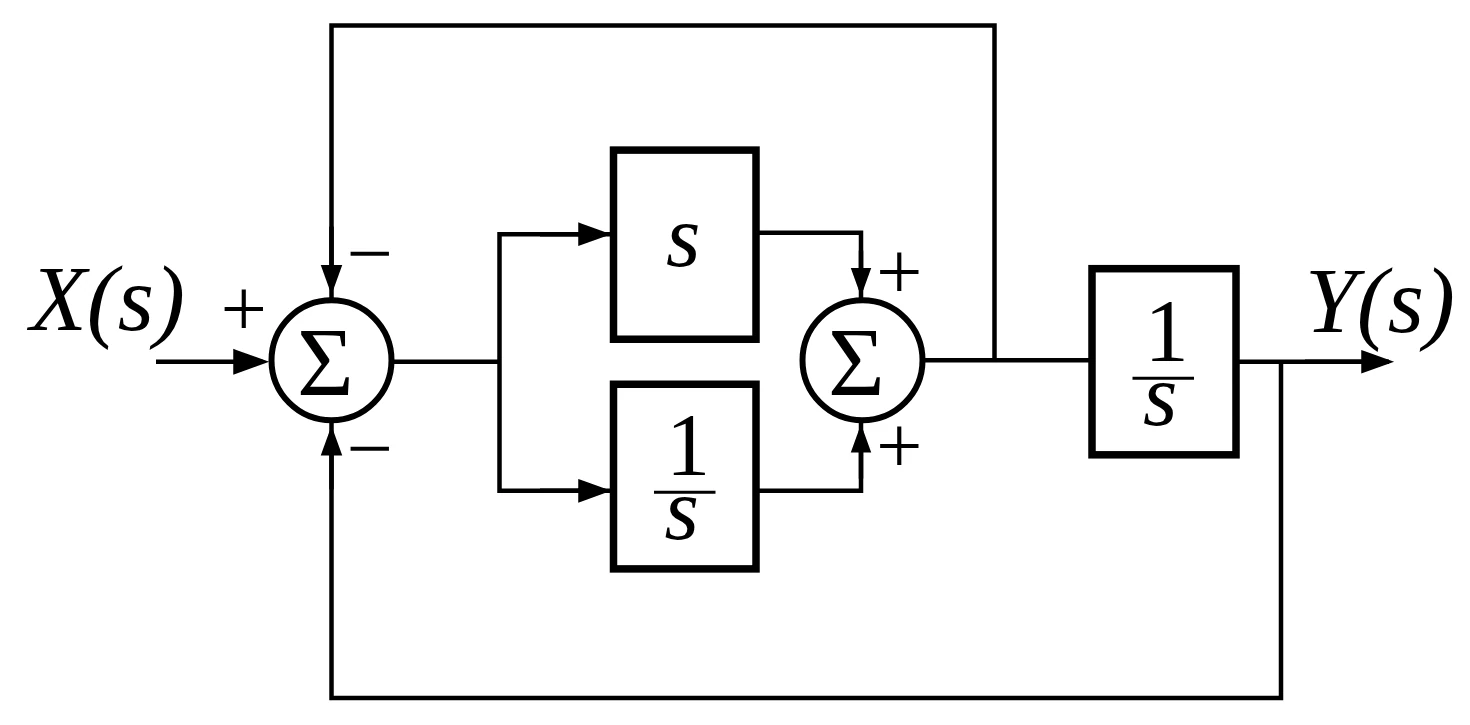
The block diagram of a system is illustrated in the figure shown, where X(s)X(s) is the input and Y(s)Y(s) is the output. The transfer function H(s)=Y(s)X(s)H(s)=\frac{Y(s)}{X(s)} is

Figure for GATE 2019 EC question 42 (Control Systems)

  • (A)
    H(s)=s2+1s3+s2+s+1H(s)=\frac{s^2+1}{s^3+s^2+s+1}
  • (B)
    H(s)=s2+1s3+2s2+s+1H(s)=\frac{s^2+1}{s^3+2s^2+s+1}
  • (C)
    H(s)=s+1s2+s+1H(s)=\frac{s+1}{s^2+s+1}
  • (D)
    H(s)=s2+12s2+1H(s)=\frac{s^2+1}{2s^2+1}

Answer (official key): B

Show the worked solution

Let EE be the first summer output and VV the second summer output. Then E=X−V−YE=X-V-Y, V=(s+1/s)EV=(s+1/s)E, and Y=V/sY=V/s. Therefore s2Y=(s2+1)[X−(s+1)Y]s^2Y=(s^2+1)[X-(s+1)Y], giving H(s)=(s2+1)/(s3+2s2+s+1)H(s)=(s^2+1)/(s^3+2s^2+s+1), option B.

Q43 · Control Systems · MCQ · 2 marks

Let the state-space representation of an LTI system be x˙(t)=A x(t)+B u(t)\dot{\mathbf{x}}(t)=A\,\mathbf{x}(t)+B\,u(t), y(t)=C x(t)+d u(t)y(t)=C\,\mathbf{x}(t)+d\,u(t) where A,B,CA,B,C are matrices, dd is a scalar, u(t)u(t) is the input to the system, and y(t)y(t) is its output. Let B=[001]TB=[0\quad0\quad1]^T and d=0d=0. Which one of the following options for AA and CC will ensure that the transfer function of this LTI system is H(s)=1s3+3s2+2s+1?H(s)=\frac{1}{s^3+3s^2+2s+1}?

  • (A)
    A=[010001−1−2−3]A=\begin{bmatrix}0&1&0\\0&0&1\\-1&-2&-3\end{bmatrix} and C=[100]C=[1\quad0\quad0]
  • (B)
    A=[010001−3−2−1]A=\begin{bmatrix}0&1&0\\0&0&1\\-3&-2&-1\end{bmatrix} and C=[100]C=[1\quad0\quad0]
  • (C)
    A=[010001−1−2−3]A=\begin{bmatrix}0&1&0\\0&0&1\\-1&-2&-3\end{bmatrix} and C=[001]C=[0\quad0\quad1]
  • (D)
    A=[010001−3−2−1]A=\begin{bmatrix}0&1&0\\0&0&1\\-3&-2&-1\end{bmatrix} and C=[001]C=[0\quad0\quad1]

Answer (official key): A

Show the worked solution

For option A, x˙1=x2\dot{x}_1=x_2, x˙2=x3\dot{x}_2=x_3, and x˙3=−x1−2x2−3x3+u\dot{x}_3=-x_1-2x_2-3x_3+u. Thus (s3+3s2+2s+1)X1=U(s^3+3s^2+2s+1)X_1=U. With C=[1 0 0]C=[1\ 0\ 0], Y=X1Y=X_1, yielding the required transfer function. Hence A.

Q51 · Networks, Signals and Systems · Numerical · 2 marks

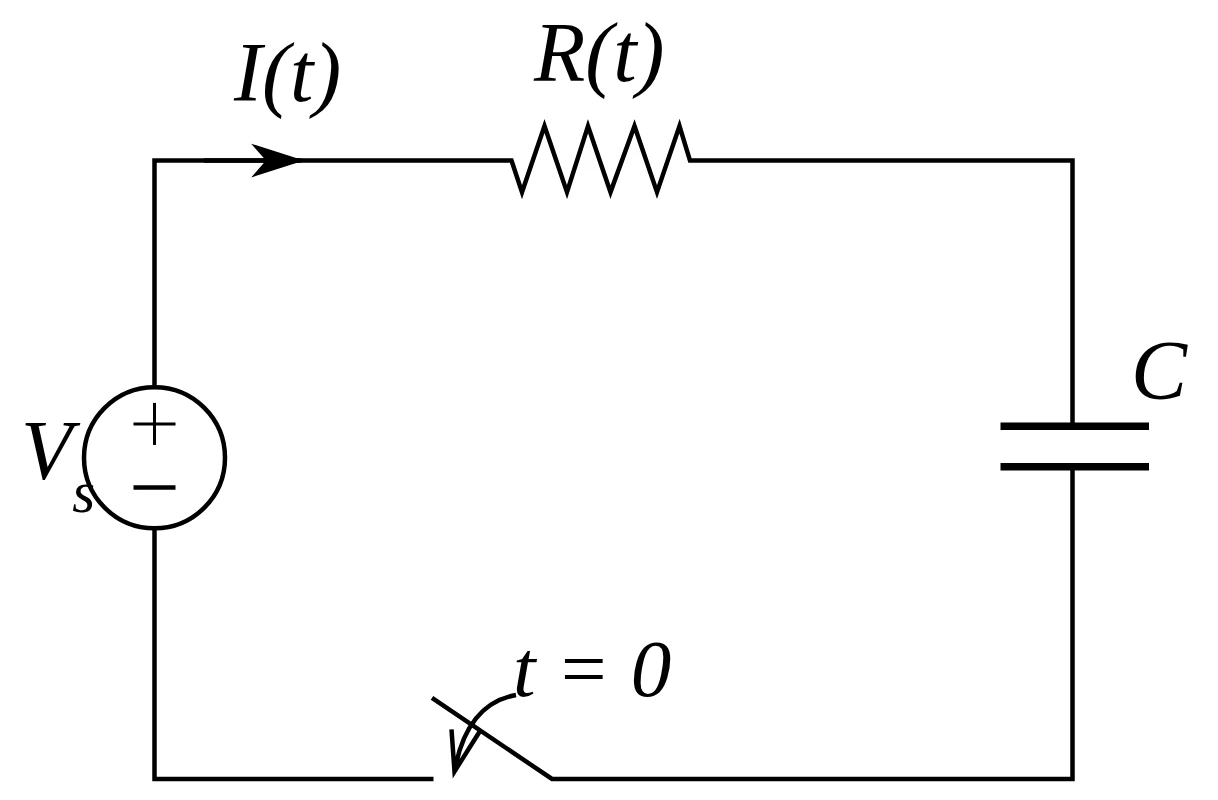
The RC circuit shown below has a variable resistance R(t)R(t) given by the following expression: R(t)=R0(1−tT) for 0≤t<TR(t)=R_0\left(1-\frac{t}{T}\right)\text{ for }0\leq t<T where R0=1 ΩR_0=1\ \Omega, and C=1 FC=1\ \text{F}. We are also given that T=3R0CT=3R_0C and the source voltage is Vs=1 VV_s=1\ \text{V}. If the current at time t=0t=0 is 1 A1\ \text{A}, then the current I(t)I(t), in amperes, at time t=T/2t=T/2 is _____ (rounded off to 22 decimal places).

Figure for GATE 2019 EC question 51 (Networks, Signals and Systems)

Answer (official key): 0.23 to 0.27

Show the worked solution

From Vs=IR+VCV_s=IR+V_C, differentiation gives RI′+(R′+1/C)I=0RI'+(R'+1/C)I=0. Since R′=−R0/TR'=-R_0/T and T=3R0CT=3R_0C, I′/I=−2/(T−t)I'/I=-2/(T-t). With I(0)=1I(0)=1, integration yields I(t)=(1−t/T)2 AI(t)=(1-t/T)^2\ \text{A}. Therefore I(T/2)=0.25 AI(T/2)=\boxed{0.25\ \text{A}}.

The other 60 questions are solved in your report when you take GATE 2019 EC as a 3-hour test.

Take GATE 2019 EC as a test

Questions about GATE 2019 EC

How many questions are in the GATE 2019 EC paper?

65 questions for 100 marks: 10 General Aptitude questions worth 15 marks and 55 Electronics & Communication Engineering questions worth 85 marks. By type, there were 40 MCQs, 25 numerical answer (NAT) questions. The paper lasted 3 hours.

Is there negative marking in GATE 2019 EC?

Yes, for MCQs only. A wrong MCQ answer costs one-third of its marks (−⅓ for a 1-mark question, −⅔ for a 2-mark question). MSQ and numerical (NAT) questions have no negative marking, and an MSQ earns marks only when every correct option is chosen.

Which topics carried the most marks in GATE 2019 EC?

Outside General Aptitude, the biggest topics were Networks, Signals and Systems (13 marks), Electronic Devices (11 marks), Control Systems (10 marks). The full topic-wise split is in the table on this page.

Were any GATE 2019 EC questions awarded marks to all?

No. Every question was graded with the answer in the official key.

Where does this GATE 2019 EC answer key come from?

From the official answer key published by IIT Madras, which organised GATE 2019. Range answers for numerical questions and questions with more than one accepted answer are kept exactly as the key gives them.

More GATE papers