Question text and figures as in the official paper, with the answer from the official key. Worked solutions for every question are in your report after you take the paper as a 3-hour test.
If ‘→’ denotes increasing order of intensity, then the meaning of the words [drizzle → rain → downpour] is analogous to [ ______ → quarrel → feud].
Which one of the given options is appropriate to fill the blank?
(A)
bicker
(B)
bog
(C)
dither
(D)
dodge
Answer (official key): A
Worked solution: in your report after you take this paper.
Q2 · General Aptitude · MCQ · 1 mark
Statements:
All heroes are winners.
All winners are lucky people.
Inferences:
I. All lucky people are heroes.
II. Some lucky people are heroes.
III. Some winners are heroes.
Which of the above inferences can be logically deduced from statements 1 and 2?
(A)
Only I and II
(B)
Only II and III
(C)
Only I and III
(D)
Only III
Answer (official key): B
Worked solution: in your report after you take this paper.
Q3 · General Aptitude · MCQ · 1 mark
A student was supposed to multiply a positive real number p with another positive real number q. Instead, the student divided p by q. If the percentage error in the student’s answer is 80%, the value of q is
(A)
5
(B)
2
(C)
2
(D)
5
Answer (official key): D
Worked solution: in your report after you take this paper.
Q4 · General Aptitude · MCQ · 1 mark
The sum of the first 20 consecutive positive odd integers is divided by 202.
What is the result?
The girls-to-boys ratio in class VIII equals the boys-to-girls ratio in class IX.
The total numbers of students in classes VIII and IX are 450 and 360,
respectively. The two classes contain the same number of girls.
In the given text, the blanks are numbered (i)−(iv). Select the best match for all the blanks.
Yoko Roi stands (i) as an author for standing (ii) as an honorary fellow, after she stood (iii) her writings that stand (iv) the freedom of speech.
(A)
(i) out; (ii) down; (iii) in; (iv) for
(B)
(i) down; (ii) out; (iii) by; (iv) in
(C)
(i) down; (ii) out; (iii) for; (iv) in
(D)
(i) out; (ii) down; (iii) by; (iv) for
Answer (official key): D
Worked solution: in your report after you take this paper.
Q7 · General Aptitude · MCQ · 2 marks
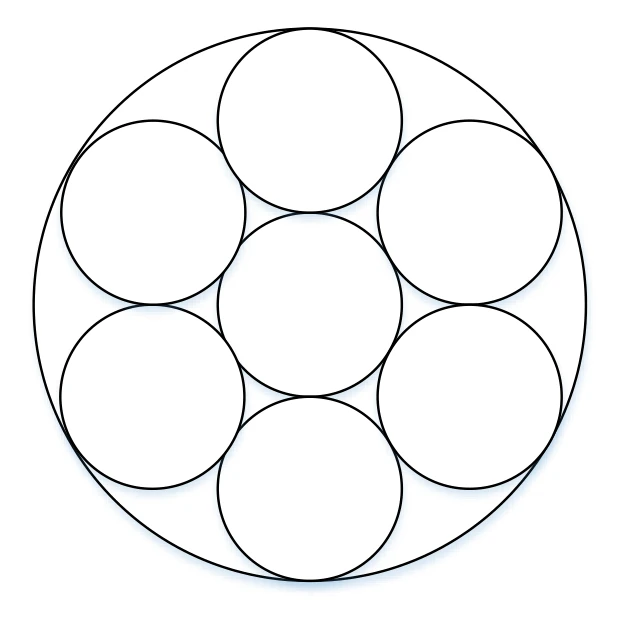
Seven identical cylindrical chalk-sticks are fitted tightly in a cylindrical container. The figure below shows the arrangement of the chalk-sticks inside the cylinder.
The length of the container is equal to the length of the chalk-sticks. The ratio of the occupied space to the empty space of the container is
(A)
5/2
(B)
7/2
(C)
9/2
(D)
3
Answer (official key): B
Worked solution: in your report after you take this paper.
Q8 · General Aptitude · MCQ · 2 marks
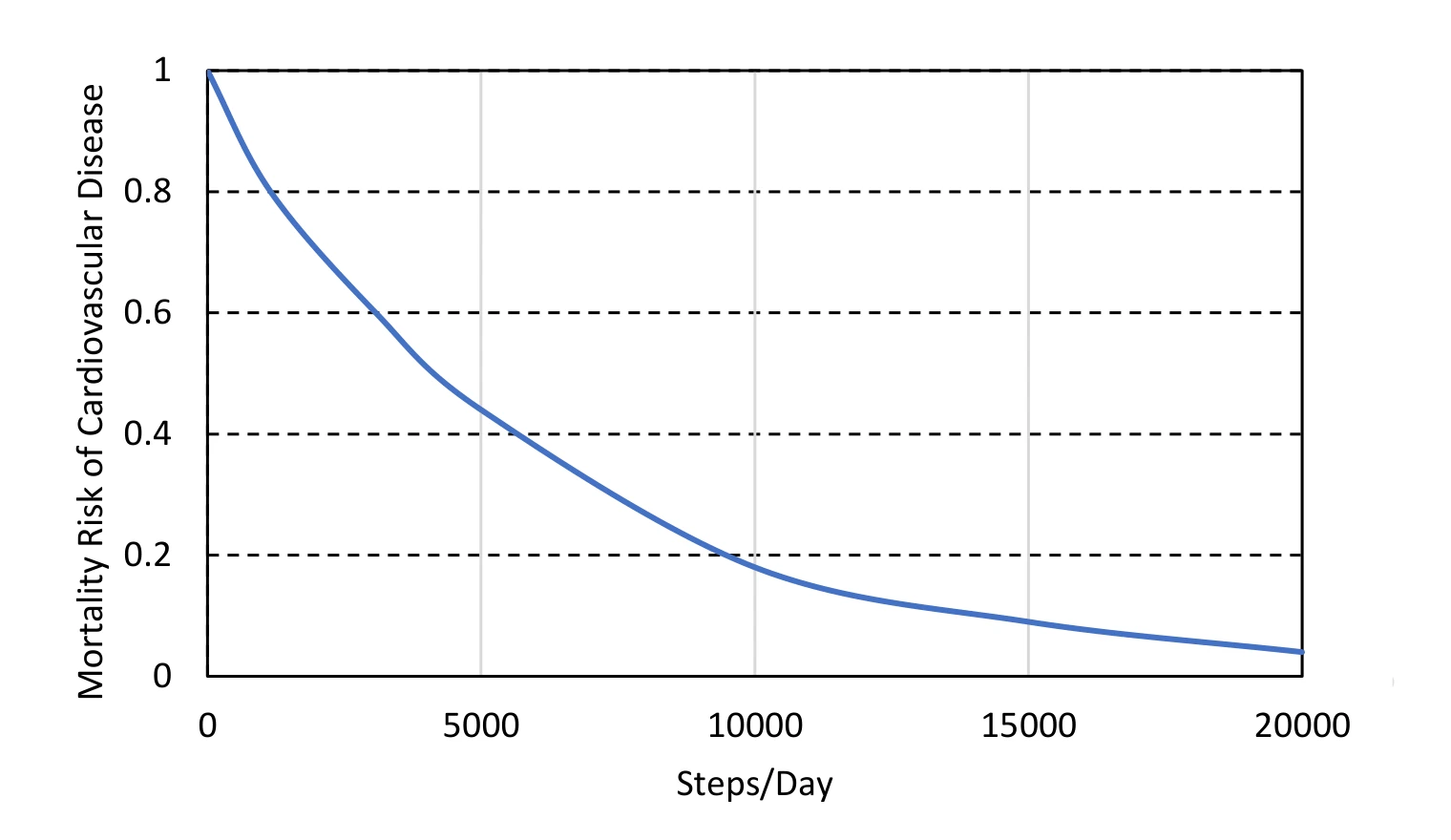
The plot below shows the relationship between the mortality risk of cardiovascular disease and the number of steps a person walks per day. Based on the data, which one of the following options is true?
(A)
The reduction from 0 to 10000 steps/day is smaller than that from 10000 to 20000.
(B)
The reduction from 0 to 5000 is smaller than that from 15000 to 20000.
(C)
Among 5000-step increments, the largest reduction occurs from 0 to 5000.
(D)
The largest reduction occurs from 15000 to 20000.
Answer (official key): C
Worked solution: in your report after you take this paper.
Q9 · General Aptitude · MCQ · 2 marks
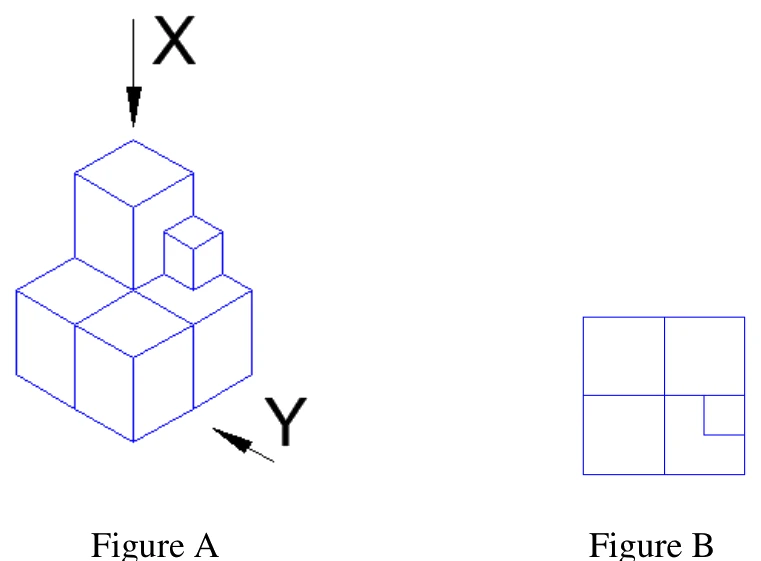
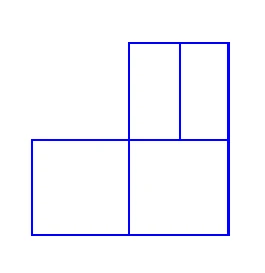
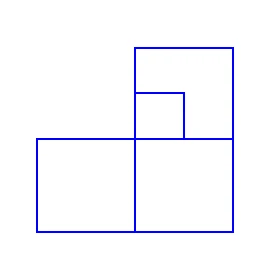
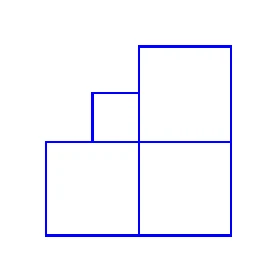
Five cubes of identical size and another smaller cube are assembled as shown in Figure A. If viewed from direction X, the planar image of the assembly appears as Figure B.
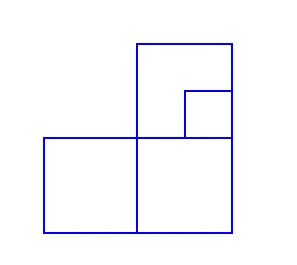
If viewed from direction Y, the planar image of the assembly (Figure A) will appear as
(A)
(B)
(C)
(D)
Answer (official key): A
Worked solution: in your report after you take this paper.
Q10 · General Aptitude · MCQ · 2 marks
Visualize a cube that is held with one of the four body diagonals aligned to the vertical axis. Rotate the cube about this axis such that its view remains unchanged. The magnitude of the minimum angle of rotation is
(A)
120∘
(B)
60∘
(C)
90∘
(D)
180∘
Answer (official key): A
Worked solution: in your report after you take this paper.
Q11 · Partial Differential Equations · MCQ · 1 mark
A partial differential equation
∂x2∂2T+∂y2∂2T=0
is defined for the two-dimensional field T:T(x,y), inside a planar square domain of size 2 m × 2 m. Three boundary edges of the square domain are maintained at value T=50, whereas the fourth boundary edge is maintained at T=100.
The value of T at the center of the domain is
(A)
50
(B)
62.5
(C)
75
(D)
87.5
Answer (official key): B
Worked solution: in your report after you take this paper.
Q12 · Linear Algebra · MCQ · 1 mark
The statements P and Q are related to matrices A and B, which are conformable for both addition and multiplication.
P: (A+B)T=AT+BT
Q: (AB)T=ATBT
Which one of the following options is CORRECT?
(A)
P is TRUE and Q is FALSE
(B)
Both P and Q are TRUE
(C)
P is FALSE and Q is TRUE
(D)
Both P and Q are FALSE
Answer (official key): A
Worked solution: in your report after you take this paper.
Q13 · Numerical Methods · MCQ · 1 mark
The second derivative of a function f is computed using the fourth-order Central Divided Difference method with a step length h. The CORRECT expression for the second derivative is
(A)
12h2−fi+2+16fi+1−30fi+16fi−1−fi−2
(B)
12h2fi+2+16fi+1−30fi+16fi−1−fi−2
(C)
12h2−fi+2+16fi+1−30fi+16fi−1+fi−2
(D)
12h2fi+2−16fi+1+30fi−16fi−1+fi−2
Answer (official key): A
Worked solution: in your report after you take this paper.
Q14 · Calculus · MCQ · 1 mark
The function f(x)=x3−27x+4, 1≤x≤6 has
(A)
Maxima point
(B)
Minima point
(C)
Saddle point
(D)
Inflection point
Answer (official key): B
Worked solution: in your report after you take this paper.
Q15 · Ordinary Differential Equations · MCQ · 1 mark
Consider two Ordinary Differential Equations (ODEs):
P: dxdy=x3yx4+3x2y2+2y4
Q: dxdy=x2−y2
Which one of the following options is CORRECT?
(A)
P is homogeneous and Q is exact
(B)
P is homogeneous and Q is not exact
(C)
P is non-homogeneous and Q is exact
(D)
Neither statement applies
Answer (official key): B
Worked solution: in your report after you take this paper.
Q16 · Structural Engineering · MCQ · 1 mark
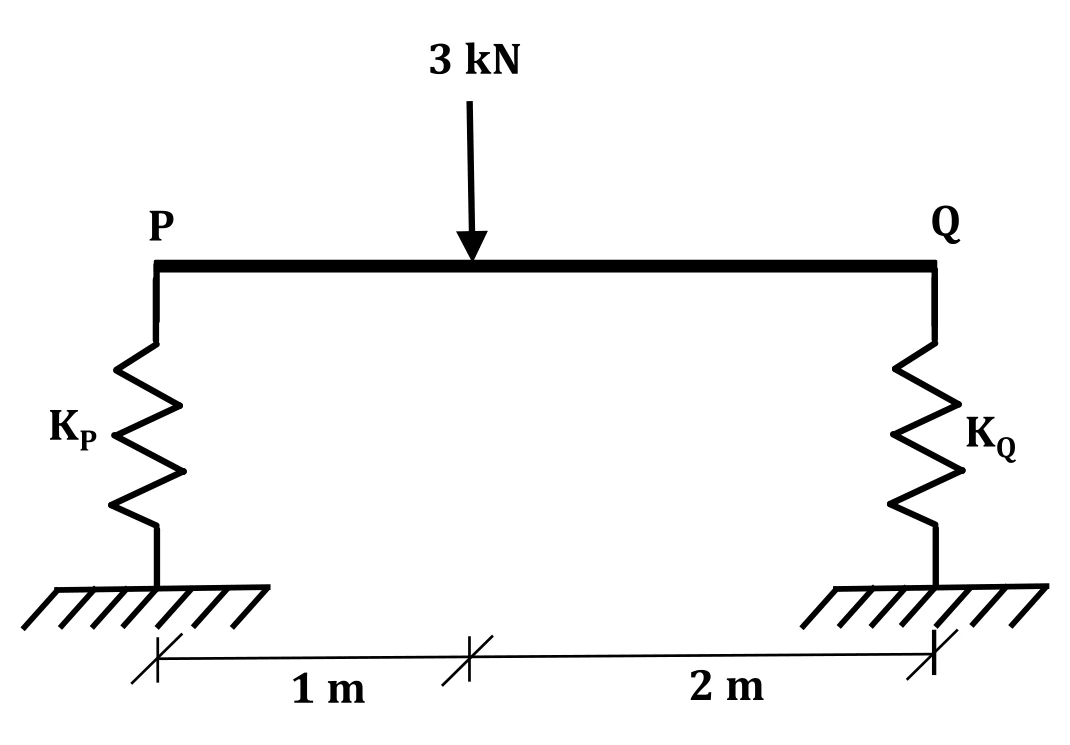
A 3 m long, horizontal, rigid, uniform beam PQ has negligible mass. The beam is subjected to a 3 kN concentrated vertically downward force at 1 m from P, as shown in the figure. The beam is resting on vertical linear springs at the ends P and Q. For the spring at the end P, the spring constant KP = 100 kN/m.
(Figure NOT to scale)
If the beam DOES NOT rotate under the application of the force and displaces only vertically, the value of the spring constant KQ (in kN/m) for the spring at the end Q is
Q17 · Construction Materials and Management · MCQ · 1 mark
Consider:
P. In a pure project organization, the project manager has complete authority
and maximum control over the project.
Q. A matrix organization facilitates relatively quick responses to changes,
conflicts and project needs.
Choose the correct truth combination.
(A)
Both P and Q are TRUE
(B)
P is TRUE and Q is FALSE
(C)
Both P and Q are FALSE
(D)
P is FALSE and Q is TRUE
Answer (official key): A
Worked solution: in your report after you take this paper.
Q18 · Structural Engineering · MCQ · 1 mark
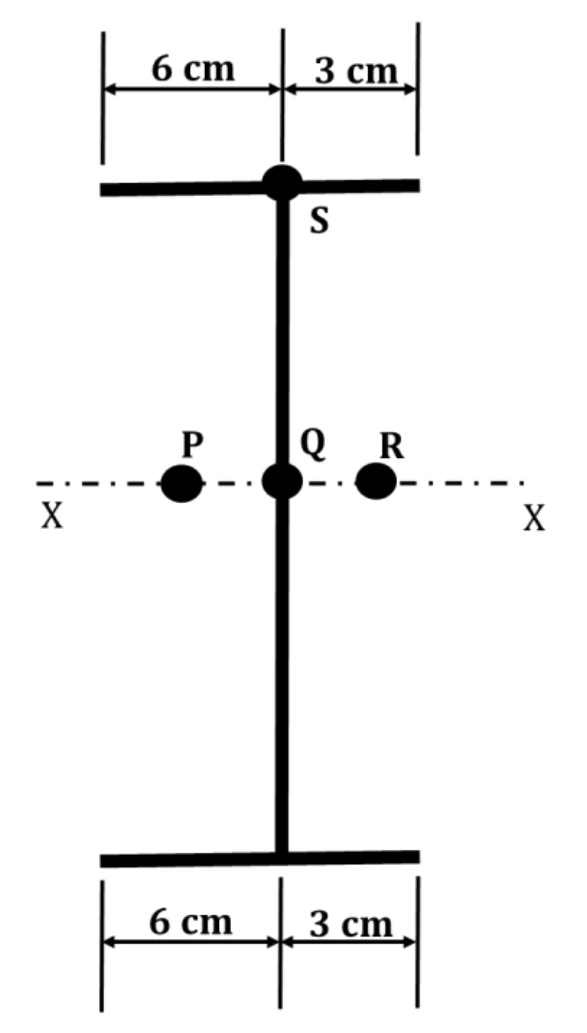
For a thin-walled section shown in the figure, points P, Q, and R are located on the major bending axis X−X of the section. Point Q is located on the web whereas point S is located at the intersection of the web and the top flange of the section.
(Figure NOT to scale)
Qualitatively, the shear center of the section lies at
(A)
P
(B)
Q
(C)
R
(D)
S
Answer (official key): C
Worked solution: in your report after you take this paper.
Q19 · Construction Materials and Management · MCQ · 1 mark
Consider the following data for a project of 300 days duration.
Budgeted Cost of Work Scheduled (BCWS) = Rs. 200
Budgeted Cost of Work Performed (BCWP) = Rs. 150
Actual Cost of Work Performed (ACWP) = Rs. 190
The ‘schedule variance’ for the project is
(A)
−₹50
(B)
−50 days
(C)
+₹50
(D)
+50 days
Answer (official key): A
Worked solution: in your report after you take this paper.
Q20 · Structural Engineering · MCQ · 1 mark
A simply supported, uniformly loaded, two-way slab panel is torsionally unrestrained. The effective span lengths along the short span (x) and long span (y) directions of the panel are lx and ly, respectively. The design moments for the reinforcements along the x and y directions are Mux and Muy, respectively. By using Rankine-Grashoff method, the ratio Mux/Muy is proportional to
(A)
lx/ly
(B)
ly/lx
(C)
(lx/ly)2
(D)
(ly/lx)2
Answer (official key): D
Worked solution: in your report after you take this paper.
Q21 · Structural Engineering · MCQ · 1 mark
Which structural-design method does not apply explicit safety factors to the
design loads?
(A)
Working stress method
(B)
Load factor method
(C)
Ultimate load method
(D)
Limit state method
Answer (official key): A
Worked solution: in your report after you take this paper.
Q22 · Geotechnical Engineering · MCQ · 1 mark
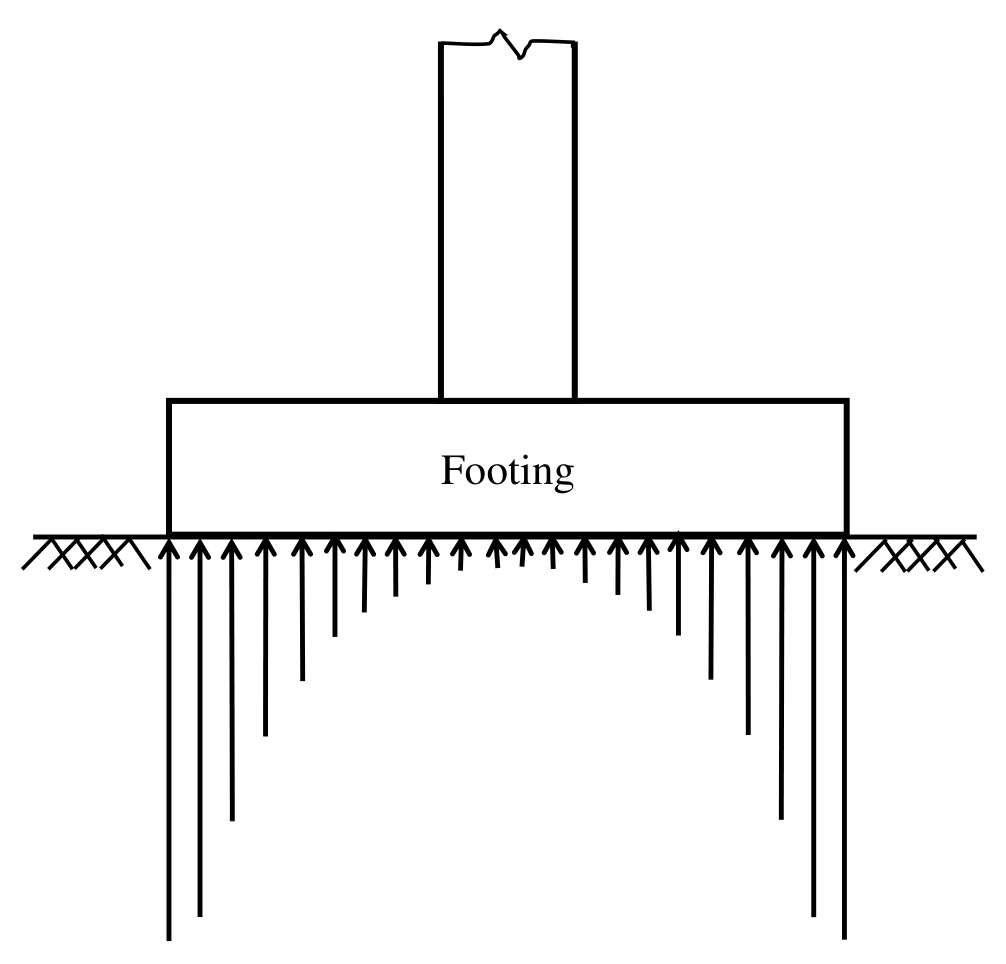
The figure shows a characteristic contact-pressure distribution beneath a
shallow footing.
Which footing/soil idealization corresponds to the shown distribution?
(A)
Rigid footing on cohesionless soil
(B)
Rigid footing on cohesive soil
(C)
Flexible footing on cohesionless soil
(D)
Flexible footing on cohesive soil
Answer (official key): B
Worked solution: in your report after you take this paper.
Q23 · Geotechnical Engineering · MCQ · 1 mark
Which one of the following saturated fine-grained soils can attain a negative Skempton’s pore pressure coefficient (A)?
(A)
Quick clay
(B)
Normally consolidated clay
(C)
Lightly consolidated clay
(D)
Over-consolidated clay
Answer (official key): D
Worked solution: in your report after you take this paper.
Q24 · Water Resources Engineering · MCQ · 1 mark
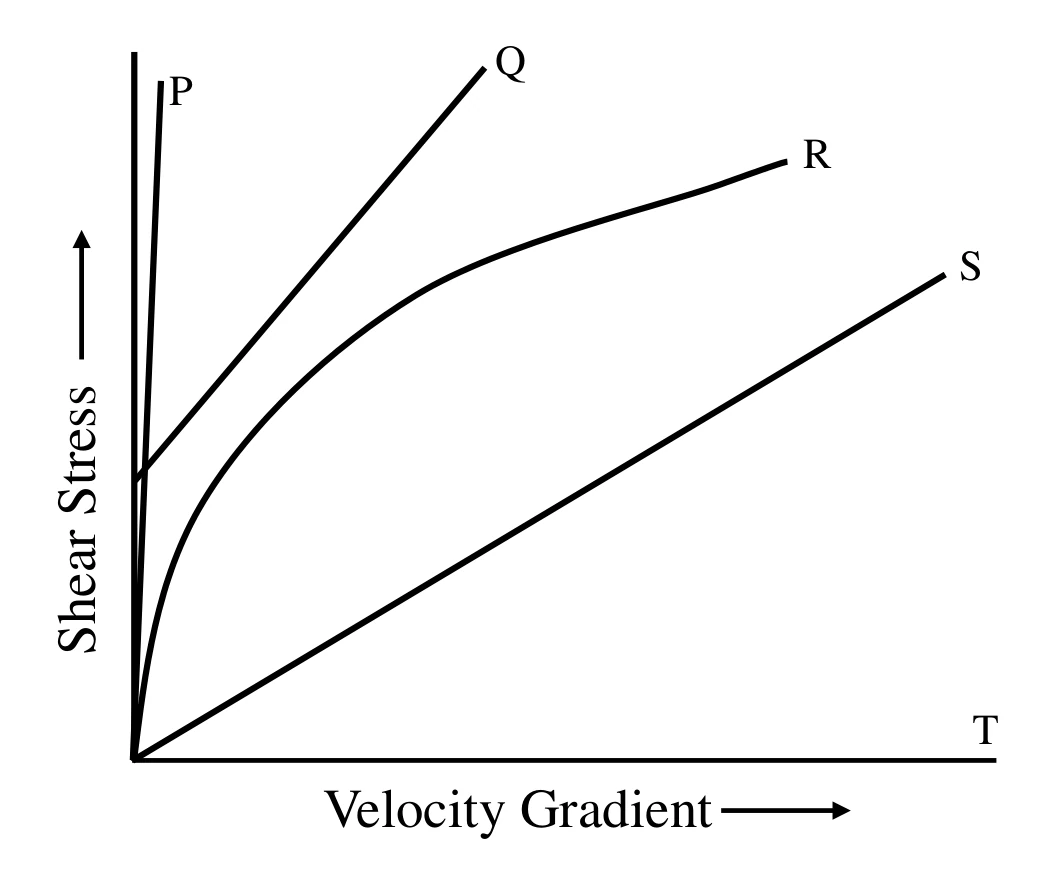
The source figure plots shear stress against velocity gradient for several
idealized rheological behaviours labelled P, Q, R, S and T.
Choose the correct identification.
(A)
P ideal fluid; Q ideal Bingham plastic; R non-Newtonian; S Newtonian
(B)
P real solid; Q ideal Bingham plastic; S Newtonian fluid; T ideal fluid
(C)
P ideal fluid; Q ideal Bingham plastic; R non-Newtonian; T real solid
(D)
P real solid; Q Newtonian; R ideal Bingham plastic; T ideal fluid
Answer (official key): B
Worked solution: in your report after you take this paper.
Q25 · Environmental Engineering · MCQ · 1 mark
What is the CORRECT match between the air pollutants and treatment techniques given in the table?
Air pollutants
Treatment techniques
P - NO2
i - Flaring
Q - SO2
ii - Cyclonic separator
R - CO
iii - Lime scrubbing
S - Particles
iv - NH3 injection
(A)
P-i; Q-ii; R-iii; S-iv
(B)
P-ii; Q-i; R-iv; S-iii
(C)
P-ii; Q-iii; R-iv; S-i
(D)
P-iv; Q-iii; R-i; S-ii
Answer (official key): D
Worked solution: in your report after you take this paper.
Q26 · Environmental Engineering · MCQ · 1 mark
Which one of the following products is NOT obtained in anaerobic decomposition of glucose?
(A)
CO₂
(B)
CH₄
(C)
H₂S
(D)
H₂O
Answer (official key): C
Worked solution: in your report after you take this paper.
Q27 · Transportation Engineering · MCQ · 1 mark
The longitudinal sections of a runway have gradients as shown in the table.
End to end for sections of runway (m)
Gradient (%)
0 to 200
+1.0
200 to 600
−1.0
600 to 1200
+0.8
1200 to 1600
+0.2
1600 to 2000
−0.5
Consider the reduced level (RL) at the starting point of the runway as 100 m. The effective gradient of the runway is
(A)
0.02%
(B)
0.35%
(C)
0.28%
(D)
0.18%
Answer (official key): C
Worked solution: in your report after you take this paper.
Q28 · Transportation Engineering · MCQ · 1 mark
On horizontal curves, superelevation/cant is produced by raising the outer edge
relative to the inner edge in which transportation systems?
(A)
Highways, railways and taxiways
(B)
Highways and railways
(C)
Railways and taxiways
(D)
Highways only
Answer (official key): B
Worked solution: in your report after you take this paper.
Q29 · Transportation Engineering · MCQ · 1 mark
Various stresses in jointed plain concrete pavement with slab size of 3.5 m × 4.5 m are denoted as follows:
Wheel load stress at interior = Swli
Wheel load stress at edge = Swle
Wheel load stress at corner = Swlc
Warping stress at interior = Sti
Warping stress at edge = Ste
Warping stress at corner = Stc
Frictional stress between slab and supporting layer = Sf
The critical stress combination in the concrete slab during a summer midnight is
(A)
Swlc+Stc
(B)
Swle+Ste+Sf
(C)
Swle+Ste−Sf
(D)
Swlc+Stc+Sf
Answer (official key): A
Worked solution: in your report after you take this paper.
Q30 · Geomatics Engineering · MCQ · 1 mark
For a reconnaissance survey, it is necessary to obtain vertical aerial photographs of a terrain at an average scale of 1 : 13000 using a camera. If the permissible flying height is assumed as 3000 m above a datum and the average terrain elevation is 1050 m above the datum, the required focal length (in mm) of the camera is
(A)
100 mm
(B)
150 mm
(C)
125 mm
(D)
200 mm
Answer (official key): B
Worked solution: in your report after you take this paper.
Q31 · Geomatics Engineering · MCQ · 1 mark
What is the CORRECT match between the survey instruments/parts of instruments shown in the table and the operations carried out with them?
Instruments/Parts of instruments
Operations
P - Bubble tube
i - Tacheometry
Q - Plumb bob
ii - Minor movements
R - Tangent screw
iii - Centering
S - Stadia cross-wire
iv - Levelling
(A)
P-ii; Q-iii; R-iv; S-i
(B)
P-iv; Q-iii; R-ii; S-i
(C)
P-i; Q-iii; R-ii; S-iv
(D)
P-iii; Q-iv; R-i; S-ii
Answer (official key): B
Worked solution: in your report after you take this paper.
Q32 · Geomatics Engineering · MCQ · 1 mark
To finalize the direction of a survey, four surveyors set up a theodolite at a station P and performed all the temporary adjustments. From the station P, each of the surveyors observed the bearing to a tower located at station Q with the same instrument without shifting it. The bearings observed by the surveyors are 30°30′00″, 30°29′40″, 30°30′20″ and 30°31′20″. Assuming that each measurement is taken with equal precision, the most probable value of the bearing is
(A)
30∘30′00′′
(B)
30∘30′20′′
(C)
30∘30′40′′
(D)
30∘31′00′′
Answer (official key): B
Worked solution: in your report after you take this paper.
Q33 · Structural Engineering · Numerical · 1 mark
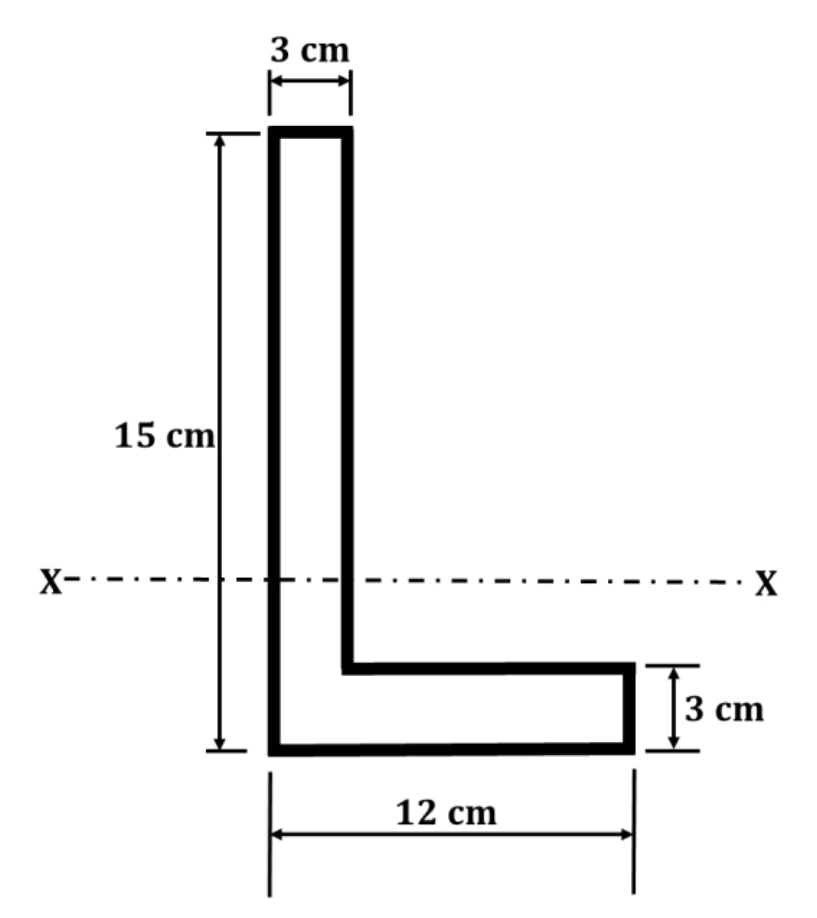
The steel angle section shown in the figure has elastic section modulus of 150.92 cm³ about the horizontal X−X axis, which passes through the centroid of the section.
(Figure NOT to scale)
The shape factor of the section is ________ (rounded off to 2 decimal places).
Answer (official key): 1.75 to 1.85
Worked solution: in your report after you take this paper.
Q34 · Geotechnical Engineering · Numerical · 1 mark
A reinforced concrete pile of 10 m length and 0.7 m diameter is embedded in a saturated pure clay with unit cohesion of 50 kPa. If the adhesion factor is 0.5, the net ultimate uplift pullout capacity (in kN) of the pile is _________________ (rounded off to the nearest integer).
Answer (official key): 545 to 555
Worked solution: in your report after you take this paper.
Q35 · Water Resources Engineering · Numerical · 1 mark
A 2 m wide rectangular channel is carrying a discharge of 30 m³/s at a bed slope of 1 in 300. Assuming the energy correction factor as 1.1 and acceleration due to gravity as 10 m/s², the critical depth of flow (in meters) is _____________ (rounded off to 2 decimal places).
Answer (official key): 2.88 to 2.94
Worked solution: in your report after you take this paper.
Q36 · Probability and Statistics · MCQ · 2 marks
In a sample of 100 heart patients, each patient has 80% chance of having a heart
attack without medicine X. It is clinically known that medicine X reduces the
probability of having a heart attack by 50%. Medicine X is taken by 50 of these
100 patients.
The probability that a randomly selected patient, out of the 100 patients, takes
medicine X and has a heart attack is
(A)
40%
(B)
60%
(C)
20%
(D)
30%
Answer (official key): C
Worked solution: in your report after you take this paper.
Q37 · Structural Engineering · MCQ · 2 marks
Not in GATE 2027 syllabus: Free vibration of undamped SDOF systems
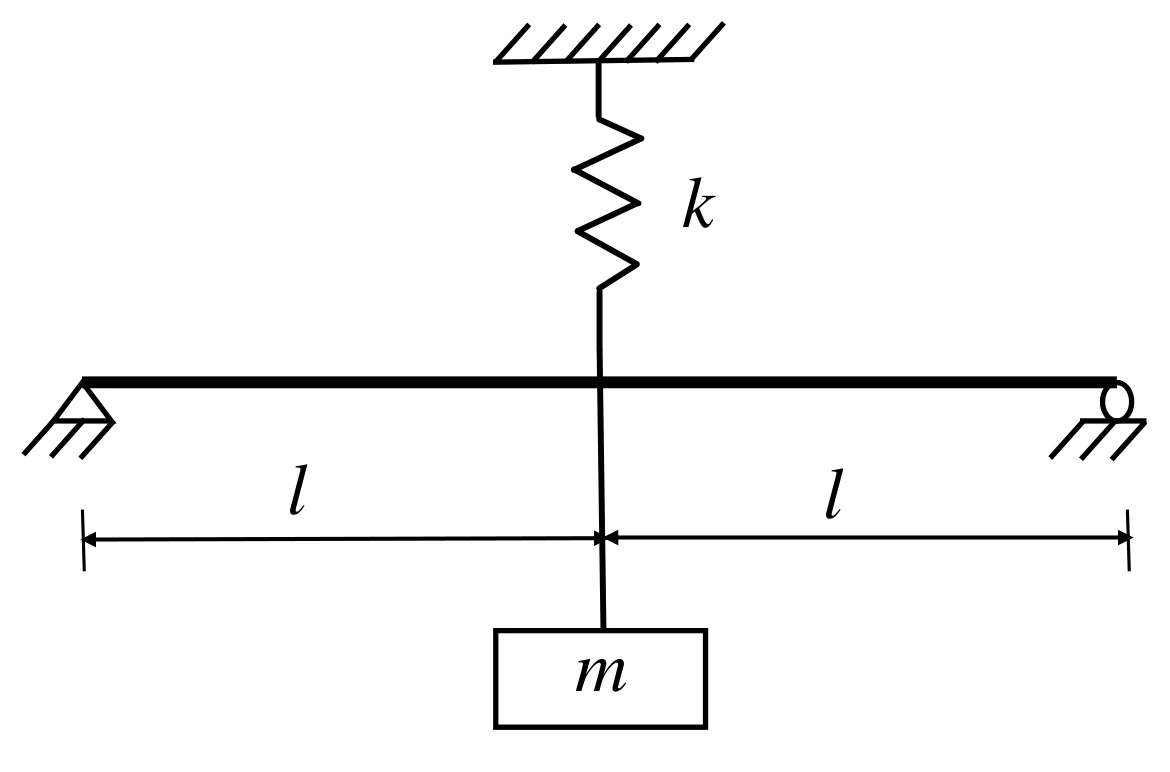
A linearly elastic beam of length 2l with flexural rigidity EI has negligible
mass. A massless spring with a spring constant k and a rigid block of mass m
are attached to the beam as shown in the figure.
The natural frequency of this system is
(A)
ml3kl3+6EI
(B)
ml3kl3+48EI
(C)
(kl3+6EI)m6EIk
(D)
(kl3+48EI)m48EIk
Answer (official key): A
Worked solution: in your report after you take this paper.
Q38 · Construction Materials and Management · MCQ · 2 marks
A critical activity in a project is estimated to take 15 days to complete at a cost
of ₹30,000. The activity can be expedited to complete in 12 days by spending a
total amount of ₹54,000.
Consider:
P: It is economically advisable to complete the activity early by crashing, if
the indirect cost of the project is ₹8,500 per day.
Q: It is economically advisable to complete the activity early by crashing, if
the indirect cost of the project is ₹10,000 per day.
Which option is CORRECT?
(A)
Both P and Q are TRUE
(B)
P is TRUE and Q is FALSE
(C)
Both P and Q are FALSE
(D)
P is FALSE and Q is TRUE
Answer (official key): A
Worked solution: in your report after you take this paper.
Q39 · Structural Engineering · MCQ · 2 marks
A homogeneous, prismatic, linearly elastic steel bar fixed at both ends has a
slenderness ratio (l/r) of 105, where l is the bar length and r is the
radius of gyration. The coefficient of thermal expansion of steel is
12×10−6/∘C.
Consider the effective length of the steel bar as 0.5l and neglect the
self-weight of the bar.
The differential increase in temperature, rounded off to the nearest integer, at
which the bar buckles is
(A)
298∘C
(B)
85∘C
(C)
400∘C
(D)
250∘C
Answer (official key): A
Worked solution: in your report after you take this paper.
Q40 · Geotechnical Engineering · MCQ · 2 marks
Consider the statements P and Q related to the analysis/design of retaining walls.
P: When a rough retaining wall moves toward the backfill, the wall friction
force/resistance mobilizes in upward direction along the wall.
Q: Most of the earth pressure theories calculate the earth pressure due to
surcharge by neglecting the actual distribution of stresses due to surcharge.
Which one of the following options is CORRECT?
(A)
Both P and Q are TRUE
(B)
P is TRUE and Q is FALSE
(C)
Both P and Q are FALSE
(D)
P is FALSE and Q is TRUE
Answer (official key): A
Worked solution: in your report after you take this paper.
Q41 · Water Resources Engineering · MCQ · 2 marks
A round-bottom triangular lined canal is to be laid at a slope of 1 in 1500, to
carry a discharge of 25 m3/s. The side slopes of the canal cross-section are
to be kept at 1.25H : 1V. If Manning's roughness coefficient is 0.013, the flow
depth (in meters) will be in the range of
(A)
2.39 to 2.42
(B)
1.94 to 1.97
(C)
2.24 to 2.27
(D)
2.61 to 2.64
Answer (official key): A
Worked solution: in your report after you take this paper.
Q42 · Environmental Engineering · MCQ · 2 marks
A hypothetical multimedia filter consists of anthracite particles
(specific gravity 1.50), silica sand (specific gravity 2.60), and ilmenite sand
(specific gravity 4.20). After backwashing, the particles should settle to form
three layers: coarse anthracite at the top, silica sand in the middle, and small
ilmenite particles at the bottom.
Assume:
(i) slow discrete settling, so Stokes' law applies;
(ii) all particles are spherical; and
(iii) the silica-sand particle diameter is 0.20 mm.
Which option correctly satisfies the diameter requirements?
(A)
diameter of anthracite particles is slightly less than 0.35 mm and diameter of ilmenite particles is slightly greater than 0.141 mm.
(B)
diameter of anthracite particles is slightly greater than 0.35 mm and diameter of ilmenite particles is slightly less than 0.141 mm.
(C)
diameter of anthracite particles is slightly less than 0.64 mm and diameter of ilmenite particles is slightly less than 0.10 mm.
(D)
diameter of anthracite particles is slightly greater than 0.64 mm and diameter of ilmenite particles is slightly less than 0.10 mm.
Answer (official key): A
Worked solution: in your report after you take this paper.
Q43 · Transportation Engineering · MCQ · 2 marks
The consolidated data of a spot speed study for a certain stretch of a highway
is given below.
Speed range (kmph)
Number of observations
0–10
7
10–20
31
20–30
76
30–40
129
40–50
104
50–60
78
60–70
29
70–80
24
80–90
13
90–100
9
The "upper speed limit" (in kmph) for the traffic sign is
(A)
50
(B)
55
(C)
65
(D)
70
Answer (official key): B
Worked solution: in your report after you take this paper.
P: Compacted fine-grained soils with flocculated structure have isotropic permeability.
Q: Phreatic surface/line is the line along which the pore water pressure is always maximum.
R: The piping phenomenon occurring below the dam foundation is typically known as blowout piping.
Which of the following option(s) is/are CORRECT?
(A)
Both P and R are TRUE
(B)
P is FALSE and Q is TRUE
(C)
P is TRUE and R is FALSE
(D)
Both Q and R are FALSE
Answer (official key): C, D
Worked solution: in your report after you take this paper.
Q46 · Transportation Engineering · MSQ · 2 marks
In the context of pavement material characterization, the CORRECT statement(s)
is/are
(A)
The load penetration curve of CBR test may need origin correction due to the non-vertical penetrating plunger of the loading machine.
(B)
The toughness and hardness of road aggregates are determined by Los Angeles abrasion test and aggregate impact test, respectively.
(C)
Grading of normal (unmodified) bitumen binders is done based on viscosity test results.
(D)
In compacted bituminous mix, Voids in the Mineral Aggregate (VMA) is equal to the sum of total volume of air voids (Vv) and total volume of bitumen (Vb).
Answer (official key): A, C, D
Worked solution: in your report after you take this paper.
Q47 · Construction Materials and Management · Numerical · 2 marks
The expression for computing the effective interest rate (ieff)
using continuous compounding for a nominal interest rate of 5% is
ieff=m→∞lim(1+m0.05)m−1.
The effective interest rate (in percentage) is ______
(rounded off to 2 decimal places).
Answer (official key): 5.11 to 5.15
Worked solution: in your report after you take this paper.
Q48 · Linear Algebra · Numerical · 2 marks
Consider
A=[211043],B=−121034.
The determinant of the matrix AB is ______ (in integer).
Answer (official key): 10
Worked solution: in your report after you take this paper.
Q49 · Structural Engineering · Numerical · 2 marks
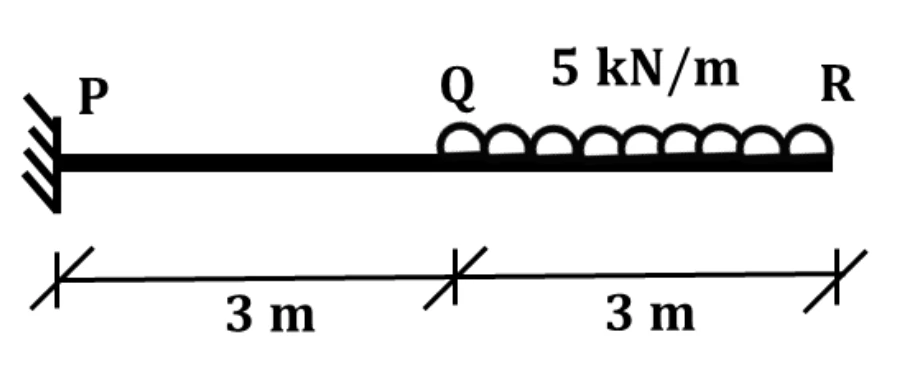
For the 6 m long horizontal cantilever beam PQR shown in the figure, Q is the
mid-point. Segment PQ has flexural rigidity
EI=2×10⁵ kN·m2, whereas segment QR has infinite flexural rigidity.
Segment QR is subjected to a uniformly distributed, vertically downward load of
5 kN/m.
The magnitude of the vertical displacement (in mm) at point Q is ______
(rounded off to 3 decimal places).
Answer (official key): 1.176 to 1.186
Worked solution: in your report after you take this paper.
Q50 · Structural Engineering · Numerical · 2 marks
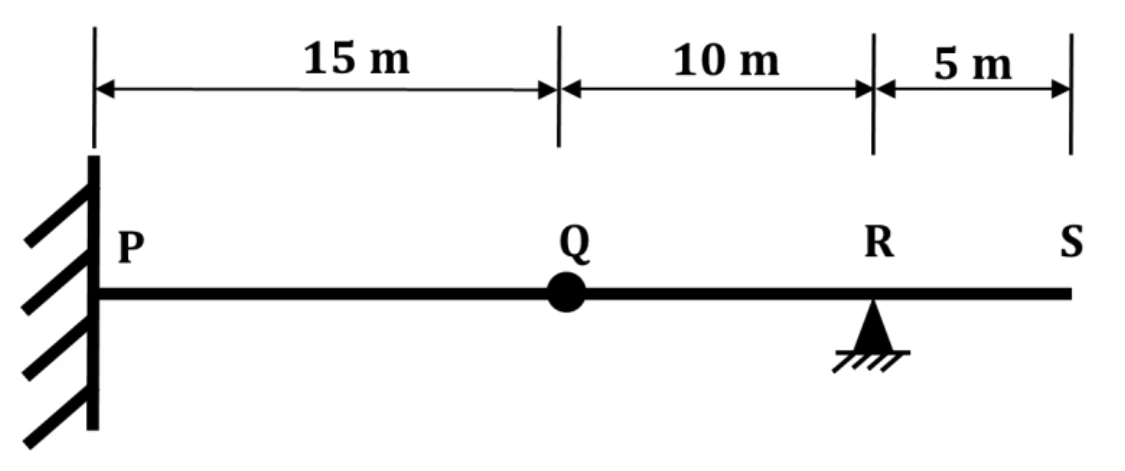
The horizontal beam PQRS shown in the figure has a fixed support at P, an internal
hinge at Q, and a pin support at R. A concentrated vertically downward load
V=10 kN can act at any point over the entire length of the beam.
The maximum magnitude of the moment reaction (in kN·m) that can act at support P
due to V is ______ (in integer).
Answer (official key): 150
Worked solution: in your report after you take this paper.
Q51 · Structural Engineering · Numerical · 2 marks
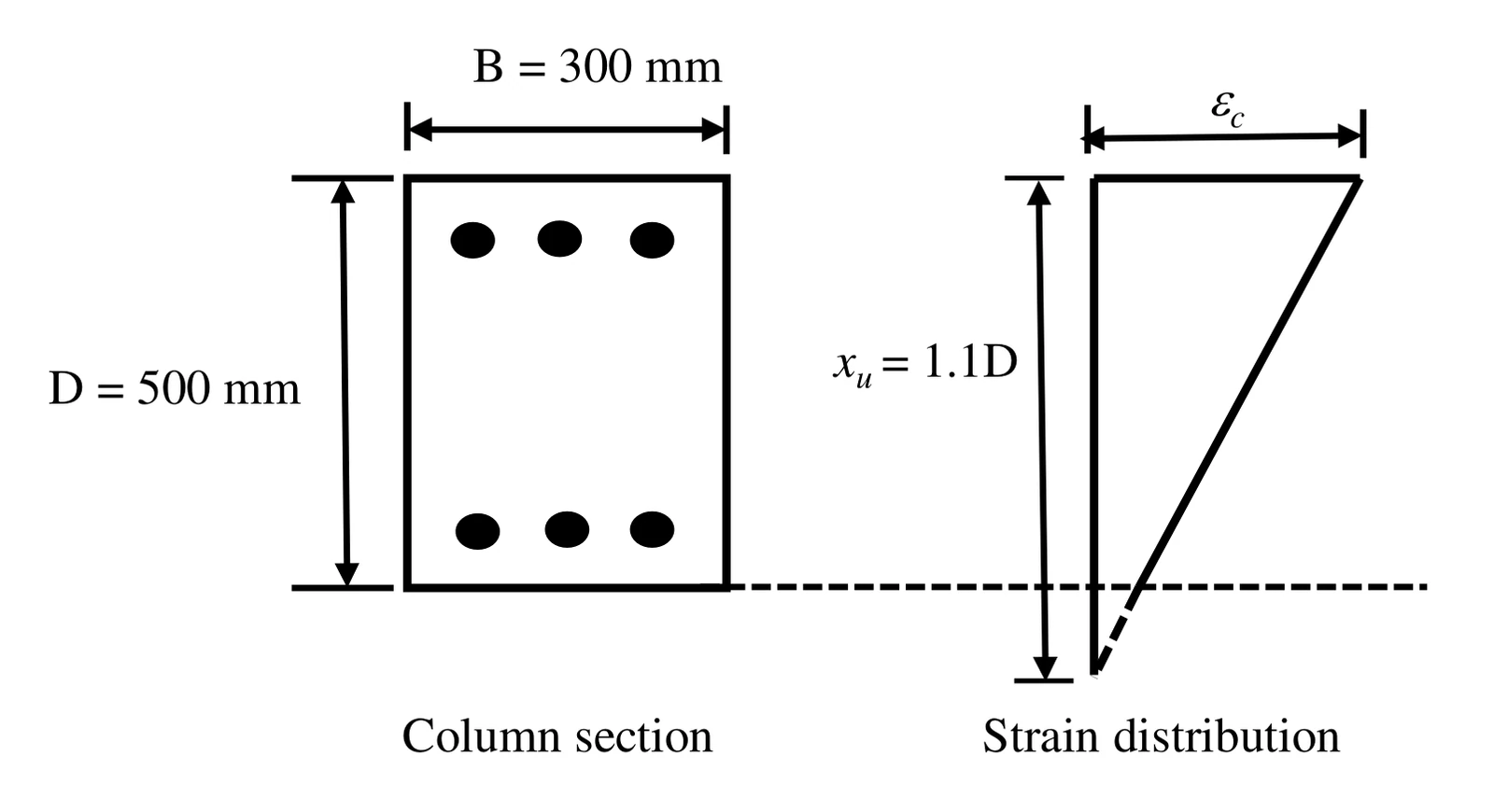
A concrete column section of size 300 mm × 500 mm is subjected to both axial
compression and bending along the major axis. The neutral-axis depth is
xu=1.1D,
as shown in the figure.
The maximum compressive strain (ϵc) at the highly compressed extreme
fibre in concrete, where there is no tension in the section, is
______ × 10−3 (rounded off to 2 decimal places).
Answer (official key): 3.2 to 3.4
Worked solution: in your report after you take this paper.
Q52 · Construction Materials and Management · Numerical · 2 marks
The table shows the activities, their durations and dependencies in a project.
Activity
Duration (days)
Depends on
A
8
—
B
4
A
C
4
B
D
4
C, L
F
4
A
G
4
F
H
6
G, L
K
10
A
L
6
F, K
The total duration (in days) of the project is ______ (in integer).
Answer (official key): 30
Worked solution: in your report after you take this paper.
Q53 · Geotechnical Engineering · Numerical · 2 marks
A homogeneous earth dam has a maximum water-head difference of 15 m between the
upstream and downstream sides. A flownet has 10 potential drops and the average
length of the element is 3 m. The specific gravity of soil is 2.65.
For a factor of safety of 2.0 against piping failure, the void ratio of the soil is
______ (rounded off to 2 decimal places).
Q54 · Geotechnical Engineering · Numerical · 2 marks
The in-situ percentage of voids of a sand deposit is 50%. The maximum and
minimum densities of sand determined from laboratory tests are 1.8 g/cm3 and
1.3 g/cm3, respectively. The specific gravity of sand is 2.7.
The relative density index of the in-situ sand is ______
(rounded off to 2 decimal places).
Answer (official key): 0.12 to 0.14
Worked solution: in your report after you take this paper.
Q55 · Geotechnical Engineering · Numerical · 2 marks
A drained triaxial test was conducted on a saturated sand specimen using a
stress-path triaxial testing system. The specimen failed when the axial stress
reached 100 kN/m2 from an initial confining pressure of 300 kN/m2.
The angle of the shearing plane (in degrees) with respect to horizontal is
______ (rounded off to the nearest integer).
Answer (official key): 30
Worked solution: in your report after you take this paper.
Q56 · Water Resources Engineering · Numerical · 2 marks
A storm with recorded cumulative precipitation of 11.0 cm produced a direct
runoff of 6.0 cm.
Time from start (h)
1
2
3
4
5
6
7
8
Cumulative precipitation (cm)
0.5
1.5
3.1
5.5
7.3
8.9
10.2
11.0
The ϕ-index of the storm is ______ cm/hr
(rounded off to 2 decimal places).
Answer (official key): 0.64 to 0.65
Worked solution: in your report after you take this paper.
Q57 · Water Resources Engineering · Numerical · 2 marks
A 500 m long water-distribution pipeline P of diameter 1.0 m conveys
0.1 m3/s. A new pipeline Q, with the same length and flow rate, is to replace
P. The Darcy friction factors for P and Q are 0.04 and 0.01, respectively.
The diameter of pipeline Q (in m) is ______
(rounded off to 2 decimal places).
Answer (official key): 0.7 to 0.8
Worked solution: in your report after you take this paper.
Q58 · Water Resources Engineering · Numerical · 2 marks
A 2 m × 1.5 m tank of 6 m height is provided with a 100 mm diameter orifice at the center of its base. The orifice is plugged and the tank is filled up to 5 m height. Consider the average value of discharge coefficient as 0.6 and acceleration due to gravity (g) as 10 m/s². After unplugging the orifice, the time (in seconds) taken for the water level to drop from 5 m to 3.5 m under free discharge condition is ____________ (rounded off to 2 decimal places).
Answer (official key): 102 to 106
Worked solution: in your report after you take this paper.
Q59 · Water Resources Engineering · Numerical · 2 marks
A rectangular channel is 4.0 m wide and carries a discharge of 2.0 m3/s
at a depth of 0.4 m. The channel transitions to a maximum width contraction at a
downstream location without influencing the upstream flow conditions.
The width (in m) at the maximum contraction is ______
(rounded off to 2 decimal places).
Answer (official key): 3.3 to 3.7
Worked solution: in your report after you take this paper.
Q60 · Environmental Engineering · Numerical · 2 marks
A circular settling tank is to be designed for primary treatment of sewage at a
flow rate of 10 million litres/day. Assume a detention period of 2.0 hours and a
surface loading rate of 40000 litres/m2/day.
The height (in m) of the water column in the tank is ______
(rounded off to 2 decimal places).
Answer (official key): 3.25 to 3.4
Worked solution: in your report after you take this paper.
Q61 · Environmental Engineering · Numerical · 2 marks
An organic waste is represented as
C240O200H180N5S.
Atomic weights are S=32, H=1, C=12, O=16, N=14. Assume complete conversion
of S to SO2 while burning.
SO2 generated (in grams) per kg of this waste is ______
(rounded off to 1 decimal place).
Answer (official key): 9.9 to 10.2
Worked solution: in your report after you take this paper.
Q62 · Transportation Engineering · Numerical · 2 marks
A horizontal curve of radius 1080 m, with transition curves on either side, in a
Broad Gauge railway track was designed and constructed for an equilibrium speed
of 70 kmph. Later, express trains are to run on this track. The maximum allowable
cant deficiency is 10 cm.
The maximum restricted speed (in kmph) of the express trains is ______
(rounded off to the nearest integer).
Answer (official key): 113 to 116
Worked solution: in your report after you take this paper.
Q63 · Transportation Engineering · Numerical · 2 marks
A vertical summit curve on a freight corridor is formed at the intersection of two gradients, +3.0% and −5.0%. Assume the following:
Only large-sized trucks are allowed on this corridor
Design speed = 80 kmph
Eye height of truck drivers above the road surface = 2.30 m
Height of object above the road surface for which trucks need to stop = 0.35 m
Total reaction time of the truck drivers = 2.0 s
Coefficient of longitudinal friction of the road = 0.36
Stopping sight distance gets compensated on the gradient
The design length of the summit curve (in meters) to accommodate the stopping sight distance is __________ (rounded off to 2 decimal places).
Answer (official key): 117 to 120
Worked solution: in your report after you take this paper.
Q64 · Geomatics Engineering · Numerical · 2 marks
A child walks on a level surface from point P to point Q at a bearing of 30°, from point Q to point R at a bearing of 90° and then directly returns to the starting point P at a bearing of 240°. The straight-line paths PQ and QR are 4 m each. Assuming that all bearings are measured from the magnetic north in degrees, the straight-line path length RP (in meters) is _________________ (rounded off to the nearest integer).
Answer (official key): 6 to 8
Worked solution: in your report after you take this paper.
Q65 · Geomatics Engineering · Numerical · 2 marks
Differential levelling is carried out from point P (BM: +200.000 m) to point R. The readings taken are given in the table.
Points
Back Sight (m)
Fore Sight (m)
Remarks
P
(−)2.050
BM: +200.000 m
Q
1.050
0.950
Q is a change point
R
(−)1.655
Reduced Level (in meters) of the point R is _____ (rounded off to 3 decimal places).
Answer (official key): 199.704 to 199.706
Worked solution: in your report after you take this paper.